
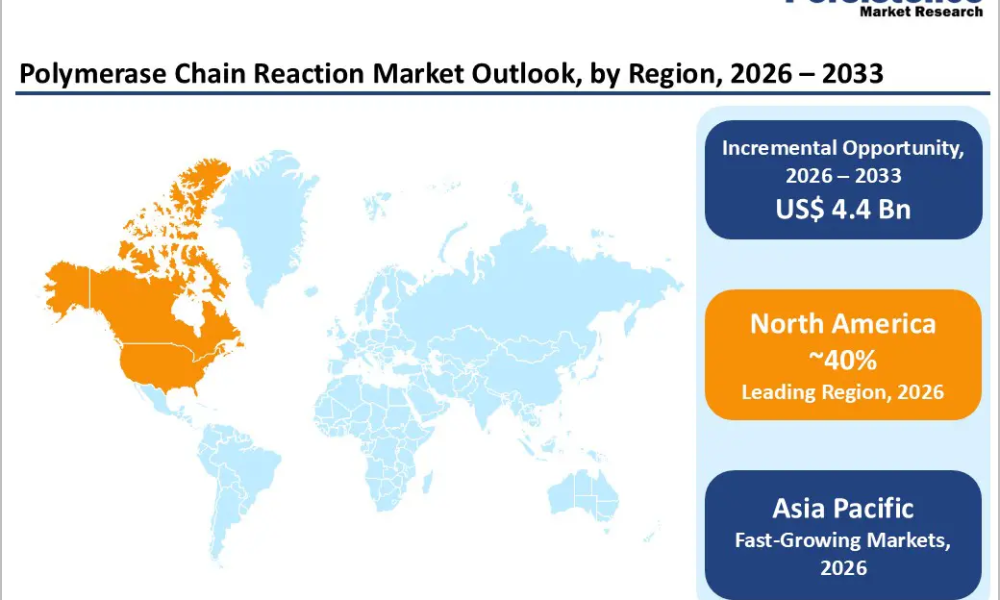
The global Polymerase Chain Reaction (PCR) market is set to experience steady growth, with its size projected to rise from $26.9 billion in 2026 to $31.3 billion by 2033, expanding at a Compound Annual Growth Rate (CAGR) of 2.2% during the forecast period. PCR, a pivotal technology within molecular diagnostics and life sciences, facilitates the rapid amplification of DNA and RNA, playing a central role in disease detection, genetic testing, research, and forensic analysis. The market’s expansion is primarily driven by increasing demand for advanced PCR technologies, such as real-time and digital PCR, expanding clinical diagnostics, and ongoing improvements in assay sensitivity, automation, and multiplex testing.
Key Industry Highlights
The PCR market’s growth trajectory is fueled by various factors, including the rising global burden of infectious diseases, which has amplified the demand for PCR-based diagnostic solutions, particularly in viral and bacterial detection. The clinical diagnostics segment remains the largest application area, especially with the increasing adoption of molecular testing across hospitals, public health labs, and diagnostic centers. Technologies like Real-time PCR (qPCR) dominate the market due to their high sensitivity, rapid results, and quantitative accuracy. The market is also supported by the use of PCR in pharmaceutical and biotechnology sectors, particularly for drug discovery, clinical trials, quality control, and biomarker validation.
Download Your Free Sample & Explore Key Insights: https://www.persistencemarketresearch.com/samples/33241
Market Dynamics
Driver: Shift Toward Precision and Personalized Medicine
A major driver of PCR market growth is the ongoing shift toward precision and personalized medicine. This transformation in clinical decision-making necessitates accurate, molecular-level insights into genetic mutations, gene expression patterns, and molecular biomarkers. Unlike traditional approaches, which often rely on uniform treatment strategies, personalized medicine tailors therapies based on individual genetic profiles. PCR plays a critical role in this paradigm by enabling sensitive, cost-effective detection of disease-specific genetic alterations.
In oncology, PCR is used extensively to identify actionable mutations, monitor minimal residual disease, and guide targeted therapies. These PCR applications ensure that treatments are personalized according to tumor biology, rather than solely relying on tumor location. Additionally, PCR assists in early diagnosis and carrier screening for rare genetic disorders, offering high specificity and scalability, making it the first-line molecular tool in many cases.
Restraint: High Dependence on Cold-chain Logistics for Reagents
One of the primary challenges facing the PCR market is the high dependence on cold-chain logistics for the transport and storage of PCR reagents. Key reagents such as enzymes, probes, primers, and buffers need to be kept at specific low temperatures throughout their lifecycle—from production to storage and use. This strict requirement for temperature control increases operational complexity and costs, especially in remote regions or areas with poor infrastructure. Temperature excursions can compromise reagent quality, resulting in reduced assay performance, false results, or even reagent wastage, which ultimately leads to inefficiencies and higher costs for laboratories.
Opportunity: Integration of AI-driven Data Analysis Platforms
The integration of artificial intelligence (AI) into PCR workflows presents a transformative opportunity for the market. Traditionally, PCR data analysis requires manual interpretation, expert threshold settings, and validation, which can introduce variability and slow results. AI algorithms can automate these processes, detecting anomalies, optimizing cycle thresholds, and flagging inconclusive results in real time, significantly improving accuracy and reproducibility.
AI-driven platforms also facilitate assay optimization by analyzing large datasets from previous PCR runs to recommend optimal reagent concentrations, primer designs, and thermal cycling conditions. These advancements reduce trial-and-error experimentation, shorten development timelines, and lower reagent wastage, particularly in research and diagnostics. In large-scale applications, AI enables better management of molecular data, identifies emerging infection trends, and supports the development of early warning systems for public health.
Get Custom Insights Designed for Your Business: https://www.persistencemarketresearch.com/request-customization/33241
Category-wise Analysis
By Product Insights
In the PCR market, the reagents and consumables segment holds the largest share. This is driven by the recurring nature of PCR testing, as reagents and consumables—such as primers, enzymes, master mixes, and PCR tubes—are required for every test. While PCR instruments are essential, they are typically capital investments that do not need to be replaced frequently. Reagents, on the other hand, are consumables, leading to continuous demand.
The growing use of advanced PCR formats like real-time (qPCR) and digital PCR (dPCR) has spurred the demand for specialized reagents. For example, multiplex assays, which detect multiple targets at once, and specialized kits for disease detection in oncology or infectious diseases, require high-quality reagents tailored for each application. The increase in PCR-based diagnostics, including COVID-19 testing and genetic screening, has further contributed to the sustained demand for reagents and consumables.
By Application Insights
Clinical diagnostics is the dominant application segment in the PCR market. The technology’s ability to provide rapid, reliable molecular diagnostics for a wide range of conditions—such as infectious diseases, genetic disorders, and cancer biomarkers—has solidified its place as the gold standard in clinical settings. PCR technology is indispensable in hospitals, diagnostic labs, and reference centers, where high volumes of tests are conducted daily.
The COVID-19 pandemic significantly accelerated the adoption of PCR technology for mass-scale testing, public health surveillance, and outbreak management. Furthermore, as personalized medicine gains traction, PCR is increasingly used for patient-specific treatment selection, minimal residual disease monitoring, and biomarker detection. This growing focus on patient-centric care continues to drive innovation and demand in the clinical diagnostics segment, which remains the largest revenue contributor in the PCR market.
Regional Insights
North America
North America, particularly the United States, leads the global PCR market, driven by its advanced healthcare infrastructure, robust research funding, and widespread adoption of molecular diagnostics. The U.S. has been at the forefront of PCR-based diagnostic testing, especially following the COVID-19 pandemic. Real-time PCR (qPCR) and digital PCR (dPCR) technologies are widely integrated into clinical diagnostics, particularly in infectious disease detection, oncology, and genetic testing.
The region also sees significant growth in multiplex PCR panels, liquid biopsy applications, and companion diagnostics, all of which are closely tied to the growing emphasis on precision medicine. Reagents and consumables contribute significantly to revenue generation, given the frequency of testing required in clinical and research settings. Moreover, innovations in point-of-care PCR devices and decentralized testing are expected to drive further growth, especially in preventive healthcare and rural areas.
Asia Pacific
The Asia Pacific region is emerging as one of the fastest-growing markets for PCR technology, driven by expanding healthcare infrastructure, increasing awareness of molecular diagnostics, and government initiatives aimed at improving disease surveillance. Countries like China, India, Japan, and South Korea are seeing rapid adoption of PCR in clinical diagnostics, research, and public health programs. As the prevalence of infectious diseases rises, the need for early detection through real-time PCR (qPCR) and digital PCR (dPCR) technologies becomes more pronounced.
Significant investments in laboratory modernization and automation are also helping to increase testing efficiency in the region. The Asia Pacific market is characterized by a rising demand for decentralized PCR testing, particularly in rural and underserved areas, where point-of-care devices can help bridge gaps in access to diagnostics. Furthermore, government grants and private investments in genomic research and biotechnology innovation are accelerating the adoption of PCR technologies.
Checkout Now & Download Complete Market Report: https://www.persistencemarketresearch.com/checkout/31553
Competitive Landscape
The PCR market is highly competitive, with companies focusing on technological advancements, product differentiation, and expanding their reach across clinical diagnostics, research, and industrial sectors. Key players in the market include Thermo Fisher Scientific, Roche Diagnostics, Bio-Rad Laboratories, QIAGEN, Agilent Technologies, and Abbott Laboratories, among others. These companies are competing through the development of high-throughput PCR platforms, multiplex assays, and AI-integrated solutions that enhance testing efficiency, accuracy, and scalability.
Strategic collaborations, mergers, and acquisitions are common as companies seek to expand their product portfolios and regional presence. The market is also seeing significant investment in point-of-care devices and decentralized testing solutions to cater to emerging markets and rural areas.
Market Segmentation
By Product
- Instruments
- Reagents & Consumables
- Software & Services
By Technology
- Conventional PCR
- Real-Time PCR (qPCR)
- Others
By Application
- Clinical Diagnostics
- Research & Academia
- Forensic Testing
- Food & Environmental Testing
By End-user
- Hospitals & Diagnostic Laboratories
- Pharmaceutical & Biotechnology Companies
- Academic & Research Institutes
- Contract Research Organizations (CROs)
By Region
- North America
- Europe
- East Asia
- South Asia and Oceania
- Latin America
- Middle East and Africa
Key Industry Developments
Recent developments in the PCR market include the release of new products and solutions that aim to enhance testing capabilities. For example, in December 2025, Roche Diagnostics China launched its first quantitative PCR system designed specifically for the Chinese market. In August 2025, Bio-Rad Laboratories introduced its EZ-Check Salmonella Kit, a PCR-based solution for rapid Salmonella detection in food and environmental samples. Additionally, Biocartis unveiled its Idylla qPCR assay for detecting mutations associated with endometrial cancer in April 2025.
Conclusion
The global PCR market continues to evolve, driven by advancements in technology, increasing demand for precision medicine, and growing healthcare infrastructure in emerging markets. As PCR technologies become more integrated with AI-driven platforms, the future holds tremendous potential for improvements in diagnostic accuracy, testing efficiency, and scalability. With sustained demand across clinical diagnostics, research, and industrial applications, the PCR market is poised for steady growth, creating opportunities for both established companies and emerging players in the field.




