
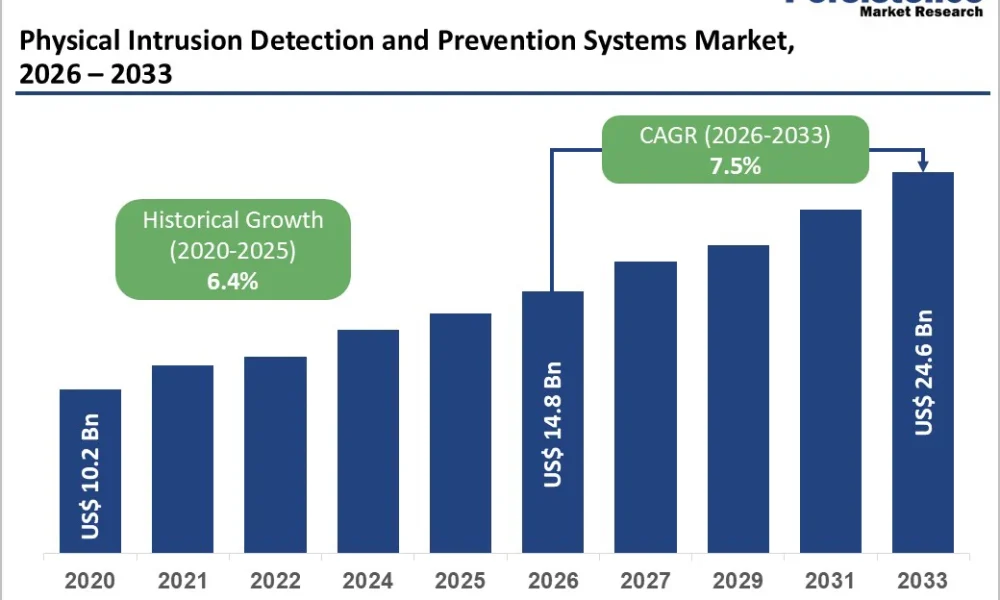
The global Physical Intrusion Detection and Prevention Systems (PIDPS) market is entering a phase of steady and technology-driven expansion. The market size is likely to be valued at US$ 14.8 billion in 2026 and is projected to reach US$ 24.6 billion by 2033, growing at a CAGR of 7.5% during 2026–2033.
This growth is supported by heightened security concerns across critical infrastructure, accelerating adoption of integrated intrusion detection technologies, and rising compliance with stringent regulatory standards worldwide. From government facilities and financial institutions to industrial plants and smart cities, physical security systems are increasingly becoming digital, intelligent, and interconnected.
Market Overview: Security Modernization Across Critical Infrastructure
Physical intrusion detection and prevention systems encompass technologies designed to detect unauthorized access and prevent breaches in real time. These systems include:
- Video surveillance systems
- Biometric access control
- Perimeter intrusion detection systems
- Motion sensors and alarm systems
- Integrated security management platforms
As security threats grow more sophisticated, organizations are moving away from standalone systems toward integrated, AI-enabled platforms that combine video analytics, IoT connectivity, and real-time threat monitoring.
The incorporation of artificial intelligence (AI), IoT sensors, and advanced analytics is significantly improving threat detection accuracy while lowering operational risks and response time.
Growth Drivers Powering Market Expansion
- Rising Global Security Threats
Increasing incidents of unauthorized access, terrorism threats, cyber-physical attacks, and asset theft are compelling organizations to invest in robust security infrastructure.
- Regulatory Compliance Requirements
Sectors such as BFSI, energy, healthcare, and transportation must comply with stringent physical security standards, driving continuous upgrades.
- AI & Real-Time Analytics Integration
AI-based object detection, facial recognition, behavior analysis, and predictive analytics are transforming traditional surveillance systems into proactive threat management solutions.
- Smart City Development
Urban digitization and infrastructure modernization projects are increasing the demand for integrated surveillance and access control networks.
Elevate your business strategy with comprehensive market data. Request a sample report now: https://www.persistencemarketresearch.com/samples/21409
Component Analysis
Hardware Dominates Market Share
Hardware is expected to account for approximately 55% of total revenue in 2026, driven by strong demand for:
- CCTV cameras
- Access control panels
- Biometric scanners
- Motion detectors
- Perimeter fencing sensors
Hardware remains foundational to security architecture, especially in high-risk government and industrial installations.
Services: The Fastest-Growing Segment
Services are projected to grow at a CAGR of 9.5% through 2033, the fastest among components.
Growth is fueled by:
- System integration complexity
- Managed security services
- Remote monitoring services
- Maintenance and lifecycle upgrades
Organizations increasingly rely on outsourced managed security providers to ensure 24/7 monitoring and rapid incident response.
System Type Analysis
Video Surveillance: Leading the Market
Video surveillance systems are anticipated to command around 32% market share in 2026, maintaining their position as the dominant system type.
Key drivers include:
- AI-enabled cameras
- Cloud video storage
- Real-time analytics
- Integration with command centers
Modern surveillance solutions now include facial recognition, license plate recognition, and crowd behavior analytics.
Biometrics: Fastest Adoption
Biometric systems are projected to grow at a CAGR of approximately 10.2% during 2026–2033, the fastest among system types.
Adoption is increasing due to:
- Enhanced authentication accuracy
- Rising identity fraud concerns
- Deployment in airports, banks, and government facilities
- Contactless access control demand
Fingerprint, iris, facial recognition, and vein-pattern authentication technologies are increasingly integrated into high-security environments.
End-User Analysis
Government: The Largest End-User
The government sector is expected to account for around 28% of total revenue in 2026.
Applications include:
- Border security
- Public infrastructure protection
- Military facilities
- Transportation hubs
Rising geopolitical tensions and homeland security investments are sustaining strong demand.
BFSI: Fastest-Growing Segment
The BFSI (Banking, Financial Services, and Insurance) sector is projected to grow at a CAGR of 8.8% through 2033, making it the fastest-growing end-user segment.
Growth is driven by:
- Strict regulatory compliance
- Asset and vault protection
- ATM monitoring systems
- Branch network security upgrades
As financial institutions digitize operations, they simultaneously strengthen physical access control systems to prevent fraud and breaches.
Regional Outlook
North America: Market Leader
North America is poised to dominate the market with an estimated 35% share in 2026.
Key factors include:
- Strong homeland security spending
- Early adoption of AI-based surveillance
- Mature enterprise infrastructure
- Strict compliance frameworks
The region benefits from strong technology providers and high enterprise security budgets.
Asia Pacific: Fastest-Growing Region
Asia Pacific is projected to expand at a CAGR of approximately 11% through 2033, making it the fastest-growing region.
Drivers include:
- Rapid urbanization
- Expanding smart city initiatives
- Infrastructure megaprojects
- Rising security modernization in India and Southeast Asia
Emerging economies are increasingly adopting advanced perimeter and surveillance systems across industrial zones and public spaces.
Competitive Landscape: Innovation and Strategic Alliances
The market is moderately consolidated, with global and regional players focusing on:
- AI-based product development
- Cloud-based security management platforms
- Strategic mergers and acquisitions
- Regional manufacturing expansion
Technology partnerships between hardware manufacturers and AI analytics firms are strengthening integrated solutions and expanding geographic reach.
In March 2025, Honeywell launched its 50 Series CCTV cameras — the company’s first security products designed and manufactured in India under the “Design in India, Make in India” initiative. This move reflects growing localization strategies and the importance of emerging markets in global security supply chains.
Emerging Trends Shaping the Future
AI-Powered Threat Intelligence
Security systems are increasingly capable of identifying suspicious behavior patterns, reducing false alarms, and enabling predictive risk analysis.
Cloud-Based Security Platforms
Cloud integration allows centralized control, remote monitoring, and scalable deployment across multi-location enterprises.
Edge Computing in Surveillance
Edge-based analytics minimize latency and improve real-time decision-making at the device level.
Convergence of Cyber and Physical Security
Organizations are integrating physical security systems with cybersecurity frameworks to address hybrid threats.
Market Challenges
Despite strong growth potential, the market faces several constraints:
- High installation and maintenance costs
- Privacy concerns surrounding facial recognition
- Integration complexity across legacy systems
- Skilled workforce shortages in security analytics
However, ongoing innovation and managed services expansion are expected to mitigate these challenges.
Future Outlook: Intelligent & Integrated Security Ecosystems
The physical intrusion detection and prevention systems market is evolving toward intelligent ecosystems rather than isolated hardware deployments. Future systems will emphasize:
- Autonomous threat detection
- AI-driven analytics dashboards
- Predictive maintenance
- Seamless interoperability across platforms
- Integration with smart building infrastructure
As organizations prioritize risk mitigation and regulatory compliance, investment in smart security infrastructure will remain a strategic priority.
Conclusion
The global physical intrusion detection and prevention systems market is projected to grow from US$ 14.8 billion in 2026 to US$ 24.6 billion by 2033, expanding at a steady 7.5% CAGR. Strong demand across government, BFSI, industrial, and enterprise sectors — combined with AI-driven innovation — is reshaping physical security landscapes.
With hardware maintaining dominance and services emerging as a high-growth area, the market presents sustained opportunities for technology providers, system integrators, and managed security firms.
As physical security converges with intelligent digital infrastructure, organizations worldwide are transitioning from reactive monitoring to predictive, real-time protection strategies — defining the next era of intrusion detection and prevention.
Related Reports:




