
The aerospace bearings market plays a fundamental role in ensuring the smooth operation, durability, and efficiency of aircraft systems. Aerospace bearings are used in engines, landing gear, flight control systems, and auxiliary components to minimize friction and improve mechanical performance. As aircraft designs evolve toward higher efficiency, lighter weight, and enhanced safety, the demand for advanced bearing technologies continues to grow. The aerospace bearings market is influenced by the expansion of global air travel, increasing aircraft production, and modernization of existing fleets. Commercial aviation remains the dominant application segment due to the continuous growth in passenger traffic and airline fleet expansion. Technological innovation, including corrosion-resistant materials and advanced coatings, is improving bearing lifespan and reliability. These advancements support aerospace manufacturers in achieving better performance standards and reducing maintenance cycles, thereby strengthening market growth over the forecast period.
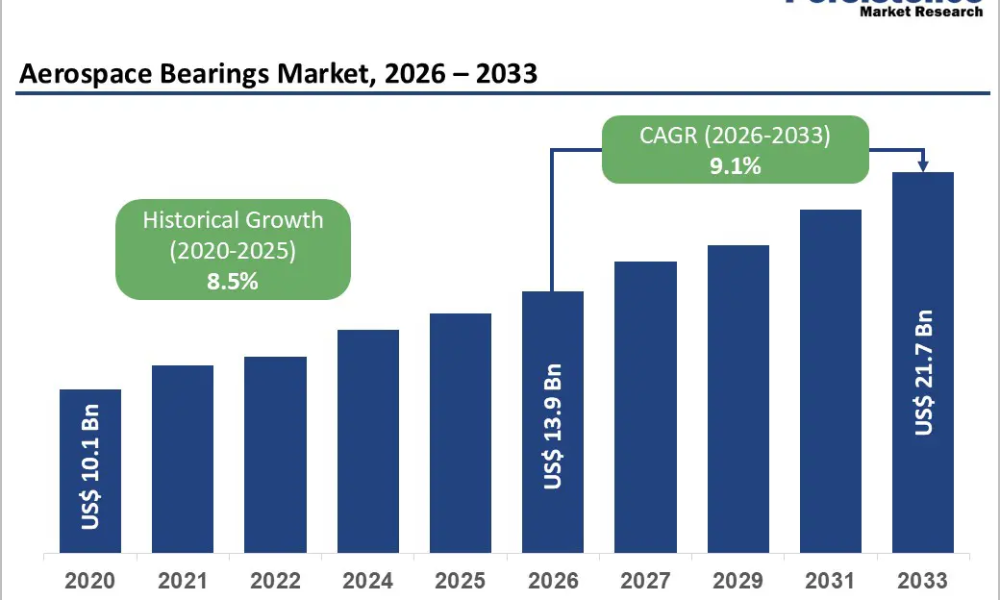
The global aerospace bearings market is likely to be valued at US$ 13.9 billion in 2026 and is projected to reach US$ 21.7 billion by 2033, growing at a CAGR of 6.6% between 2026 and 2033. This growth reflects strong demand from aircraft manufacturers, maintenance providers, and defense organizations. The leading segment within the market is engine bearings, as they operate under high stress, temperature, and speed conditions, making performance reliability essential. North America remains the leading geographical region due to the presence of major aircraft manufacturers, defense contractors, and advanced aerospace infrastructure. Continuous investments in aircraft development and technological upgrades are driving regional dominance. Increasing defense spending and growing commercial airline fleets are also contributing significantly to market expansion. Emerging aerospace manufacturing hubs in Asia Pacific are strengthening global production networks, further supporting overall aerospace bearings market growth.
Get Your FREE Sample Report Instantly Click Now: https://www.persistencemarketresearch.com/samples/17914
The key players studied in the report include:
- AST Bearings
- Aurora Bearings
- GGB Bearings Technology
- JTEKT
- Kaman Specialty Bearings
- National Precision Bearings
- New Hampshire Ball Bearings
- August Steinmeyer GmbH & Co. KG
- UMBRAGROUP
- Kugel Aerospace & Defence
- Thomson Industries, Inc.
- Beaver Aerospace & Defense, Inc.
- Others Key Players
Key Highlights from the Report
➤ The aerospace bearings market is projected to grow from US$ 13.9 billion in 2026 to US$ 21.7 billion by 2033 at a CAGR of 6.6%.
➤ Increasing aircraft production and fleet expansion are driving demand for high-performance aerospace bearings globally.
➤ Engine bearings remain the leading segment due to their critical role in aircraft performance and safety.
➤ North America dominates the aerospace bearings market due to strong aerospace manufacturing infrastructure.
➤ Technological advancements in materials and coatings are improving bearing durability and efficiency.
➤ Growing maintenance, repair, and overhaul activities are creating sustained long-term demand for aerospace bearings.
Market Segmentation
By Product Type
- Plain Bearings
- Roller Bearings
- Ball Bearings
- Roller Screws
- Ball Screws
By Platform
- Fixed-Wing
- Rotary-Wing
- Unmanned Aerial Vehicle (UAV)
By Material
- Stainless Steel
- Fiber Reinforced Composites
- Engineered Plastics
- Aluminum Alloys
- Metal Backed
By Application
- Engine
- Aero-structure
- Landing Gear
- Others
Customize This Report for Your Exact Requirements: https://www.persistencemarketresearch.com/request-customization/17914
Regional Insights
North America leads the aerospace bearings market due to its strong aerospace manufacturing ecosystem and presence of major aircraft manufacturers and defense organizations. The region benefits from high investments in aerospace research, advanced production technologies, and maintenance infrastructure. The United States is a major contributor due to its large commercial airline fleet and defense aviation programs. Continuous technological innovation and strong government support are reinforcing market leadership. Aerospace component suppliers and bearing manufacturers in the region focus heavily on research and development to improve performance and reliability. The demand for advanced bearings in next-generation aircraft is also contributing to sustained growth. North America’s well-established aerospace industry ensures consistent demand for high-quality bearing solutions across multiple applications.
Asia Pacific is emerging as a high-growth region in the aerospace bearings market due to increasing aircraft production, expanding airline fleets, and rising defense investments. Countries such as China and India are investing heavily in aerospace manufacturing capabilities and infrastructure development. The expansion of domestic airlines and regional connectivity programs is driving demand for new aircraft. Maintenance, repair, and overhaul activities are also expanding rapidly in the region, creating additional opportunities for bearing suppliers. Aerospace manufacturing partnerships and technology transfers are strengthening the regional supply chain. Growing economic development and increasing air travel demand are supporting long-term market expansion. Asia Pacific is expected to play a crucial role in the future growth of the aerospace bearings market.
Market Drivers
One of the primary drivers of the aerospace bearings market is the steady increase in global air passenger traffic and airline fleet expansion. Airlines are investing in new aircraft to improve operational efficiency, fuel economy, and passenger capacity. This directly increases demand for aerospace components, including bearings, which are essential for engine and structural performance. Bearings ensure smooth rotation and reduce friction, improving fuel efficiency and operational reliability. The expansion of low-cost carriers and regional airlines is also contributing to higher aircraft procurement rates. As airlines modernize their fleets, the demand for advanced bearings with longer operational life is increasing. Aircraft manufacturers require reliable bearing solutions to ensure safety and performance. This continuous expansion of the aviation sector is creating sustained growth opportunities for the aerospace bearings market.
Another significant driver is the increasing focus on aircraft safety, reliability, and performance optimization. Aerospace bearings must operate under extreme conditions, including high temperature, pressure, and rotational speed. Technological advancements in bearing materials and coatings are enabling improved durability and resistance to wear and corrosion. Manufacturers are developing lightweight bearing solutions to reduce aircraft weight and improve fuel efficiency. Defense aviation modernization programs are also increasing demand for advanced aerospace components. Military aircraft require high-performance bearings to ensure operational readiness and reliability. The integration of advanced technologies in aerospace manufacturing is strengthening the demand for precision-engineered bearings. These factors collectively support strong growth in the aerospace bearings market.
Market Restraints
Despite strong growth prospects, the aerospace bearings market faces challenges related to high manufacturing costs and strict regulatory requirements. Aerospace bearings must meet rigorous quality and safety standards, which increases production complexity and cost. Manufacturers must invest heavily in research, testing, and certification to ensure compliance with aviation regulations. These requirements can limit market entry for smaller manufacturers. High production costs can also affect profit margins and increase overall aircraft manufacturing expenses. Aerospace companies must balance performance requirements with cost efficiency. The need for specialized materials and precision manufacturing adds to operational challenges. These factors can slow down the pace of market expansion.
Another restraint is the long product lifecycle and replacement intervals associated with aerospace bearings. Unlike automotive components, aerospace bearings are designed for durability and extended service life. This reduces frequent replacement demand in certain applications. Aircraft operators focus on preventive maintenance to maximize component lifespan. Economic fluctuations and airline financial challenges can also affect aircraft procurement and maintenance spending. Delays in aircraft production programs may impact bearing demand. Supply chain disruptions and raw material availability issues can further create challenges for manufacturers. These factors can influence overall growth trends in the aerospace bearings market.
Market Opportunities
The aerospace bearings market presents significant opportunities through technological innovation and the development of advanced materials. Manufacturers are focusing on lightweight and corrosion-resistant bearing solutions to improve aircraft performance and fuel efficiency. Advanced coatings and lubrication technologies are extending bearing life and reducing maintenance requirements. These innovations are improving operational efficiency and reducing long-term costs for aircraft operators. The increasing adoption of next-generation aircraft is creating demand for high-performance bearings. Manufacturers investing in advanced research and development are gaining competitive advantages. The integration of smart monitoring systems in bearings is also emerging as a promising trend.
Another major opportunity lies in the expansion of maintenance, repair, and overhaul activities globally. As aircraft fleets grow, the need for regular inspection and component replacement increases. Maintenance providers require reliable bearing solutions to ensure safe aircraft operations. Emerging aerospace markets are investing in maintenance infrastructure, creating new revenue opportunities. The growth of domestic aircraft manufacturing programs is also strengthening demand. Aerospace suppliers expanding their global presence can benefit from increasing regional demand. Partnerships between aerospace manufacturers and component suppliers are further supporting market expansion. These opportunities are expected to drive sustained growth in the aerospace bearings market.
Ready to Dive Deep? Buy Full Report Today: https://www.persistencemarketresearch.com/checkout/17914
Recent Developments:
- SKF expanded its aerospace bearing production capabilities in September 2025 to support growing aircraft demand.
- Schaeffler Group introduced advanced aerospace bearing solutions designed for improved durability in March 2026.
Frequently Asked Questions
➤ What are the main factors influencing the Aerospace Bearings Market growth?
➤ Which companies are the major sources in the Aerospace Bearings Market industry?
➤ What are the market’s opportunities, risks, and general structure in the Aerospace Bearings Market?
➤ How are market types and applications explored in the Aerospace Bearings Market?
➤ What does a business area’s assessment implicate for the Aerospace Bearings Market?
Future Opportunities and Growth Prospects
The aerospace bearings market is expected to witness steady growth driven by rising aircraft production, increasing maintenance activities, and technological innovation. Manufacturers focusing on advanced materials, improved durability, and lightweight designs will gain competitive advantages. Emerging aerospace markets and expanding airline fleets will create sustained demand. Continued investments in aerospace research and development will further strengthen long-term growth prospects for the aerospace bearings market.




