

Overview
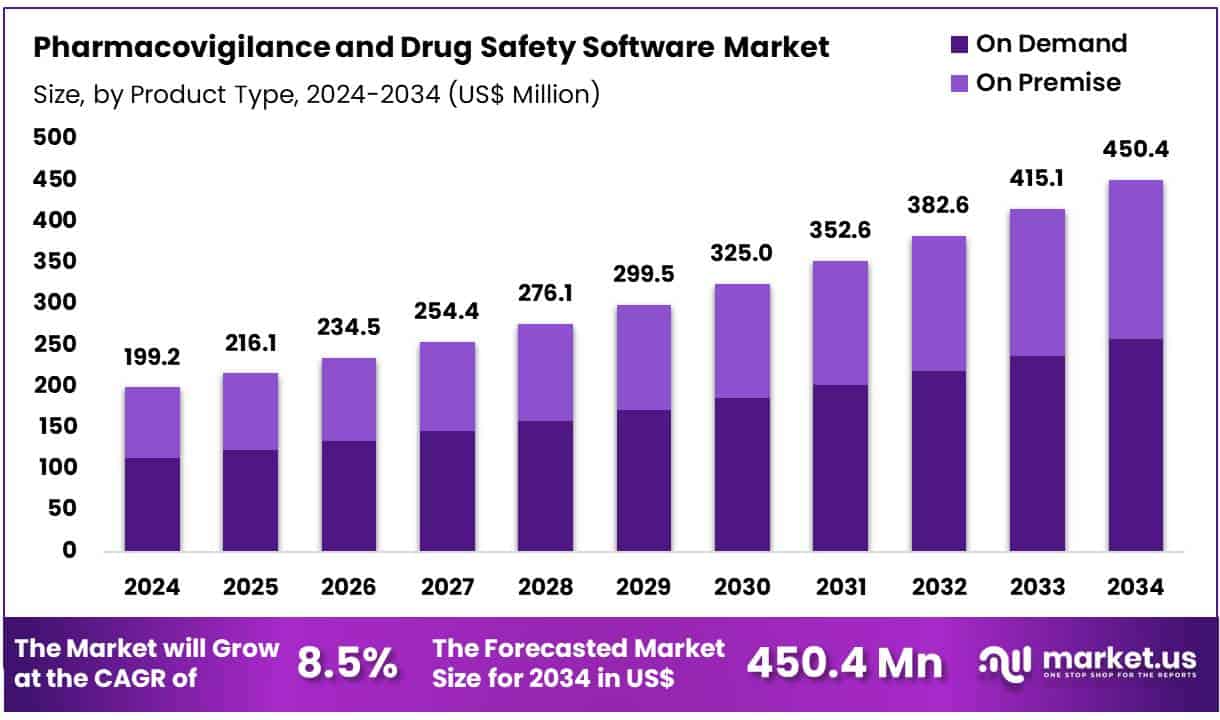
Global Pharmacovigilance and Drug Safety Software Market size is expected to be worth around US$ 450.4 Million by 2034 from US$ 199.2 Million in 2024, growing at a CAGR of 8.5% during the forecast period 2025 to 2034. In 2024, North America led the market, achieving over 36.5% share with a revenue of US$ 72.7 Million.
The global pharmacovigilance and drug safety software market is experiencing consistent growth, driven by the rising need for robust drug safety monitoring and regulatory compliance. Increased incidences of adverse drug reactions and growing pressure on pharmaceutical companies to ensure post-marketing surveillance are major contributors to this trend. The demand for automated systems to streamline data collection, analysis, and reporting is supporting the adoption of pharmacovigilance software across regions.
The market is segmented based on software type, delivery mode, and end-user. Among software types, adverse event reporting solutions are widely used due to their ability to enhance regulatory communication and reduce manual errors. In terms of delivery, cloud-based software continues to gain preference owing to its flexibility, scalability, and ease of access.
Pharmaceutical companies, biotechnology firms, contract research organizations, and regulatory authorities are the primary users of these systems. Pharmaceutical companies lead the segment, driven by their need to comply with evolving global safety standards and streamline pharmacovigilance workflows.
Regionally, North America holds a dominant position due to its advanced healthcare IT infrastructure, strong regulatory frameworks, and early adoption of digital technologies. Europe follows closely with ongoing efforts to harmonize drug safety protocols. Ongoing integration of artificial intelligence, automation, and real-time data analytics is expected to reshape the landscape of drug safety operations, enhancing signal detection and improving patient outcomes globally.
Click here to get a Sample report copy@ https://market.us/report/pharmacovigilance-and-drug-safety-software-market/free-sample/
Key Takeaways
- Market Overview: In 2024, the pharmacovigilance and drug safety software market generated a total revenue of US$ 199.2 million. The market is projected to grow at a compound annual growth rate (CAGR) of 8.5%, reaching approximately US$ 450.4 million by 2034.
- By Product Type: The market is segmented into on-premise and on-demand solutions. In 2023, the on-demand segment led the market, accounting for a 57.3% share, driven by flexibility and scalability advantages.
- By Application: Key application areas include case data collection & management, adverse event reporting & analysis, and signal detection & other safety risk assessment. Among these, the signal detection & other safety risk assessment segment held the largest share, contributing 39.6% to the overall market.
- By End User: The market comprises pharmaceutical and biotechnology companies, contract research organizations (CROs)/business process outsourcing (BPOs), and other entities. Pharmaceutical and biotechnology companies emerged as the dominant end-user segment in 2023, holding a 55.4% revenue share.
- Regional Insights: North America maintained its leading position in the global market, accounting for a 36.5% share in 2023, supported by advanced healthcare infrastructure and strong regulatory oversight.
Segmentation Analysis
- Product Type Analysis: The on-demand segment held a leading market share of 57.3%, driven by growing adoption of cloud-based pharmacovigilance solutions. These platforms offer scalability, cost-efficiency, and ease of integration without large upfront investments in IT infrastructure. Real-time data access enhances regulatory reporting, while faster software updates support operational agility. As regulatory scrutiny intensifies and firms prioritize compliance and flexibility, demand for on-demand software is expected to grow steadily across the pharmaceutical and biotechnology landscape.
- Application Analysis: Signal detection and other safety risk assessment applications accounted for 39.6% of the market share. This segment is gaining prominence as pharmaceutical companies aim to proactively identify potential drug safety risks. The integration of machine learning and advanced analytics improves signal accuracy and response time. Rising post-marketing surveillance data volumes and regulatory demands are driving software adoption, helping reduce adverse events and product recalls. Enhanced focus on patient safety is likely to sustain segment growth in the long term.
- End-user Analysis: Pharmaceuticals and biotechnology companies dominated the end-user segment with a 55.4% revenue share. These firms are investing in pharmacovigilance software to meet increasing global regulatory demands and improve drug safety monitoring across product lifecycles. Enhanced data accuracy, efficient signal detection, and cost optimization are key drivers. The growing reliance on outsourcing to CROs and PV service providers is also expanding market reach. This segment is expected to maintain robust growth as compliance and risk management remain top priorities.
Market Segments
Product Type
- On Premise
- On Demand
Application
- Case Data Collection & Management
- Adverse Event Reporting & Analysis
- Signal Detection & Other Safety Risk Assessment
End-user
- Healthcare Companies (Pharmaceuticals & Biotechnology Companies)
- CROs/BPOs or PV service providers when outsourced.
- Others
To Purchase this Premium Report @ https://market.us/purchase-report/?report_id=149888
Regional Analysis
In 2023, North America led the pharmacovigilance and drug safety software market, accounting for the highest revenue share of 36.5%. This dominance is largely attributed to the region’s stringent regulatory framework, primarily enforced by the U.S. Food and Drug Administration (FDA).
The FDA’s Adverse Event Reporting System (FAERS) processes a substantial volume of safety reports annually, creating a strong need for advanced software to ensure timely data submission, signal detection, and regulatory compliance.
Requirements outlined under 21 CFR Part 314 mandate rigorous post-marketing surveillance and adverse event reporting, compelling pharmaceutical companies to invest in robust pharmacovigilance platforms. Additionally, the rising complexity of clinical trials and a heightened focus on patient safety further drive demand for integrated safety management systems across the region.
Conversely, the Asia Pacific region is projected to witness the fastest compound annual growth rate (CAGR) during the forecast period. This growth can be attributed to increased pharmaceutical manufacturing activity, expanding drug exports, and a greater emphasis on aligning with international pharmacovigilance standards. Countries in the region are also introducing stricter drug safety regulations and investing in healthcare IT infrastructure. The growing number of adverse drug reaction (ADR) reports and the push for regulatory harmonization are expected to accelerate software adoption across Asia Pacific.
Key Players Analysis
Leading players in the pharmacovigilance and drug safety software market are driving growth through the integration of advanced technologies such as artificial intelligence (AI), machine learning, and cloud computing. These innovations enhance software functionality, improve automation in safety reporting, and support real-time data analysis. A strong emphasis is placed on achieving interoperability to enable seamless data exchange across diverse healthcare systems, thereby improving regulatory compliance and operational efficiency.
Companies are also expanding their market presence through strategic collaborations, mergers, and acquisitions, allowing them to diversify their service portfolios. The development of intuitive user interfaces and mobile-compatible platforms further boosts engagement among healthcare professionals and caregivers. Continuous investment in research and development remains a priority to ensure product innovation and alignment with evolving regulatory demands.
One such key player, ArisGlobal LLC, provides an end-to-end suite of software solutions designed for life sciences organizations. Its flagship platform, LifeSphere, incorporates AI-driven automation to streamline pharmacovigilance, regulatory, and clinical workflows. This platform enables organizations to meet global compliance standards efficiently. ArisGlobal’s strategic focus on innovation, quality, and digital transformation has solidified its reputation as a reliable and forward-thinking provider in the pharmacovigilance and drug safety software market.
Market Key Players
- Tata Consultancy Services
- Oracle
- IQVIA
- IBM
- Cognizant
- Capgemini
- Aris Global
- Accenture
Market Dynamics
- Driver: The primary driver of the pharmacovigilance and drug safety software market is the increasing volume of adverse drug event (ADE) reports worldwide. Regulatory authorities such as the FDA and EMA mandate strict reporting standards, compelling pharmaceutical companies to adopt advanced software solutions. These platforms help ensure compliance, streamline data collection, and support faster risk detection. The growing complexity of global clinical trials and heightened emphasis on patient safety further reinforce the demand for automated and compliant safety monitoring systems.
- Trend: A key trend shaping the market is the integration of artificial intelligence (AI) and machine learning in pharmacovigilance software. These technologies enable automation of adverse event detection, data categorization, and signal prioritization. Real-time analytics and predictive capabilities enhance regulatory reporting accuracy and decision-making speed. Additionally, the shift toward cloud-based platforms supports remote access, scalability, and easier system updates. This trend reflects the industry’s broader move toward digital transformation and data-driven pharmacovigilance practices for improved efficiency and safety.
- Opportunity: A major opportunity lies in the expanding pharmaceutical activities across emerging markets, particularly in Asia Pacific and Latin America. As drug manufacturers in these regions seek international regulatory approvals, the need for standardized pharmacovigilance systems is increasing. Moreover, growing government investment in healthcare IT infrastructure supports wider adoption of safety monitoring platforms. Vendors offering cost-effective, multilingual, and compliance-ready software have the potential to capture substantial market share by addressing the unique regulatory challenges and scalability needs of these developing regions.
Conclusion
In conclusion, the global pharmacovigilance and drug safety software market is poised for sustained growth, driven by rising adverse drug events, stringent regulatory requirements, and expanding pharmaceutical activities. The adoption of advanced technologies such as AI, machine learning, and cloud computing is reshaping the landscape, enabling real-time data analysis and improved compliance.
North America leads in adoption due to regulatory rigor, while Asia Pacific offers significant growth potential. As pharmaceutical stakeholders prioritize patient safety and regulatory alignment, the demand for scalable, intelligent, and integrated pharmacovigilance solutions is expected to remain strong throughout the forecast period.
View More Reports:
mHealth Services Market To Surpass US$ 250 Billion by 2034
Healthcare Mobility Solutions Market to Reach USD 1,288 Billion by 2034
Healthcare Mobility Solutions Market to Reach USD 1,288 Billion by 2034
Healthcare Integration Market Poised for 9.7% CAGR Growth by 2034
Healthcare Integration Market Poised for 9.7% CAGR Growth by 2034



