
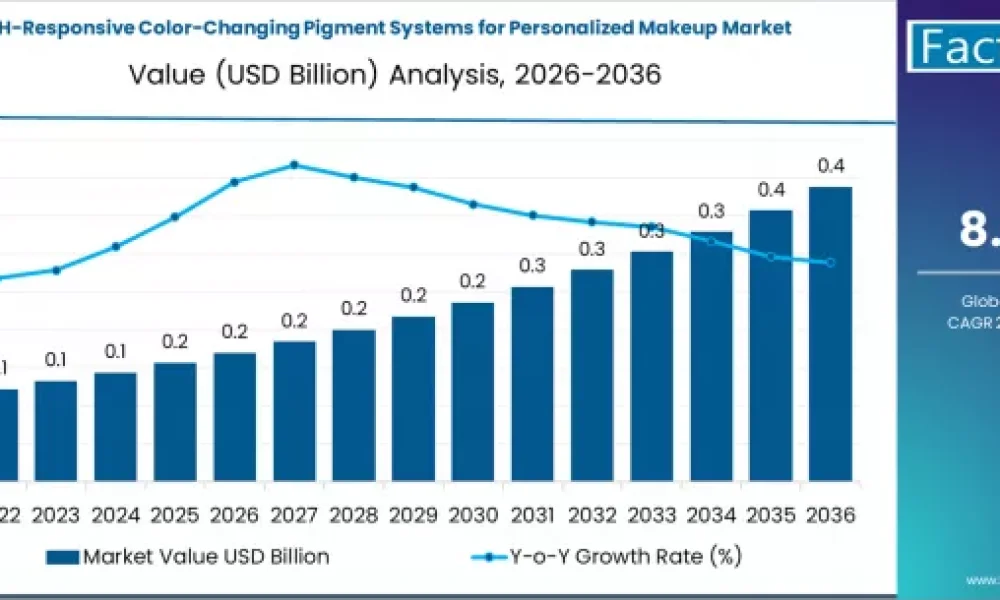
As the global beauty industry moves beyond universal shade ranges toward “biological personalization,” the pH-responsive color-changing pigment systems for personalized makeup market is witnessing a major technological acceleration. Valued at USD 0.17 billion in 2026, the sector is projected to expand to USD 0.38 billion by 2036, growing at a Compound Annual Growth Rate (CAGR) of 8.6%.
This growth addresses the “How” of personalized makeup: the engineering of “smart” formulations that react to the skin’s unique acid mantle. By utilizing specialized chromophores—molecules that alter their structure upon contact with the skin’s natural pH (typically ranging from 4.5 to 5.5) —manufacturers are enabling a new category of “living cosmetics” that develop a custom-tailored hue for every wearer.
Request for Sample Report | Customize Report |purchase Full Report – https://www.factmr.com/connectus/sample?flag=S&rep_id=13411
The Mechanics of Adaptation: Who, What, and Why
The “What” of this innovation centers on pH-sensitive dyes, such as Red 27, and advanced encapsulation systems. These pigments remain colorless or stable in their packaging but undergo a reversible chemical transition when applied to the skin. This “Why” is rooted in the “skincare-first” movement: consumers are increasingly seeking products that eliminate the guesswork of shade-matching while supporting the skin’s natural barrier.
The “Who” of the sector is led by global pigment and material science giants, including Sensient Cosmetic Technologies, Merck KGaA, BASF SE, Sun Chemical Corporation, Kobo Products Inc., and Chromatic Technologies Inc. These leaders are transitioning the industry from novelty “mood” products to high-performance daily wear.
Strategic Market Drivers and Insights for 2026:
- Lip and Cheek Dominance: Lip products currently hold a 52% market share, driven by the high consumer demand for long-lasting, hydrating tints that adapt to the wearer’s natural lip chemistry.
- The “Daily Wear” Shift: Personalized makeup for everyday use now accounts for 49% of end-use cases, reflecting a move away from occasional “special effect” products toward essential beauty routines.
- Precision Encapsulation: In 2026, the market is shifting toward smart encapsulation, where pigments are protected in microscopic shells that break only upon skin contact, preventing premature color shifts and ensuring a fresh application every time.
Regional Leadership and Consumer Psychology
The Asia-Pacific region continues to lead as a hub for adaptive beauty, driven by a cultural preference for “translucent” and “natural” aesthetics. Meanwhile, North America and Europe are seeing a surge in demand for “clean-label” pH pigments that are free from synthetic stabilizers and heavy metals.
“We are entering the era of ‘Metabolic Beauty,'” says a senior industry analyst. “In 2026, the value of a pigment isn’t just in the color it provides, but in its ability to read the wearer’s biology. A blush is no longer just a color on top of the skin; it is a personalized reaction with the skin.”
Challenges and the Path to 2030
Despite the momentum, the industry faces the challenge of formulation stability. Creating a pigment that remains inert in a waxy base but reacts instantly to skin moisture requires sophisticated chemical buffering. Furthermore, as “waterless beauty” trends grow, developing anhydrous pH-responsive systems—which do not rely on water to trigger the color shift—is a primary R&D focus for 2026.
For investors and analysts, the pH-responsive segment represents a high-retention vertical within the $6.4 billion global personalized beauty market. As consumers demand “authenticity over algorithms,” products that provide a result “impossible to fake”—because they are physically tied to the wearer’s own chemistry—are set to dominate the luxury and prestige tiers.
About the Market Research: This press release is based on 2026 market intelligence, industrial pigment reports, and consumer behavioral analysis. It highlights the convergence of advanced chemistry, the “skinification” of makeup, and the global demand for hyper-personalized beauty solutions.
About Fact.MR
Fact.MR is a global market research and consulting firm, trusted by Fortune 500 companies and emerging businesses for reliable insights and strategic intelligence. With a presence across the U.S., UK, India, and Dubai, we deliver data-driven research and tailored consulting solutions across 30+ industries and 1,000+ markets. Backed by deep expertise and advanced analytics, Fact.MR helps organizations uncover opportunities, reduce risks, and make informed decisions for sustainable growth.



