
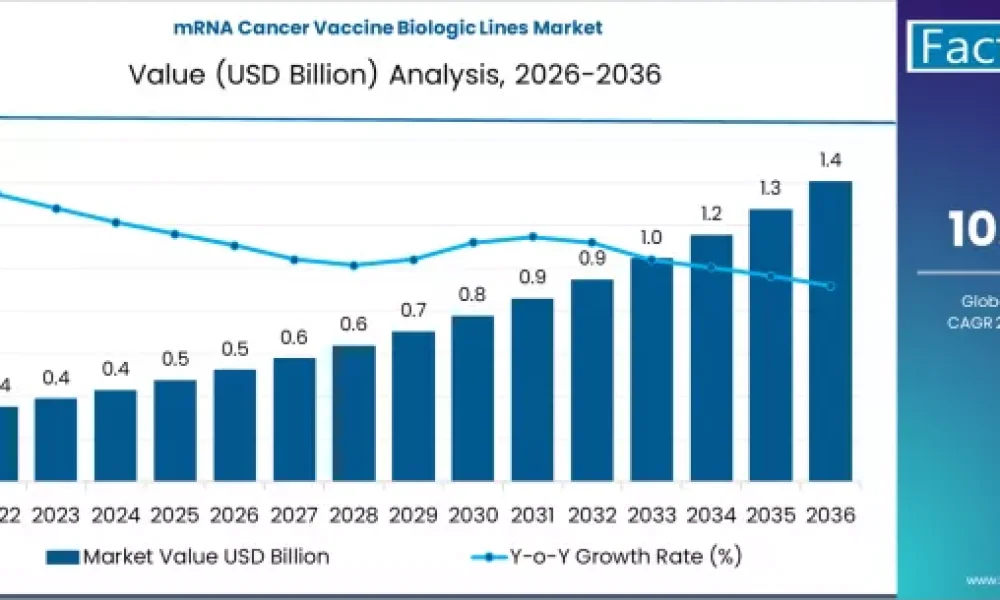
As the biopharmaceutical industry shifts its focus from pandemic response to chronic disease intervention, the mRNA cancer vaccine biologic lines market is entering a period of unprecedented expansion. Valued at approximately USD 0.52 billion in 2026, the global market is projected to reach USD 1.41 billion by late 2036, growing at a Compound Annual Growth Rate (CAGR) of 10.4% through 2035.
This surge answers the “How” and “Why” of modern immunotherapy: the transition from traditional, slow-moving biologic production to modular, rapid-response mRNA synthesis lines. Unlike traditional vaccines that require months of cell-culture incubation, mRNA biologic lines utilize cell-free in vitro transcription (IVT), allowing for the design and manufacture of personalized “neoantigen” vaccines in as little as 4 to 6 weeks.
Request for Sample Report | Customize Report |purchase Full Report – https://www.factmr.com/connectus/sample?flag=S&rep_id=13405
The Precision Mandate: Who, What, and When
The “What” of the market centers on specialized manufacturing infrastructure—including automated DNA template synthesis, lipid nanoparticle (LNP) encapsulation systems, and AI-driven neoantigen profiling. These technologies enable clinicians to sequence a patient’s specific tumor and produce a “custom biologic” designed to train the immune system to recognize and destroy malignant cells while sparing healthy tissue.
The “Who” of this specialized sector is led by a powerful consortium of biotechnology pioneers and global pharmaceutical giants, including Moderna, Inc., BioNTech SE, CureVac N.V., Gritstone bio, Inc., and Merck & Co. (partnering on the blockbuster candidate V940/mRNA-4157). These firms are currently scaling their Phase III clinical trials for high-need indications such as melanoma and non-small cell lung cancer (NSCLC), with early 2026 data suggesting a potential paradigm shift in adjuvant care.
Key Market Insights and Strategic Drivers:
- Synergy with Checkpoint Inhibitors: Modern mRNA biologic lines are increasingly designed for “combination therapy.” Data from the KEYNOTE-942 trial showed that pairing an mRNA vaccine with pembrolizumab reduced the risk of recurrence or death by 49% in melanoma patients.
- The “Where” of Innovation: North America remains the dominant revenue hub, accounting for over 31% of the market share. However, the Asia-Pacific region is the fastest-growing frontier, driven by significant investments in biotechnology infrastructure in Singapore, Japan, and China.
- Why Modular Lines are Winning: In 2026, the biomanufacturing industry is moving toward “Factory-in-a-Box” designs. These modular biologic lines allow for local, decentralized production, overcoming the logistical hurdles and extreme cold-chain requirements that hindered previous generations of biologics.
Overcoming the “Cold-Tumor” Challenge
The primary technological challenge in 2026 is converting “immunologically cold” tumors—those that do not naturally attract immune cells—into “hot” tumors. Advanced mRNA biologic lines are now being used to encode for interleukin-12 and other cytokines that “inflame” the tumor microenvironment, making the cancer vaccine significantly more effective in historically resistant types like pancreatic and brain cancers.
“The 2026 biologic line is a digital-biological hybrid,” says a senior oncology manufacturing analyst. “By integrating Large Language Models (LLMs) into the antigen selection process, we have reduced development timelines by up to 70%. We are no longer making drugs for a population; we are building a factory for a single patient.”
Future Outlook: Toward Self-Amplifying RNA (saRNA)
By 2030, the market is set to be redefined by Self-Amplifying mRNA (saRNA) biologic lines. This next-generation technology allows for lower dosing with longer-lasting protein expression, potentially reducing the cost per patient—currently estimated between $60,000 and $100,000—and improving global accessibility.
For investors and analysts, the mRNA cancer vaccine biologic lines vertical represents a high-value opportunity within the broader $210 billion cancer biologics industry. As regulatory bodies like the FDA and EMA adopt more flexible “platform designations” for mRNA, the infrastructure for personalized immunotherapy is positioned to become a cornerstone of 21st-century medicine.
About the Industry Research: This press release is based on 2026 biopharmaceutical market intelligence and clinical trial updates. It reflects the intersection of genetic engineering, AI-driven diagnostics, and the global shift toward precision oncology.
About Fact.MR
Fact.MR is a global market research and consulting firm, trusted by Fortune 500 companies and emerging businesses for reliable insights and strategic intelligence. With a presence across the U.S., UK, India, and Dubai, we deliver data-driven research and tailored consulting solutions across 30+ industries and 1,000+ markets. Backed by deep expertise and advanced analytics, Fact.MR helps organizations uncover opportunities, reduce risks, and make informed decisions for sustainable growth.



