
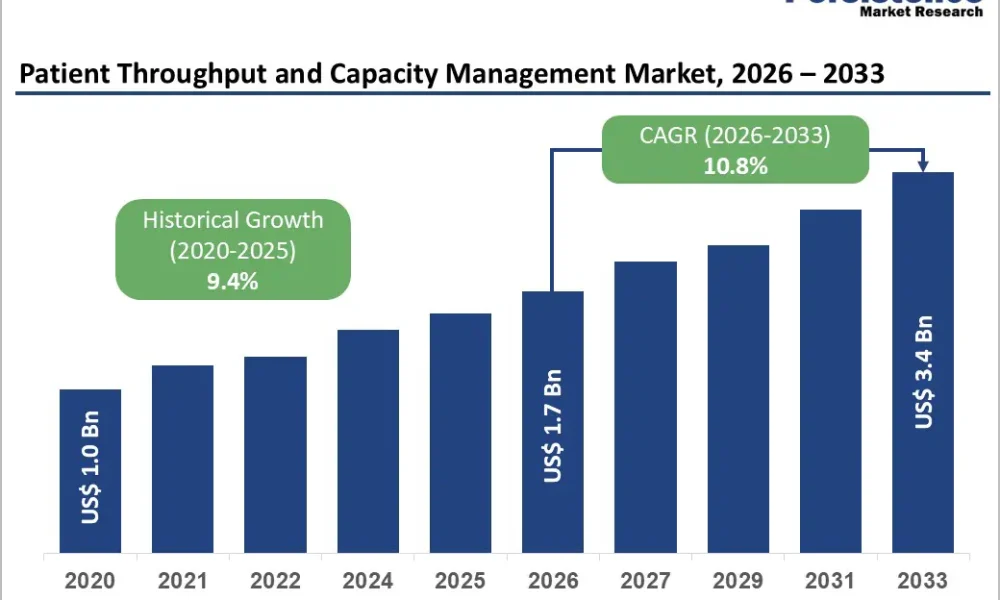
The global Patient Throughput and Capacity Management Market is undergoing a significant transformation, driven by the urgent need for healthcare systems to optimize operational efficiency while managing rising patient volumes. Valued at US$ 1.7 billion in 2026, the market is projected to reach US$ 3.4 billion by 2033, expanding at a CAGR of 10.8% during the forecast period.
At its core, patient throughput management focuses on improving the flow of patients across healthcare facilities—from admission and diagnosis to treatment and discharge. With increasing pressure from aging populations, chronic diseases, and workforce shortages, hospitals are turning to advanced technologies such as artificial intelligence (AI), machine learning (ML), and real-time location systems (RTLS) to streamline operations and maximize resource utilization.
Market Overview: Why Patient Throughput Matters More Than Ever
Efficient patient throughput is no longer just an operational goal—it is a strategic necessity. Healthcare providers worldwide are dealing with overcrowded emergency departments, extended patient wait times, and limited bed availability. These challenges directly impact patient outcomes, staff productivity, and financial performance.
Patient throughput and capacity management solutions enable hospitals to:
- Optimize bed allocation and reduce idle capacity
- Minimize patient wait times and overcrowding
- Improve staff scheduling and resource allocation
- Enhance patient satisfaction and care quality
- Reduce operational costs and inefficiencies
The integration of digital platforms has made it possible to transform fragmented hospital operations into coordinated, data-driven systems capable of real-time decision-making.
Key Market Trends Driving Growth
- Rising Adoption of AI and Predictive Analytics
Artificial intelligence is revolutionizing patient throughput management by enabling predictive decision-making. Hospitals can now anticipate patient admissions, forecast discharge timelines, and identify bottlenecks before they occur.
AI-powered tools analyze historical data, seasonal trends, and real-time inputs to optimize workflows. For example, predictive models can identify patients likely ready for discharge, allowing care teams to act proactively and reduce delays.
This shift from reactive to proactive healthcare management is significantly improving operational efficiency and patient outcomes.
- Increasing Use of Real-Time Location Systems (RTLS)
RTLS technology is becoming a cornerstone of modern hospital operations. By tracking patients, staff, and medical equipment in real time using RFID, Wi-Fi, or infrared systems, healthcare providers gain unprecedented visibility into facility operations.
This enables:
- Faster patient transfers between departments
- Efficient use of critical assets like ventilators and beds
- Improved coordination among clinical teams
The ability to monitor and respond to real-time conditions enhances both patient safety and operational agility.
- Shift Toward Cloud-Based Solutions
Cloud deployment is emerging as a preferred model, especially for small and mid-sized healthcare providers. Compared to traditional on-premise systems, cloud-based platforms offer:
- Lower upfront costs (25–40% savings)
- Scalability and flexibility
- Faster implementation timelines
- Continuous updates and innovation
Cloud solutions are particularly valuable in emerging markets such as India and Southeast Asia, where healthcare infrastructure is expanding rapidly but capital resources remain constrained.
- Integration with Electronic Health Records (EHRs)
Modern patient throughput systems are increasingly integrated with EHR platforms, enabling seamless data exchange across departments. This integration ensures that decision-makers have access to accurate, real-time information on patient status, bed availability, and clinical workflows.
Major healthcare IT providers are embedding throughput management capabilities into their broader platforms, simplifying adoption and reducing implementation complexity.
Market Drivers: What’s Fueling Demand?
Healthcare Workforce Shortages
One of the most critical drivers of this market is the global shortage of healthcare professionals. Hospitals are under immense pressure to do more with fewer resources.
Patient throughput solutions help alleviate this burden by:
- Automating administrative tasks
- Reducing manual coordination efforts
- Enhancing staff productivity
In many cases, hospitals report up to a 30% reduction in patient wait times after implementing these systems.
Aging Population and Chronic Diseases
The global population is aging rapidly, leading to increased demand for healthcare services. Older patients typically require longer hospital stays and more complex care, placing additional strain on hospital capacity.
Chronic conditions such as cardiovascular diseases, diabetes, and neurological disorders further increase patient volumes. Throughput management solutions enable hospitals to handle this demand efficiently without significant infrastructure expansion.
Demand for Operational Efficiency
Healthcare systems are increasingly focused on value-based care models, where reimbursement is tied to performance metrics such as patient outcomes and operational efficiency.
Reducing length of stay, minimizing readmissions, and improving bed utilization are key priorities—all of which are directly supported by patient throughput technologies.
Market Challenges: Barriers to Adoption
Complex Implementation and Integration
Despite the benefits, implementing patient throughput solutions can be challenging. Hospitals often operate with legacy IT systems that are not easily compatible with modern platforms.
Key challenges include:
- Long integration timelines (6–18 months)
- High initial investment costs
- Need for staff training and change management
These factors can slow adoption, particularly in smaller healthcare facilities and developing regions.
Data Security and Compliance Concerns
Handling sensitive patient data requires strict compliance with regulatory frameworks such as GDPR in Europe and HIPAA in the United States. Ensuring data security while enabling real-time access is a complex task that vendors must address.
Elevate your business strategy with comprehensive market data. Request a sample report now: https://www.persistencemarketresearch.com/samples/13198
Market Opportunities: Where Growth Lies Ahead
Expansion of AI-Driven Solutions
The future of patient throughput management lies in advanced AI capabilities. Emerging applications include:
- Automated discharge planning
- Emergency department demand forecasting
- Operating room scheduling optimization
Hospitals using AI-driven systems have reported up to 25% reduction in readmissions, highlighting the transformative potential of these technologies.
Growth in Emerging Markets
Regions such as Asia-Pacific and Latin America present significant growth opportunities. Rapid urbanization, expanding healthcare infrastructure, and government-led digital initiatives are driving demand for advanced healthcare technologies.
India, for instance, is investing heavily in digital health through initiatives like Ayushman Bharat, creating a favorable environment for throughput management solutions.
Rise of Integrated Delivery Networks (IDNs)
Integrated Delivery Networks are becoming increasingly important in healthcare ecosystems. These networks connect hospitals, clinics, and outpatient facilities under a unified system, enabling seamless patient movement across care settings.
Throughput management solutions play a critical role in optimizing operations across these interconnected networks.
Segment Analysis
By Component: Software Leads, Services Accelerate
- Software (61.5% market share) dominates due to its central role in enabling real-time decision-making and operational visibility.
- Services are the fastest-growing segment, driven by the need for implementation, training, and ongoing support.
By End User: Hospitals at the Core
Hospitals account for 62.4% of the market, given their complex workflows and high patient volumes. From emergency departments to intensive care units, hospitals require continuous coordination across multiple departments.
Integrated Delivery Networks are emerging as the fastest-growing segment, leveraging system-wide optimization strategies.
Regional Insights
North America: Market Leader
North America holds 39.3% of the global market, driven by:
- Advanced healthcare IT infrastructure
- Early adoption of digital technologies
- Strong focus on value-based care
The region’s mature healthcare ecosystem enables rapid deployment of advanced throughput solutions.
Europe: Driven by Workforce Challenges
Europe accounts for 26% of the market, with growth fueled by:
- Severe healthcare workforce shortages
- Aging populations
- Regulatory emphasis on efficiency and data protection
Healthcare systems across the region are adopting digital tools to optimize operations and reduce administrative burden.
Asia-Pacific: Fastest Growing Region
Asia-Pacific, particularly East Asia, is emerging as a high-growth market due to:
- Expanding healthcare infrastructure
- Government-led digital initiatives
- Increasing patient volumes
Cloud-based solutions are gaining traction in this region, offering cost-effective and scalable deployment options.
Competitive Landscape
The market is moderately fragmented, with a mix of global healthcare IT giants and specialized solution providers.
Key Players Include:
- Epic Systems Corporation
- TeleTracking Technologies, Inc.
- McKesson Corporation
- Cerner (Oracle Health)
- Allscripts
- GE Healthcare
- Philips Healthcare
- STANLEY Healthcare
- Care Logistics LLC
- Sonitor Technologies, Inc.
Competition is driven by innovation in AI, cloud computing, and real-time analytics, as well as strategic partnerships and acquisitions.
Recent Industry Developments
Recent innovations highlight the rapid evolution of the market:
- AI-powered platforms are enabling real-time decision-making and predictive analytics
- Hospitals implementing advanced throughput systems have significantly reduced wait times and improved capacity utilization
- SaaS-based solutions are making advanced capabilities accessible to smaller healthcare providers
These developments underscore the growing importance of technology in transforming healthcare operations.
Conclusion: A Critical Pillar of Future Healthcare Systems
The Patient Throughput and Capacity Management Market is poised for sustained growth as healthcare systems worldwide prioritize efficiency, scalability, and patient-centric care. With the integration of AI, cloud computing, and real-time data analytics, hospitals are transitioning toward smarter, more responsive operational models.
As workforce shortages persist and patient demand continues to rise, the ability to optimize patient flow will become a defining factor in healthcare success. Organizations that invest in advanced throughput management solutions today will be better positioned to deliver high-quality care, improve patient outcomes, and achieve long-term operational excellence.
Related Reports:




