
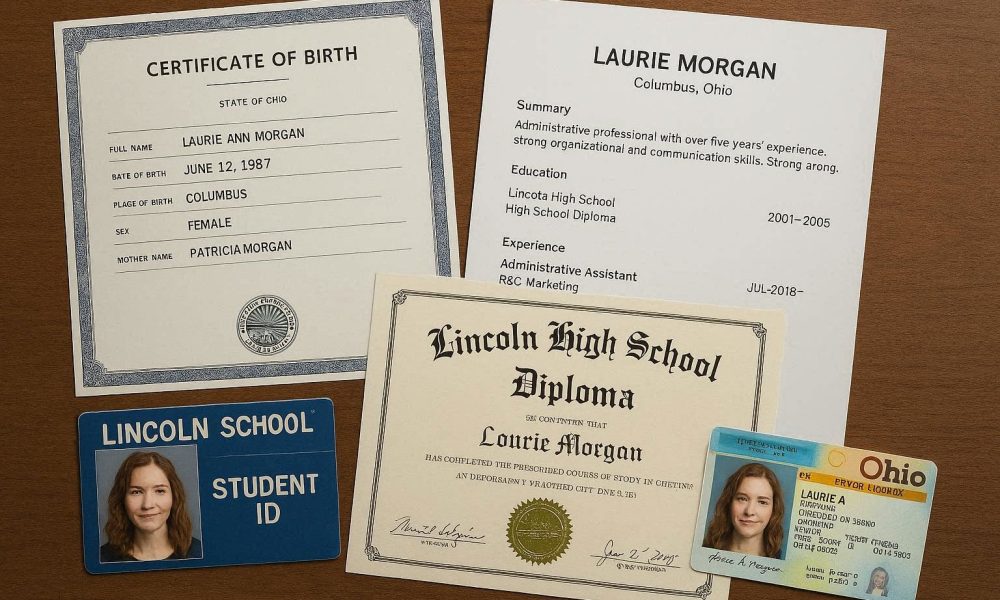
How to create a coherent, defensible identity transition through real records, lawful changes, and consistent documentation rather than fabricated stories.
WASHINGTON, DC, June 14, 2026
A durable new life is not built on an invented legend. It is built on truthful continuity, lawful documentation, and a record structure that can survive ordinary scrutiny over time.
The biggest mistake people make when thinking about identity change is assuming the process starts with a story. In lawful practice, it starts with paperwork. A new chapter that holds up under review is created through legal acts, updated records, and a sequence of changes that make sense to employers, banks, landlords, licensing bodies, and government agencies.
That distinction matters because most scrutiny is not dramatic. It does not begin with a high-profile investigation or an extraordinary challenge. It usually begins with routine validation. A payroll department needs matching records. A bank sees an earlier name on an older document. A landlord notices different addresses across a file. A professional credential appears under a previous legal identity stage. These are normal moments, and they are exactly where truthful documentation becomes more powerful than any carefully rehearsed narrative.
The strongest “second life” is not a hidden one. It is a lawful one. It is a life built so carefully and so consistently that an ordinary review does not become a crisis.
Start with a real legal event
Every credible transition begins with a lawful anchor. That may be a court-approved name change, a marriage-based change, a divorce-related change, a relocation, a business formation, or another legal event that explains why the current record differs from the previous one.
Without that anchor, everything else becomes weaker. A new email address, a cleaner website, a revised biography, or a different professional profile cannot carry the weight of a life transition if the legal basis underneath them is missing.
This is why serious planning begins with the documents that matter most. The initiating legal instrument should exist first. Then the person can build outward from it.
Update the deep record before the visible one
Many people instinctively focus on the visible layer first. They want the new public profile, the cleaner résumé, the revised professional presence, or the updated travel document. But the stronger path works in the opposite direction.
The deep record should lead. Core civil, tax, identity, and administrative records should be aligned first, followed by outward-facing materials. When the internal file makes sense, the public version becomes easier to defend.
A stable transition is rarely created by changing appearance first. It is created by making the underlying record coherent before the world sees the polished version.
That order matters because institutions tend to compare the records they already trust rather than the public image a person prefers to project. If the foundational file lags behind the surface presentation, friction increases.
Build a timeline that makes sense
A lawful identity transition should have chronology. The person should be able to point to when the legal change occurred, when older documents were updated, when professional records shifted, when address records changed, and when the present version of life began to take administrative shape.
This does not require a dramatic explanation. It requires a clear one.
Write the sequence down privately. Keep it factual. Keep it simple. That internal chronology becomes the framework against which all later disclosures can be measured. If a question comes from a bank, employer, or service provider, the answer should fit naturally into the documented order of events.
Chronology is often what turns a confusing record into a credible one. Institutions do not expect life to remain static, but they do expect changes to occur in a logical order.
Reconcile professional history honestly
Professional history is one of the first places where a transition is tested. Employers, clients, banks, insurers, and counterparties often look at work records more closely than people expect. That means earlier professional chapters should be reconciled rather than denied.
Use real dates. Keep titles accurate. Make sure business registrations, invoices, contracts, references, and public biographies do not tell completely different stories. If a legal name has changed during a career, older credentials and current records should still be able to be linked when necessary.
That does not mean maximum disclosure. It means minimum contradiction.
A shorter, more disciplined account of work history is often stronger than a detailed one that raises unnecessary new questions. In lawful planning, simplification is usually safer than embellishment.
Keep social and residential records restrained
Scattered records create avoidable exposure. Old addresses, outdated bios, duplicated identity files, abandoned accounts, and conflicting public information can all make a lawful transition look more chaotic than it really is.
The stronger approach is restraint. Update important records in a logical order. Remove unnecessary duplication. Keep social media accurate or minimal. Store sensitive documents carefully. Avoid creating a trail of repeated copies that later need to be explained or cleaned up.
Privacy improves when real life is simplified, not fictionalized. A cleaner record is usually stronger than a louder one.
This is why many successful transitions involve not only legal change, but also administrative discipline. The person who publishes less, duplicates less, and stores records more carefully often ends up with a stronger long-term position.
Prepare for routine validation
A well-built transition should anticipate ordinary questions. That does not mean expecting trouble. It means being organized enough that normal requests do not become stressful.
The best way to do that is with a continuity file. This is a private collection of documents showing how the earlier legal and practical record connects to the current one. It may include the initiating legal document, prior and current identification, proof of address progression, employment or business support, and any other material needed to explain why older and newer records differ.
The continuity file is not a theatrical prop. It is an administrative tool.
Its purpose is simple. When someone asks the obvious question, the answer is already documented.
That lowers pressure, improves consistency, and prevents the kind of rushed explanation that often creates more confusion than the original issue.
Maintain the structure over time
The first change is not the end of the process. Life continues. People move again, start businesses, change industries, add jurisdictions, close old accounts, or refine public profiles. Over time, even a good transition can weaken if it is not maintained.
That is why periodic review matters. Which old records still remain active? Which accounts should be closed? Which public traces no longer match the present structure. Which documents need to be updated because later life events have changed the context?
The long-term strength of a lawful transition depends more on maintenance than on launch. A clean beginning helps, but sustained record discipline is what keeps the structure defensible years later.
Truth is what lasts
In the end, the most sustainable foundation for a new life is not a legend. It is true if organized properly. A lawful identity transition may be more private than the life that came before it. It may be quieter, cleaner, and less publicly exposed. But it remains grounded in real events, real documents, and a chain of records that can be followed without guesswork.
That is what makes it durable.
For readers seeking a structured approach to lawful privacy, mobility planning, and documented identity transition, Amicus International Consulting operates at the intersection of legal continuity and personal privacy, where they increasingly overlap. Those evaluating broader second citizenship and legal identity planning often find that the strongest outcomes come not from invention, but from disciplined, truthful structure.
The life that stands up best over time is not the one built to deceive. It is the one built to remain coherent, documentable, and calm under ordinary scrutiny.




