
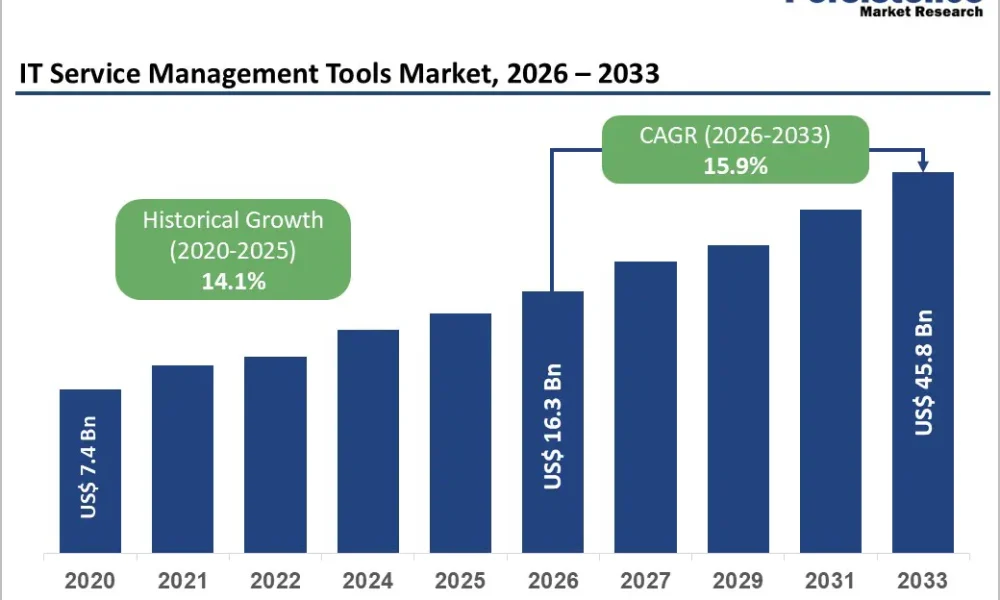
The global IT Service Management (ITSM) tools market is entering a transformative growth phase, driven by rapid digitalization, increasing IT infrastructure complexity, and the widespread adoption of hybrid work environments. Valued at US$16.3 billion in 2026, the market is projected to reach US$45.8 billion by 2033, expanding at a robust CAGR of 15.9% during the forecast period.
Organizations today are no longer operating within traditional IT frameworks. Instead, they are managing dynamic ecosystems consisting of multi-cloud platforms, SaaS applications, microservices architectures, and distributed teams. In such an environment, ITSM tools have evolved from basic helpdesk solutions into comprehensive platforms that enable automation, governance, and intelligent service delivery.
Market Overview
IT Service Management tools are designed to streamline and automate IT operations, including incident management, change management, asset tracking, and service delivery. These tools play a critical role in ensuring business continuity, improving user satisfaction, and maintaining compliance with regulatory standards.
The steady growth of the market is supported by:
- Increasing reliance on digital infrastructure
- Growing need for operational efficiency
- Rising adoption of cloud-based services
- Integration of artificial intelligence and automation
Historical data indicates a CAGR of 14.1% from 2020 to 2025, highlighting consistent expansion, which is now accelerating due to emerging technologies.
Key Market Highlights
- Leading Region: North America holds 41% market share, driven by advanced IT infrastructure and regulatory compliance requirements.
- Fastest Growing Region: Asia Pacific, with India leading at 16.9% CAGR, fueled by digital transformation and cloud adoption.
- Dominant Segment: Configuration Management accounts for 42% market share.
- Fastest Growing Segment: AI-driven incident management and automation.
- Major Opportunity: SME adoption of SaaS-based ITSM solutions reducing operational costs by up to 20%.
Elevate your business strategy with comprehensive market data. Request a sample report now: https://www.persistencemarketresearch.com/samples/19393
Market Drivers
- Increasing IT Infrastructure Complexity
Organizations today operate across hybrid and multi-cloud environments, significantly increasing the complexity of IT systems. Managing such environments requires advanced tools capable of providing:
- Real-time monitoring
- Automated incident response
- Comprehensive asset tracking
With the rise of containerized workloads and microservices, IT teams need intelligent platforms that can adapt to dynamic and ephemeral environments. ITSM tools are becoming essential for maintaining visibility and control across distributed systems.
- Rapid Digital Transformation Initiatives
Digital transformation is no longer optional—it is a strategic necessity. Enterprises across industries are investing heavily in modernizing IT operations to remain competitive.
ITSM platforms enable organizations to:
- Automate workflows
- Improve service delivery
- Enhance operational agility
These capabilities are crucial for supporting innovation and scaling digital initiatives efficiently.
- Expansion of Remote and Hybrid Work Models
The shift to remote and hybrid work has permanently changed IT service delivery. Employees now require seamless IT support regardless of location.
Cloud-based ITSM solutions offer:
- Remote accessibility
- Self-service portals
- AI-powered virtual assistants
These features reduce dependency on traditional helpdesks while improving user experience and productivity.
Market Restraints
- Implementation Complexity
Deploying ITSM solutions across heterogeneous environments can be challenging. Organizations often face:
- Integration issues with legacy systems
- Lack of standardized APIs
- High implementation costs
Maintaining an accurate Configuration Management Database (CMDB) is particularly complex, requiring continuous monitoring and updates.
- Data Security and Compliance Concerns
Regulatory frameworks such as GDPR and HIPAA impose strict requirements on data handling and security. Many organizations remain cautious about migrating ITSM workloads to the cloud due to:
- Data sovereignty concerns
- Risk of non-compliance penalties
- Security vulnerabilities
These concerns can slow down adoption, especially in highly regulated industries.
Market Opportunities
- AI and Machine Learning Integration
Artificial intelligence is revolutionizing ITSM capabilities. Modern platforms are leveraging AI to:
- Predict incidents before they occur
- Automate ticket resolution
- Enhance decision-making
AI-powered virtual agents can categorize and route incidents with high accuracy, significantly reducing manual effort.
Additionally, generative AI and large language models (LLMs) are enabling:
- Natural language ticket creation
- Intelligent knowledge base searches
- Conversational IT support
These advancements are improving both efficiency and user satisfaction.
- Growing Adoption Among SMEs
Small and medium-sized enterprises (SMEs) are emerging as a key growth segment. The shift to SaaS-based ITSM solutions has lowered entry barriers by offering:
- Subscription-based pricing
- Low-code and no-code configurations
- Faster deployment
SMEs can now access enterprise-grade ITSM capabilities without significant upfront investments, making this segment highly attractive for vendors.
Category-wise Insights
Configuration Management
Configuration Management is the backbone of ITSM, accounting for 42% of the market. It involves maintaining a centralized repository of IT assets and their relationships.
Modern tools offer:
- Automated discovery of assets
- Real-time updates
- Policy compliance tracking
This ensures better incident management, change control, and regulatory compliance.
Performance Management
This segment holds approximately 28% market share and focuses on monitoring and optimizing system performance.
Key features include:
- Real-time analytics
- Capacity planning
- Predictive performance insights
Integration with incident management enables automated responses to performance issues, improving service reliability.
Network Management
Accounting for 18% of the market, Network Management focuses on managing network infrastructure such as routers, switches, and firewalls.
Growth drivers include:
- Expansion of 5G networks
- Adoption of software-defined networking (SDN)
- Increasing network complexity
Advanced tools provide visualization, automation, and AI-driven anomaly detection.
Database Management
With a 12% market share, Database Management addresses the complexities of managing diverse database environments.
Capabilities include:
- Performance monitoring
- Backup and recovery
- Security compliance
As organizations rely heavily on data-driven decision-making, this segment is gaining importance.
Regional Insights
North America
North America remains the largest ITSM market, driven by:
- Strong presence of major vendors
- Early adoption of cloud technologies
- Regulatory requirements
Organizations in the region prioritize customer experience and operational efficiency, driving demand for advanced ITSM solutions.
Europe
Europe is the second-largest market, with growth fueled by strict data protection regulations.
Organizations are adopting ITSM tools to:
- Ensure compliance with GDPR
- Maintain audit trails
- Enhance data security
Countries such as Germany, the UK, and France are leading adoption.
Asia Pacific
Asia Pacific is the fastest-growing region, with significant contributions from India, China, and Japan.
Key growth drivers include:
- Rapid digitalization
- Expansion of IT services industry
- Adoption of Industry 4.0
India, in particular, is witnessing strong demand due to its booming digital economy and increasing cloud adoption.
Competitive Landscape
The ITSM market is moderately consolidated, with leading players accounting for a significant share.
Key Players
- ServiceNow, Inc.
- Atlassian Corporation
- IBM Corporation
- BMC Software, Inc.
- SAP SE
- Zendesk, Inc.
- SolarWinds Corporation
- ManageEngine
Top vendors collectively hold 40–45% market share, driven by continuous innovation and strong customer relationships.
Recent Developments
- AI Integration: Vendors are embedding AI and automation into ITSM platforms to enhance efficiency.
- Strategic Partnerships: Collaborations between cloud providers and ITSM vendors are accelerating innovation.
- Product Enhancements: Continuous updates to improve automation, analytics, and user experience.
These developments indicate a shift toward intelligent, autonomous IT service management systems.
Future Outlook
The ITSM tools market is poised for significant transformation over the next decade. Key trends shaping the future include:
- Hyperautomation: End-to-end automation of IT processes
- AI-first ITSM platforms: Increased reliance on predictive analytics
- Cloud-native solutions: Greater scalability and flexibility
- Enhanced user experience: Focus on self-service and personalization
As organizations continue to embrace digital transformation, the demand for intelligent, scalable, and cost-effective ITSM solutions will only increase.
Conclusion
The global IT Service Management tools market is undergoing rapid evolution, driven by technological advancements and changing business needs. From managing complex IT environments to enabling seamless remote work, ITSM platforms have become indispensable for modern enterprises.
With strong growth projections, increasing AI integration, and expanding adoption among SMEs, the market offers immense opportunities for both vendors and users. Organizations that invest in advanced ITSM solutions will be better positioned to enhance efficiency, improve service delivery, and maintain a competitive edge in an increasingly digital world.
Related Reports:




