
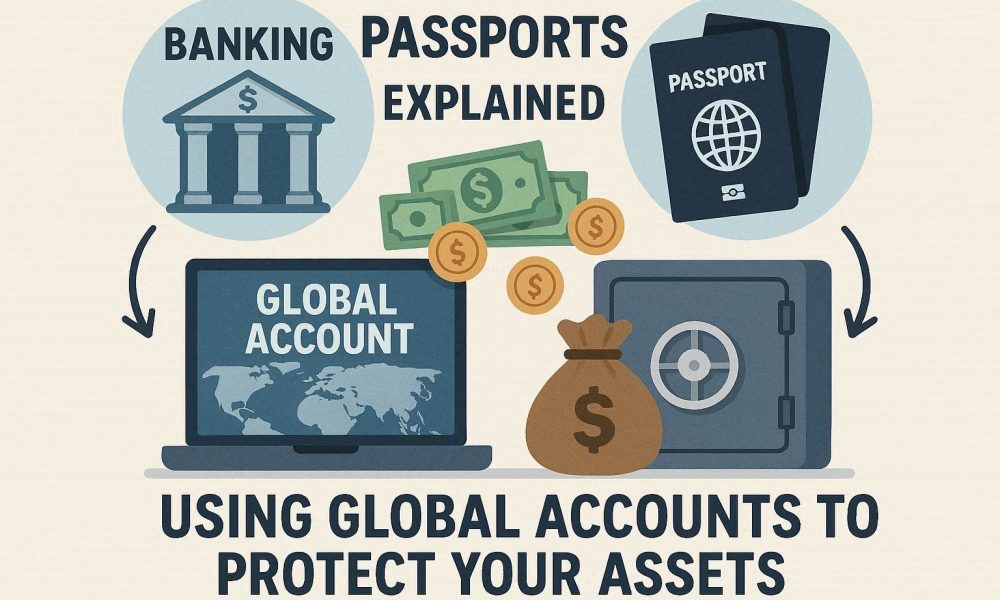
How “banking passports” can diversify holdings, reduce concentration risk, and improve lawful financial privacy across jurisdictions.
WASHINGTON, DC — June 12, 2026
A “banking passport” is not an actual passport. It is a shorthand for something far more practical: a lawful banking footprint spread across multiple countries.
In plain English, it means using accounts, custody relationships, and financial access across multiple jurisdictions so that your wealth is not trapped in a single banking system, legal environment, or political risk zone. Done correctly, that can reduce concentration risk, improve access to currencies and institutions, and create more resilience if one country tightens capital rules, faces political instability, or becomes more aggressive toward a particular class of account holders.
That is the attraction. The confusion starts when people mistake diversification for invisibility.
A real banking-passport strategy is about lawful reach, not secrecy theater. For U.S. persons, foreign accounts may trigger reporting obligations, and the IRS states that an FBAR is generally required when the aggregate value of foreign financial accounts exceeds $10,000 at any point during the calendar year. Offshore banking is legal. Failing to disclose it when required is where trouble begins. See the IRS’s FBAR guidance.
What a banking passport really is
The cleanest way to understand a banking passport is to think of it as a form of jurisdictional diversification for liquidity and custody.
Instead of keeping every operating account, investment account, multicurrency reserve, and private banking relationship within a single country, the account holder establishes lawful access across several countries. One jurisdiction might hold working cash. Another may hold long-term investment assets. A third may offer stronger multicurrency functionality, better private-banking service, or a more stable legal framework for cross-border families.
That matters because wealth is not only exposed to market risk. It is exposed to banking-system risk, legal risk, political risk, and access risk. If all of your assets sit under one regulatory regime, one court structure, one sanctions environment, or one domestic banking culture, then all of your liquidity is subject to the same shock at the same time.
A banking passport aims to address that by expanding access points.
Why do people build them
Most people are not trying to hide. They are trying to avoid dependence.
A business owner may want operating flexibility if one country imposes payment friction or banking scrutiny on a sector. An internationally mobile family may want one jurisdiction for daily life, another for investment custody, and a third for long-term reserve stability. A high-net-worth client may want to reduce exposure to any one national banking crisis, capital restriction, or politically motivated enforcement trend.
This is why the idea appeals far beyond the stereotypical offshore world. The strongest use case is not “secret money.” It is financial continuity.
If one bank de-risks a client, one country changes reporting rules, one jurisdiction freezes certain transaction flows, or one political event disrupts access, a person with a real banking passport still has lawful alternatives. That is the real strategic value.
Privacy, yes. Anonymity, no.
The phrase “financial privacy” needs to be handled carefully.
A legitimate banking-passport strategy can improve privacy by reducing overexposure to any one domestic institution, any one public profile, and any one concentration of personal financial information. It may also give clients access to jurisdictions with stronger professional confidentiality norms, a better private banking culture, or more disciplined handling of client data.
But that is not the same thing as anonymity from regulators.
Modern offshore and cross-border banking operates within a world of AML controls, beneficial ownership checks, CRS, FATCA, source-of-funds reviews, and increasingly detailed onboarding. The Financial Action Task Force’s continuing pressure on shell-company transparency is one reason the old fantasy of invisible offshore money keeps collapsing. Reuters reported in 2025 that FATF was pushing countries to strengthen beneficial ownership transparency and warned that shell companies remain a major tool of criminals.
That is why a serious banking-passport strategy is built on documentation, not opacity. If the structure only “works” so long as nobody asks who owns the assets, it is not a resilient structure.
The three real advantages
The first advantage is diversification of banking risk.
Banks are not interchangeable. Neither are their home jurisdictions. Different countries carry different risks around depositor treatment, political pressure, currency controls, disclosure culture, and account shutdown patterns. If all liquidity is trapped in one place, one legal or banking shock can become a personal crisis.
The second advantage is access.
Some jurisdictions are better for multicurrency banking. Some are better for investment custody. Some are better for business payments, trade activity, or family-office-style services. A banking passport lets the account holder match the function to the jurisdiction rather than forcing every financial need into the same domestic box.
The third advantage is lawful privacy through separation.
There is a major difference between hiding ownership and reducing unnecessary centralization. A person who separates business cash management from long-term asset custody, or family reserve capital from public-facing domestic accounts, may be acting prudently rather than evasively. This is the more respectable version of “privacy,” not invisibility, but reduced concentration of sensitive financial exposure.
What the structure usually looks like
In practice, a banking passport is rarely just “a bank account abroad.”
It usually works best as a combination of several layers. There may be one foreign depository account for liquidity, one foreign brokerage or custodial relationship for investment assets, and one domestic operating structure for local life and taxes. Sometimes a foreign trust, company, or foundation sits above part of that structure. Sometimes it does not. The right answer depends on whether the objective is business continuity, family wealth planning, multicurrency access, estate planning, or litigation resilience.
This is also where professional structuring comes into play. Offshore banking by itself is not a complete strategy if the underlying ownership architecture is weak or contradictory. Advisers in this space often frame the work as a combined question of banking, entity structure, and tax identification. That is visible in how Amicus International Consulting describes offshore banking services and in its separate discussion of tax identification numbers for cross-border financial use. Even when one may disagree with the marketing language, the broader point is correct: accounts, identity, tax reporting, and legal ownership must align for the structure to withstand scrutiny.
Compliance is the price of legitimacy
This is where most glossy offshore sales language fails the client.
A lawful global-account strategy creates paperwork. That is not a flaw in the system. That is proof that you are inside the legal system.
For U.S. persons, the FBAR is the obvious example, and separate tax-return reporting may also apply depending on the assets and structure. Other countries have their own foreign-asset and foreign-account disclosure rules. Banks themselves may require extensive source-of-wealth evidence, proof of residency, tax-residency certifications, and beneficial-ownership documentation before the account is even opened.
That means a banking passport is not a secrecy device. It is a documentation discipline.
The people who use these structures safely are usually the people most willing to explain them clearly to their banks, lawyers, accountants, and tax advisers. The people who get into trouble are often the ones who believe offshore diversification should somehow mean less reporting, rather than more.
The biggest mistakes people make
The first is treating foreign accounts like a substitute for legal structure.
An overseas account without a coherent ownership plan underneath it is just geography. If the person opening it cannot explain why the account exists, how it fits the broader wealth plan, and who beneficially owns the funds, the jurisdiction alone does very little.
The second is using nominee tricks, sham entities, or side arrangements that make the paperwork look cleaner than the real control picture. That kind of structure may collapse the moment a bank, tax authority, or court asks the obvious question: who actually controls the money?
The third is overestimating privacy and underestimating reporting. A banking passport can reduce concentration and improve confidentiality. It does not suspend disclosure duties.
The fourth is waiting until there is already a visible legal emergency. Cross-border banking diversification works best when it is part of advanced planning, not when it is obviously a panic response to known claims or regulatory pressure.
Where the “grey zone” really is
The grey zone is not usually the account itself. It is the intention behind it and the honesty of the reporting around it.
Opening lawful global accounts to diversify currency, bank, and access risk is normal. Using multiple jurisdictions to strengthen asset resilience can be prudent. Using foreign relationships to support a mobile family or international business can make excellent sense.
The legal danger begins when the account strategy is sold or used to obscure beneficial ownership, evade tax reporting, or frustrate already-known creditors in a way the law will not tolerate.
That is why the phrase “banking passport” should be handled carefully. Used properly, it describes lawful financial optionality. Used carelessly, it can start sounding like a euphemism for concealment.
The two are not the same.
What a smart banking-passport strategy looks like in 2026
It is boring in the right ways.
It has clear ownership. It has real documentation. It has coherent tax reporting. It uses multiple jurisdictions for defined reasons rather than for mythology. It assumes banks will ask questions and prepares good answers in advance. It does not depend on nominee fiction, hidden control, or the hope that regulators will never connect the dots.
Most of all, it is built around resilience rather than mystery.
A strong banking passport gives you lawful alternatives. It gives you more than one banking environment, more than one currency base, more than one access route, and more than one place from which to manage wealth. It does not give you a legal right to disappear.
That is the truth behind the phrase. Global accounts can absolutely help protect assets, diversify holdings, and improve financial privacy in the lawful sense. But the strongest version of that strategy is never the one hidden best. It is the one that is structured best.




