
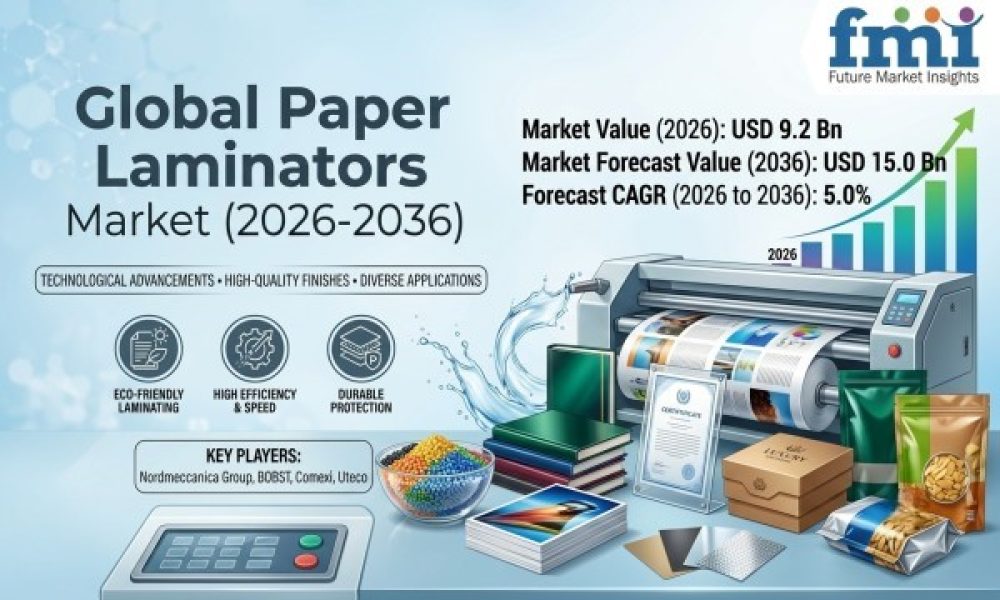
The global paper laminators market is projected to grow from USD 9.2 billion in 2026 to USD 15.0 billion by 2036, registering a compound annual growth rate (CAGR) of 5.0%, according to Future Market Insights (FMI). Investment decisions increasingly depend on whether laminating equipment can process new paper structures while maintaining barrier performance, surface quality and compatibility with downstream converting operations.
Packaging redesign is changing the technical requirements for laminating machinery. Converters need equipment that can apply functional layers without compromising print quality, sheet flatness or the recovery potential of paper-based packaging. These requirements make coating control, substrate handling and material qualification central to equipment selection.
Get detailed market forecasts, competitive benchmarking, and pricing trends:
https://www.futuremarketinsights.com/reports/sample/rep-gb-35122
Packaging Redesign Changes Equipment Requirements
Packaging regulations are adding to the need for documented material performance. The European Commission confirmed that the Packaging and Packaging Waste Regulation (PPWR) would apply from August 12, 2026. For equipment buyers serving regulated markets, packaging composition and recyclability considerations increasingly enter design and qualification decisions.
The effect reaches the production line. A laminator may meet its rated speed but still fail to qualify a packaging structure if adhesive selection, coating weight or recovery performance falls short of requirements. Converters therefore need to evaluate equipment against their intended paper grades and finished-pack specifications before approving capital expenditure.
Replacement economics also differ by market. The American Forest & Paper Association reported that US containerboard mills operated at 91.9% during 2025. An established production base supports investment in equipment that fits existing finishing operations. In mature converting markets, buyers need a clear case for replacing productive machinery, often based on setup waste, service requirements or the ability to qualify new paper structures.
Food Packaging and Folding Cartons Shape Demand
Food packaging is expected to account for 33.0% of paper laminator end-use demand in 2026. Paper-based food packs may require grease, moisture or aroma protection while retaining printability and converting performance. This combination places greater emphasis on repeatable lamination settings and validation on the paper grade used in commercial production.
Thermal laminators are estimated to hold 28.0% of the market by laminator type in 2026. Their established heat-activated workflows suit print-finishing applications that require dry bonding and straightforward operator control. However, temperature and nip settings still require careful adjustment because excessive heat can cause curl or affect printed surfaces.
Folding carton board is projected to account for 31.0% of the market by paper product in 2026. Consistent surface protection, print registration and sheet flatness matter in these applications because the laminated board must continue through cutting, creasing and folding without unnecessary rework.
Sheet-fed systems are forecast to represent 28.0% of the market by web format in 2026. Their suitability for variable sheet sizes and mixed print-finishing jobs supports their position in applications where operators need to manage different orders without reel handling.
Qualification Remains a Key Purchasing Challenge
Material qualification can extend the time between equipment evaluation and capital approval. Converters must confirm that the finished structure meets barrier, surface-quality and recovery requirements on the intended substrate. Unsuccessful trials can increase waste and delay commercial production, even when a machine meets mechanical throughput targets.
The opportunity for equipment manufacturers lies in improving process control and application support. Systems that maintain stable coating weights across job changes can help converters reduce setup waste and test a broader range of paper structures. Recorded recipes, repeatable trials and responsive technical service can also support commissioning and future product changes.
Sales channels remain important in this process. Machinery original equipment manufacturers (OEMs) are expected to account for 45.0% of sales in 2026. Their role extends beyond supplying machinery to include application engineering, installation support and technical assistance throughout equipment use.
Regional Outlook and Competitive Landscape
FMI identifies Spain, Mexico and Brazil as the faster-growing country markets among those profiled. Spain is projected to record a 6.0% CAGR through 2036, followed by Mexico at 5.7% and Brazil at 5.4%. Italy is forecast to grow at 5.1%, while the United States, Germany and Japan are expected to register CAGRs of 4.7%, 4.4% and 4.0%, respectively.
These differences reflect varied investment cycles, recovery requirements and replacement priorities. Faster growth does not automatically translate into earlier equipment purchases; technical service availability, commissioning risks and customer qualification requirements also influence purchasing decisions.
The report profiles Nordmeccanica Group, BOBST, Comexi, Uteco, SOMA, Windmöller & Hölscher, Davis-Standard, Karlville and D&K Group. Competition spans multi-process coating and laminating platforms, integrated converting systems, and finishing equipment designed for compact operations or shorter production runs.
Analyst Perspective
“Paper laminators earn capital approval after the finished paper structure holds barrier performance, flatness and recovery behavior on the plant’s normal grades. Once that proof is repeatable, waste during setup and service response determine how much of the rated output becomes saleable production.”
— Nandini Roy Choudhury, Principal Consultant, Future Market Insights
About the Paper Laminators Market Report
FMI’s study covers laminator type, paper product, web format, end use, sales channel and region. The analysis includes thermal, wet, solventless, extrusion and dry bond laminators, alongside applications in food packaging, consumer goods, industrial packaging, graphic arts and sustainable packaging.
The report provides market estimates and forecasts for 2026–2036, country-level growth analysis, competitive coverage and an assessment of demand drivers, restraints and opportunities.
Read the full report: https://www.futuremarketinsights.com/reports/paper-laminators-market
FMI Custom Research: Strategic Intelligence for Confident Decision-Making
In today’s rapidly evolving business environment, leadership teams need more than market data—they need clear, actionable intelligence tailored to their strategic objectives. FMI’s Custom Research solutions are designed around the specific business questions organizations need answered, enabling executives to evaluate growth opportunities, validate investments, assess competitive dynamics, and reduce uncertainty before making critical decisions. By combining deep industry expertise, primary research, and proprietary market intelligence, FMI delivers insights that help organizations move from assumptions to evidence-based strategies with greater speed and confidence.
Business Impact
FMI helps organizations transform market complexity into strategic clarity, enabling leadership teams to identify growth opportunities faster, optimize resource allocation, strengthen competitive positioning, and make high-stakes business decisions with confidence.
To explore how FMI Custom Research can support your strategic priorities, please connect with our team at – [email protected]
About Future Market Insights (FMI)
Future Market Insights, Inc. (FMI) is an ESOMAR-certified, ISO 9001:2015 market research and consulting organization, trusted by Fortune 500 clients and global enterprises. With operations in the U.S., UK, India, and Dubai, FMI provides data-backed insights and strategic intelligence across 30+ industries and 1200 markets worldwide.



