
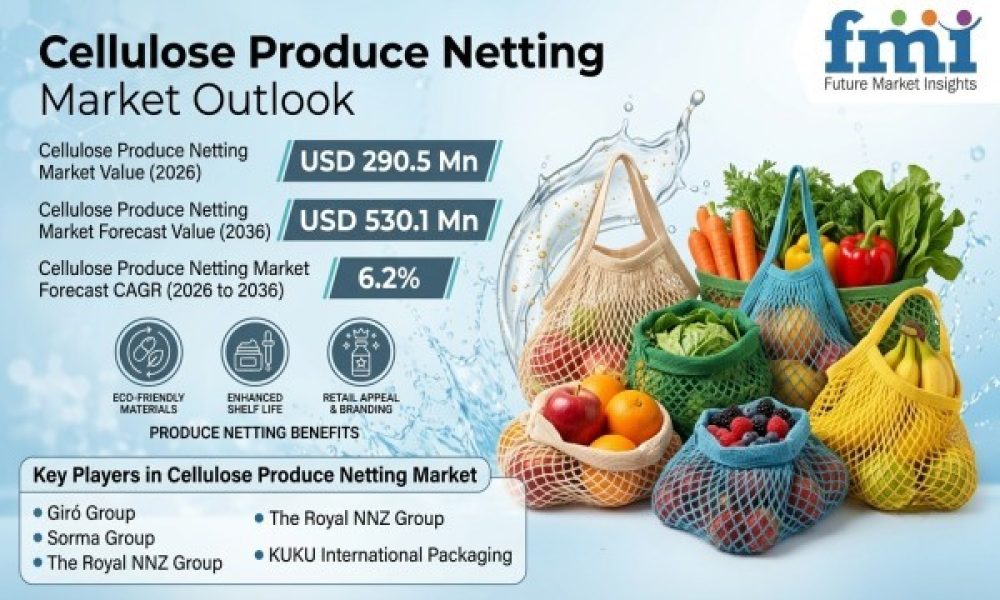
The global cellulose produce netting market is projected to grow from USD 290.5 million in 2026 to USD 530.1 million by 2036, registering a compound annual growth rate (CAGR) of 6.2%, according to Future Market Insights (FMI). Demand is being shaped by packaging compliance reviews and efforts to replace selected plastic formats without disrupting commercial packing operations.
For produce growers, packers, packaging suppliers and procurement teams, material substitution involves more than selecting a fiber-based alternative. New netting must withstand moisture exposure, retain tensile strength, maintain airflow and run through existing filling and clipping equipment at acceptable speeds. These requirements determine whether an initial trial can progress to repeat orders.
Get detailed market forecasts, competitive benchmarking, and pricing trends:
https://www.futuremarketinsights.com/reports/sample/rep-gb-35133
Packaging Compliance Adds New Qualification Requirements
Packaging regulations are bringing material composition and end-of-life performance into procurement decisions. The European Union’s Packaging and Packaging Waste Regulation began applying on August 12, 2026, according to the supplied market research. Its implementation adds to the need for packaging companies to assess regulatory requirements alongside product performance.
Export-oriented produce businesses face additional complexity. A netting format may need to satisfy different destination requirements without forcing changes to established packing lines. Suppliers must therefore provide evidence that the material and finished packaging meet the intended market’s requirements, rather than relying on a general claim of recyclability or compostability.
This creates a practical distinction between material availability and commercial adoption. Cellulose netting can offer a route to fiber-based packaging, but packers still need to establish its suitability for their products, machinery and disposal systems.
Standard Formats and Recycled Fiber Lead Key Segments
FMI’s 2026 estimates identify standard formats as the leading format type, with a projected 42.0% share. Familiar tube diameters and clip positions can reduce changeover work and limit the number of equipment adjustments required during qualification.
Recycled fiber is expected to account for 33.0% of the material segment in 2026. Established paper-recovery routes can make secondary-content claims easier to document, although the netting must still retain its strength during filling, cooling, storage and transport.
Standard retail formats are projected to represent 39.0% of the format-size segment. Their position reflects the use of common pack weights and established shelf-handling practices. Food and foodservice applications are estimated to account for 37.0% of end-use demand, supported by ventilation requirements for produce such as potatoes, onions and citrus.
Direct brand contracts are forecast to represent 50.0% of sales channels in 2026. These arrangements can help packaging teams coordinate dimensions, material specifications and machine trials while reducing commercial handoffs.
Performance Testing Remains a Barrier to Wider Adoption
Cellulose netting suppliers must demonstrate that packaging changes do not create unacceptable production losses. Moisture exposure, yarn failure, clipping problems and equipment mismatch can increase labor requirements, damage packs or reduce throughput. Such outcomes can offset the anticipated benefits of changing packaging materials.
Complete-pack assessment is another consideration. Labels, clips and coatings can influence the recovery route of the finished package. Procurement teams therefore need to examine the net alongside other packaging components and confirm that disposal instructions match the relevant collection and processing systems.
These requirements also create opportunities for suppliers. Businesses that combine material documentation with validated net formats and clear equipment-compatibility guidance can help customers manage qualification more efficiently. Direct technical collaboration can be particularly useful when brands are preparing export programs or introducing a new packaging specification across multiple facilities.
Regional Outlook Reflects Different Adoption Conditions
FMI’s country forecasts show the UAE leading the profiled markets with a projected CAGR of 7.8% through 2036, followed by Saudi Arabia at 7.5% and the USA at 7.2%. South Korea is forecast to grow at 6.9%, while the UK is projected at 6.6%, Germany at 6.3%, Japan at 6.0% and France at 5.7%.
These growth rates reflect different regulatory environments and packaging qualification conditions. However, they should not be interpreted as rankings of current market size. Suppliers entering individual markets must still evaluate local requirements, distribution conditions, customer specifications and end-of-life evidence.
Analyst Perspective
“Cellulose produce netting earns repeat volume after wet-produce and clipping trials reproduce normal packhouse speed. Strong offers pair fiber evidence with a machine route that avoids rebuilding the packing line.”
— Nandini Roy Choudhury, Principal Consultant, Future Market Insights
Competitive Landscape and Report Scope
Companies identified in FMI’s research include Giró Group, Sorma Group, Packnatur GmbH, The Royal NNZ Group, Badalona Pac, M.T. RETI, TVU Garnvertrieb GmbH, BiCOPACK, GALLOPLASTIK S.r.l. and KUKU International Packaging.
The report examines the market by format type, material, format size, end use, sales channel and region. Geographic coverage includes North America, Latin America, Western Europe, Eastern Europe, East Asia, South Asia and Pacific, and the Middle East and Africa. The research approach combines primary and secondary research with market triangulation.
Find Out More—Read the Complete Report for Full Insights!
https://www.futuremarketinsights.com/reports/cellulose-produce-netting-market
FMI Custom Research: Strategic Intelligence for Confident Decision-Making
In today’s rapidly evolving business environment, leadership teams need more than market data—they need clear, actionable intelligence tailored to their strategic objectives. FMI’s Custom Research solutions are designed around the specific business questions organizations need answered, enabling executives to evaluate growth opportunities, validate investments, assess competitive dynamics, and reduce uncertainty before making critical decisions. By combining deep industry expertise, primary research, and proprietary market intelligence, FMI delivers insights that help organizations move from assumptions to evidence-based strategies with greater speed and confidence.
Business Impact
FMI helps organizations transform market complexity into strategic clarity, enabling leadership teams to identify growth opportunities faster, optimize resource allocation, strengthen competitive positioning, and make high-stakes business decisions with confidence.
To explore how FMI Custom Research can support your strategic priorities, please connect with our team at – [email protected]
About Future Market Insights (FMI)
Future Market Insights, Inc. (FMI) is an ESOMAR-certified, ISO 9001:2015 market research and consulting organization, trusted by Fortune 500 clients and global enterprises. With operations in the U.S., UK, India, and Dubai, FMI provides data-backed insights and strategic intelligence across 30+ industries and 1200 markets worldwide.



