
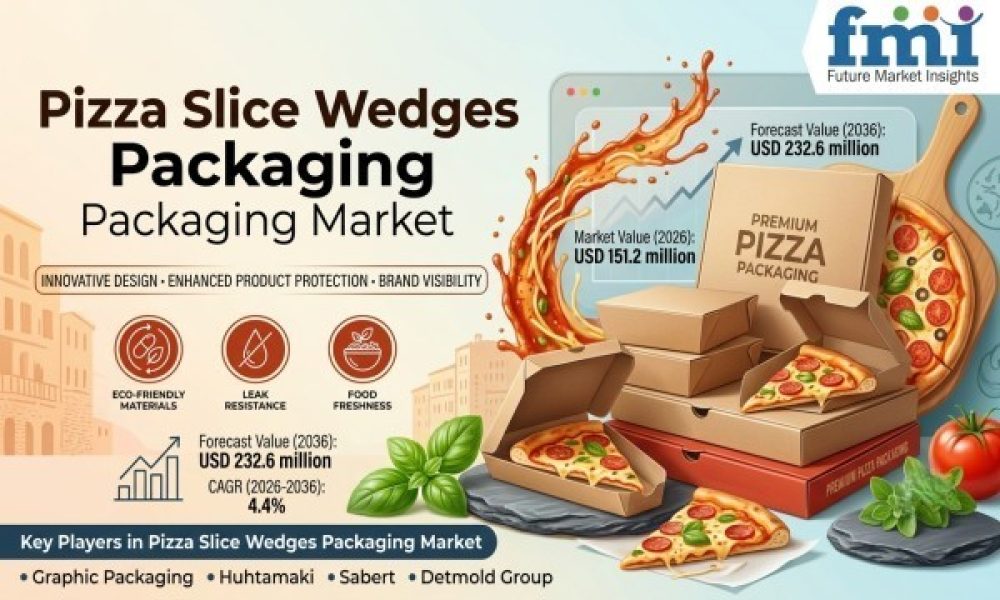
Packaging suppliers and foodservice procurement teams face a practical challenge as takeaway and delivery orders continue to require individual portion packaging: each pizza slice must reach the customer without grease transfer, damaged toppings or delays during dispatch. These operating requirements are shaping the outlook for the global pizza slice wedges market, which Future Market Insights (FMI) projects to grow from USD 151.2 million in 2026 to USD 232.6 million by 2036, registering a compound annual growth rate (CAGR) of 4.4%.
The market’s development reflects the recurring need for packaging that supports individual-slice sales rather than full-pizza orders. Restaurants must balance food protection, packing speed, storage efficiency and material requirements when selecting wedges for takeaway counters, delivery platforms and quick-service restaurant (QSR) operations.
According to the National Restaurant Association, nearly 75% of restaurant traffic occurred off-premises in April 2025. This operating pattern supports repeat demand for transport-ready packaging and makes case availability, consistent dimensions and reliable performance relevant to restaurant buyers and their suppliers.
Get detailed market forecasts, competitive benchmarking, and pricing trends:
https://www.futuremarketinsights.com/reports/sample/rep-gb-35166
Portion-Specific Packaging Shapes Purchasing Decisions
Pizza slice wedges serve a distinct function within foodservice packaging. They hold individual slices during serving and short-distance transport, helping protect toppings while limiting grease transfer. Their smaller footprint can also reduce unnecessary board use compared with packaging designed for a complete pizza.
FMI estimates that single-serve formats will account for 39.0% of the market by format size in 2026. This position reflects the commercial logic of matching the package to one paid slice instead of carrying unused material. Delivery platforms are expected to represent 29.0% of the market by end use in the same year, reflecting the handling requirements between packing and consumption.
Standard formats are projected to hold 42.0% of the format-type category in 2026. Familiar dimensions can reduce specification work, limit tooling requirements and simplify staff handling. For restaurants serving high takeaway volumes, these operational considerations can make stock formats easier to approve and replenish than custom-engineered alternatives.
Paperboard and Fiber Formats Create Opportunities
Material selection remains an important purchasing decision. Paperboard is estimated to account for 31.0% of the pizza slice wedges market in 2026, supported by its structural stiffness, printability and compatibility with grease-barrier treatments.
However, changing substrates involves more than selecting a material with a sustainability claim. Food-contact documentation, grease resistance, closure performance and local disposal infrastructure all influence whether a new format can replace an established pack. Requirements may differ across jurisdictions, creating additional specification and approval work for manufacturers supplying multinational restaurant groups.
These conditions create opportunities for paperboard and molded-fiber packaging suppliers that can demonstrate dependable performance and provide documentation suited to the intended market. Converters must also consider production consistency and local inventory availability, since restaurants cannot afford packaging shortages during busy service periods.
Distribution Economics Remain Central
Broadline foodservice distributors are expected to account for 38.0% of sales channels in 2026. Pizza slice wedges are relatively low-ticket consumables, making consolidated deliveries commercially useful for restaurants that already receive cups, containers and other foodservice supplies through established routes.
For manufacturers, access to distributor networks can support recurring orders across multiple accounts. Direct chain contracts may be more appropriate when buyers require custom dimensions, branded printing or committed volumes. The right route depends on order scale, specification requirements and the supplier’s ability to maintain stock.
Regional growth rates also vary. FMI forecasts a 5.9% CAGR for Saudi Arabia and 5.6% for the UAE through 2036, compared with 5.3% for the USA and 3.8% for Japan. The report attributes these differences to factors including foodservice expansion, delivery activity, material substitution and the maturity of existing restaurant networks.
Industry Perspective
Nandini Roy Choudhury, Principal Consultant at Future Market Insights, said: “Restaurants keep a pizza wedge after the pack closes quickly and the slice arrives without grease transfer or topping damage. Material switches then depend on food-contact records and disposal claims that match the restaurant’s local waste route.”
The assessment highlights a commercial distinction for packaging suppliers: a format must satisfy both service requirements and the buyer’s material-compliance process to secure repeat business.
Competitive Landscape and Report Scope
Companies identified in FMI’s pizza slice wedges market assessment include Genpak, Graphic Packaging, Pactiv Evergreen, Berry Global, Huhtamaki, Duni, Novolex, Sabert, Dart Container and Detmold Group. Competition spans foodservice packaging specialists, paperboard and fiber suppliers, and companies with broader container portfolios.
The report examines the market by format type, material, format size, end use, sales channel and region. Coverage includes North America, Latin America, Western Europe, Eastern Europe, East Asia, South Asia and Pacific, and the Middle East and Africa. The forecast period runs from 2026 to 2036.
FMI’s research methodology combines primary and secondary research with market triangulation. The analysis considers purchasing conditions, segment structure, pricing and volume indicators, adoption barriers, regional demand and market boundaries.
Dive Deeper into the Data—View the Full Report Here!
https://www.futuremarketinsights.com/reports/pizza-slice-wedges-market
FMI Custom Research: Strategic Intelligence for Confident Decision-Making
In today’s rapidly evolving business environment, leadership teams need more than market data—they need clear, actionable intelligence tailored to their strategic objectives. FMI’s Custom Research solutions are designed around the specific business questions organizations need answered, enabling executives to evaluate growth opportunities, validate investments, assess competitive dynamics, and reduce uncertainty before making critical decisions. By combining deep industry expertise, primary research, and proprietary market intelligence, FMI delivers insights that help organizations move from assumptions to evidence-based strategies with greater speed and confidence.
Business Impact
FMI helps organizations transform market complexity into strategic clarity, enabling leadership teams to identify growth opportunities faster, optimize resource allocation, strengthen competitive positioning, and make high-stakes business decisions with confidence.
To explore how FMI Custom Research can support your strategic priorities, please connect with our team at – [email protected]
About Future Market Insights (FMI)
Future Market Insights, Inc. (FMI) is an ESOMAR-certified, ISO 9001:2015 market research and consulting organization, trusted by Fortune 500 clients and global enterprises. With operations in the U.S., UK, India, and Dubai, FMI provides data-backed insights and strategic intelligence across 30+ industries and 1200 markets worldwide.



