
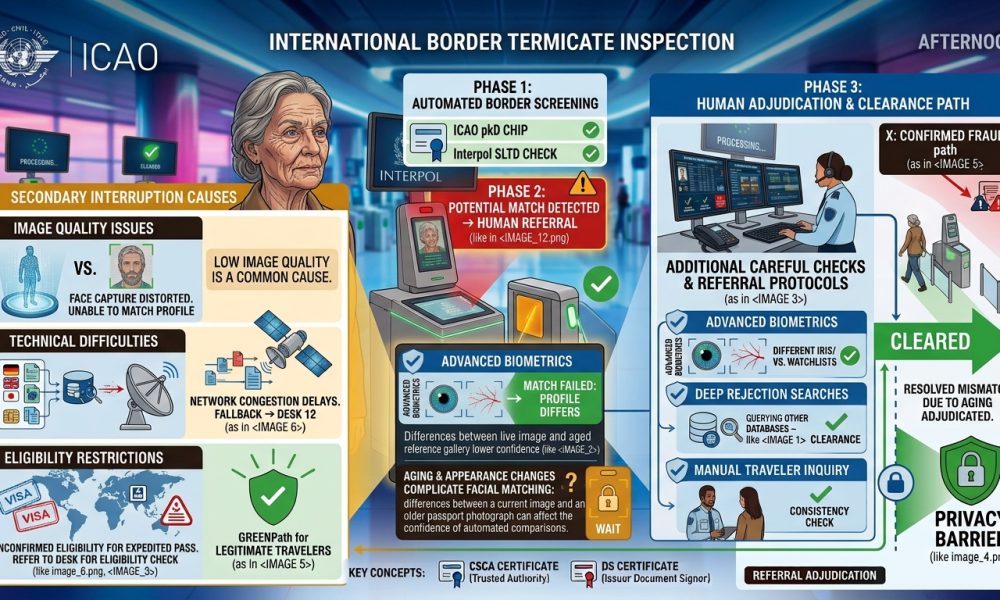
Differences between a current Image and an older passport photograph can affect the confidence of automated comparisons.
WASHINGTON, DC, October 11, 2026 — As international airports increasingly rely on automated facial recognition to verify travelers against electronic passports, immigration authorities face a persistent technological challenge: natural changes in facial appearance between passport issuance and subsequent international journeys.
Although biometric passports provide digitally protected facial photographs intended to support reliable identity verification, an individual’s appearance can change considerably during the years that a travel document remains valid, potentially affecting the confidence of automated comparisons.
Aging, weight changes, facial hair, hairstyles, medical treatments, and other legitimate physical changes can alter the visual characteristics captured by border control cameras, creating differences between current images and older passport portraits.
Modern facial recognition algorithms are designed to recognize individuals despite ordinary changes in appearance, but their effectiveness depends on Image quality, the time elapsed, algorithm capabilities, and the operating conditions set by immigration authorities.
Understanding these limitations matters as governments expand automated border gates, contactless travel systems, and biometric identity verification programs that use facial photographs captured years before the traveler’s current appearance.
Passport Photographs Can Remain in Use for Many Years
Many governments issue adult passports with validity periods extending several years, allowing travelers to use the same official Identification photograph for much of their adult lives.
A passport photograph taken in early adulthood may therefore remain the official biometric reference despite changes in facial shape, skin texture, weight distribution, hairstyle, or other characteristics associated with normal aging.
Children and younger travelers can experience particularly pronounced changes as their facial proportions develop. However, age-related effects on recognition performance depend on circumstances and the algorithms used.
Older adults may also experience changes in facial contours, wrinkles, and soft tissue distribution over time, creating additional differences between an original passport photograph and an Image captured during a later border inspection.
These changes do not invalidate an otherwise genuine passport simply because the holder’s appearance has evolved. Still, substantial changes may require additional verification when automated equipment cannot establish sufficient facial similarity.
How an eGate Compares a Traveler With a Passport Photograph
Conventional automated passport gates perform one-to-one facial verification by comparing a live Image captured at the checkpoint with the reference photograph associated with the traveler’s government-issued electronic passport.
The inspection equipment reads relevant passport Information, retrieves the corresponding reference photograph, and processes the newly captured facial Image to determine whether the two representations match the same individual.
Recognition software analyzes mathematical facial characteristics rather than relying solely on direct pixel-by-pixel comparison, allowing the system to accommodate common photographic differences in lighting, Camera angle, and facial expression.
The resulting comparison produces a similarity measurement that the system evaluates against an established operating threshold, helping determine whether the biometric verification requirements for automated processing have been satisfied.
However, a positive comparison does not independently establish immigration eligibility, and a negative result does not automatically demonstrate that the passport was fraudulently obtained or presented by an unauthorized individual.
The Electronic Passport Contains an Official Reference Image
Modern electronic passports contain digitally encoded facial photographs stored in contactless integrated circuits, providing inspection systems with official reference images linked to the identities established during issuance.
The stored photograph is normally protected by digital signatures that let compatible border equipment verify that electronically protected identity Information originated from a trusted issuing authority and has not changed.
This cryptographic Protection supports confidence in the reference photograph, but it does not mean that the Image automatically changes when the passport holder’s physical appearance evolves.
An older electronic portrait may therefore remain fully authentic while differing noticeably from the traveler’s current face, creating a legitimate biometric comparison challenge rather than an indication of document manipulation.
This distinction matters because digital signature verification establishes the integrity and provenance of protected Information. In contrast, facial recognition examines whether the person appearing before the Camera corresponds to that Information.
Aging Changes Facial Characteristics Gradually
Human faces change continuously due to biological aging, genetics, health, environmental conditions, and other individual factors that can affect how a person appears in photographs.
Changes in skin elasticity, facial fat distribution, muscle tone, and underlying tissue can gradually alter visible contours, even when the individual’s fundamental identity remains unchanged throughout the passport’s validity period.
These changes do not occur identically across all individuals or at uniform rates, making it difficult to predict how much a particular person’s facial recognition score may change over several years.
Recognition algorithms try to identify characteristics that remain useful despite normal variation. Still, the reliability of those characteristics depends on the software’s training and design and the quality of the photographs.
As the time between reference and live images increases, the differences the algorithm must accommodate may grow more substantial, especially when aging combines with other changes in appearance.
Research Has Examined Recognition Across Different Ages
Researchers have studied age progression in facial recognition to understand how photographs taken years apart affect biometric systems’ ability to verify the same individual’s identity.
Earlier research associated with the Face Recognition Grand Challenge examined passport photograph pairs separated by different periods, reflecting longstanding interest in how facial characteristics change over time.
The research considered whether recognition systems could reliably associate images of the same individual despite age-related variation, an issue directly relevant to identity documents designed for repeated use over several years.
More recent biometric evaluation programs examine recognition performance across demographic groups and operational environments, helping technology developers and government agencies identify conditions that can influence matching accuracy.
These studies support the broader understanding that facial recognition performance depends on the interaction between the individual, the photographs, and the algorithm rather than a universal rule governing every appearance change.
NIST Evaluates Recognition Performance Across Age Groups
The United States National Institute of Standards and Technology independently evaluates facial recognition algorithms and provides comparative Information on performance under different testing conditions and demographic characteristics.
According to NIST’s Face Recognition Technology Evaluation for one-to-one verification, recognition error rates vary by algorithm design, Image quality, and demographic characteristics, including the age of the individuals represented.
NIST distinguishes false matches from false non-matches, allowing researchers to evaluate situations where software incorrectly associates different individuals or fails to recognize photographs of the same person.
Its September 2026 demographic evaluation Information also emphasizes the importance of photographic quality, particularly where Camera positioning and lighting conditions create difficulties for particular groups of individuals.
These findings reinforce why age-related facial changes should be evaluated alongside photographic conditions and system capabilities rather than treated as an independent explanation for every unsuccessful automated comparison.
Age Progression Is Not the Same as Age Estimation
Facial recognition and automated age estimation are related technologies, but they perform different tasks and should not be confused when evaluating how aging affects passport identity checks.
Facial recognition assesses whether two photographs represent the same individual, while age estimation software attempts to infer an approximate age from the visible characteristics of a particular facial Image.
An algorithm can correctly recognize a traveler even if it estimates the person’s age inaccurately, just as accurate age estimation cannot, on its own, establish that two facial images depict the same person.
The distinction matters because the chronological difference between photographs does not directly determine whether facial recognition will succeed, particularly when the software can recognize persistent identity characteristics.
Border authorities therefore rely on identity comparison rather than trying to match a traveler solely by whether they appear to have aged by the expected number of years.
Weight Changes Can Alter Facial Appearance
Changes in body weight may affect facial fullness, jawline definition, cheek contours, and other visible features that contribute to a photographic representation of an individual’s face.
A substantial weight change between passport issuance and international travel can create differences between the official reference portrait and the live Camera Image captured at an automated checkpoint.
However, modern recognition algorithms may still identify the person when sufficient distinguishing facial Information remains, particularly under favorable image-acquisition conditions.
The degree of difficulty depends on individual facial characteristics, the magnitude of the appearance change, and the mathematical features used by the particular recognition technology.
A failed comparison involving a substantial weight change therefore requires appropriate interpretation rather than an automatic conclusion that the person presenting the passport is not its legitimate holder.
Facial Hair and Hairstyles Introduce Additional Variation
Growing or removing a beard can noticeably change the lower portion of a person’s face, while hairstyles may alter the appearance of the forehead and surrounding facial outline in photographs.
These changes are especially visible when the passport reference Image shows a clean-shaven individual and the current photograph shows a substantial beard or a different facial-hair presentation.
Recognition algorithms are designed to tolerate many changes that do not affect stable facial characteristics, but extensive obstructions or variations can still reduce the quality of Information available for comparison.
Hair covering important facial regions may also interfere with Image acquisition, particularly when the equipment requires an unobstructed view of the eyes and surrounding facial features.
The practical significance depends on the inspection system, because ordinary grooming changes do not necessarily prevent recognition when the Camera captures sufficient facial Information.
Eyeglasses and Accessories Can Affect Image Capture
Eyeglasses, hats, facial coverings, and other accessories may affect automated recognition by obscuring relevant facial regions or introducing reflections that reduce the quality of the photograph the gate captures.
Some systems accommodate ordinary eyewear, but government instructions may require travelers to remove certain accessories when they interfere with automated comparison.
The United Kingdom’s official guidance on problems with ePassport gates identifies changes in appearance and failure to follow Camera instructions as reasons legitimate travelers may be directed to an officer.
The guidance also advises passengers to look directly at the screen and remove certain accessories when instructed, reflecting the need for a clear facial Image during inspection.
These requirements focus on the quality of the biometric comparison rather than the passport’s authenticity, which remains a separate issue for document verification.
Lighting Conditions Can Influence Facial Similarity
Even when a traveler’s appearance has changed little, poor lighting can degrade Image quality and reduce the recognition software’s ability to identify key facial characteristics.
Underexposure may obscure important details, while excessive lighting or reflections can reduce the visibility of facial regions required for reliable Image analysis and comparison.
The interaction between illumination and facial appearance becomes particularly important when the reference photograph was captured under standardized passport photography conditions. Still, the live Image is obtained in a busy airport environment.
Automated systems can use controlled lighting and image-quality assessment to reduce these differences, but their effectiveness depends on equipment design and operating conditions.
Inadequate photographic quality should therefore be considered separately from genuine age-related changes, since the two factors can combine to produce an unsuccessful comparison even when the person’s identity is legitimate.
Camera Height and Positioning Also Matter
Automated border gates must accommodate travelers of different heights and physical characteristics, so Camera positioning and the angle of the captured Image are important to reliable facial verification.
A Camera recording a face from an unfavorable angle may change the apparent relationship between facial features, reducing similarity to a standardized frontal passport photograph.
NIST research identifies Camera positioning as a factor that can increase false non-match rates, particularly when equipment fails to accommodate substantial differences in passenger height.
Travelers may therefore encounter recognition difficulties that arise from Image geometry rather than changes in the underlying physical characteristics of their faces.
Appropriate Camera positioning and adherence to displayed instructions can improve Image capture, but they do not eliminate every possible recognition problem involving age progression or other legitimate appearance changes.
Facial Alignment Helps Reduce Photographic Differences
Before comparing facial photographs, recognition software typically identifies key facial regions and adjusts Image positioning to create a consistent mathematical basis for evaluating similarity.
This process, often called facial alignment, can involve locating the eyes, nose, mouth, and other landmarks before adjusting scale, rotation, and the images’ relative positions.
Alignment helps the algorithm distinguish normal photographic variation from real differences in facial structure, improving its ability to compare images taken under different conditions.
However, alignment cannot fully compensate for differences caused by aging, facial obstructions, extreme Camera angles, or insufficient photographic detail.
These limitations explain why a system can perform sophisticated Image preparation while still encountering uncertainty when comparing a current photograph with an older passport reference Image.
Similarity Scores Are Not Universal Identity Percentages
Facial recognition algorithms commonly produce similarity scores that indicate how closely two facial representations match under the mathematical model used by the system.
A higher score generally indicates stronger resemblance according to that model, but it should not automatically be interpreted as a universal percentage probability that the images depict the same person.
Different algorithms use different scoring methods and operating thresholds, so direct comparisons between numerical results from unrelated systems can be misleading.
When aging or appearance changes reduce similarity, the result may fall below the threshold required for automated acceptance even when both images represent the legitimate passport holder.
The appropriate response is additional verification under applicable border procedures, rather than interpreting a particular score as conclusive evidence of the traveler’s identity or the document’s authenticity.
False Non-Matches Explain Some Legitimate Rejections
A false non-match occurs when a recognition system fails to associate two images of the same person, potentially interrupting automated processing even though the traveler has presented the correct passport.
Age-related changes can contribute to this outcome when the current facial representation differs sufficiently from the original reference Image, especially when poor photographic conditions add uncertainty.
Recognition performance also depends on the decision threshold the border authority selects, because different operational settings can shift the balance between incorrect acceptance and rejection.
An unsuccessful match therefore shows that the algorithm did not meet its configured comparison requirements, not necessarily that the traveler presented inaccurate identity Information.
This distinction is essential to understanding why immigration authorities retain manual examination procedures even when automated recognition systems perform strongly under appropriate testing conditions.
Children Can Present Particular Age-Progression Challenges
Children’s facial proportions change as they grow, creating potentially significant differences between photographs captured at different developmental stages and the images presented during later international travel.
These changes can be more pronounced than the relatively gradual facial development many people experience during adulthood, adding complexity to biometric identity verification.
Governments often set different passport validity periods or automated gate eligibility requirements for younger travelers, though the precise rules vary by national legislation and border processing arrangements.
An automated system designed and evaluated primarily using adult facial images may not perform the same when processing younger individuals whose reference photographs were captured several years earlier.
These considerations reinforce the importance of age-appropriate evaluation and alternative inspection procedures where automated technology cannot reliably establish the identity relationship.
Older Adults May Experience Different Appearance Changes
Facial appearance can continue to change throughout later adulthood, with variations in skin texture, soft tissue distribution, and other physical characteristics affecting the relationship between current and historical photographs. Recognition is not necessarily predictable from chronological age alone, because individuals experience different physical changes and algorithms vary in their ability to recognize persistent biometric characteristics.
Some older travelers may still pass automated facial comparisons without difficulty, while others may require additional examination when reference images are old or photo conditions are unfavorable.
This distinction matters because age should not automatically indicate that a biometric comparison will fail or that additional examination is necessary.
Border authorities must therefore evaluate actual identity Information and system performance rather than making unsupported assumptions based solely on an individual traveler’s apparent age.
Medical Treatments Can Change Visible Appearance
Certain medical treatments, reconstructive procedures, injuries, or other health-related circumstances can significantly change facial appearance between passport issuance and a later international journey.
These changes may affect the visible characteristics used during automated comparison, although the extent of any resulting recognition difficulty depends on the particular circumstances and the algorithm involved.
A change in appearance does not, by itself, make a passport legally invalid, because document validity remains governed by the issuing authority’s rules and the applicable circumstances.
However, a substantial difference may require additional identity verification if an automated system cannot establish a sufficiently reliable comparison with the official reference photograph.
Travelers should consult the issuing authority’s guidance when significant appearance changes raise questions about whether replacement passport photography or updated documentation may be appropriate.
Makeup and Temporary Appearance Changes Have Variable Effects
Cosmetics and other temporary changes can alter facial appearance, but their impact on automated recognition depends on how they affect the visual characteristics the system analyzes.
Ordinary cosmetic differences may have little practical effect when important identifying features remain visible, while more extensive changes may influence Image quality or the mathematical representation used for comparison.
The relationship varies across recognition technologies, so it is inappropriate to claim that a particular cosmetic appearance will automatically lead to acceptance or rejection at an airport checkpoint.
These considerations matter because identity verification systems should accommodate normal variations in appearance without treating routine differences as proof of intentional identity concealment.
Ultimately, the appropriate response to a difficult biometric comparison is to verify through authorized procedures rather than assume reasons for the traveler’s appearance.
Different Algorithms Can Produce Different Results
Facial recognition technology is not a single universal system because different developers use distinct training methods, mathematical architectures, image-processing procedures, and operational configurations.
The same pair of photographs may produce different similarity measurements across algorithms, especially when the images show substantial age-related variation or different photographic conditions.
NIST evaluations show that recognition performance varies across submitted technologies, so independent testing matters when governments select systems for sensitive identity verification applications.
A traveler who completes facial comparison at one airport may therefore encounter a different result elsewhere, even when presenting the same valid passport and maintaining the same physical appearance.
These variations do not necessarily show that one border authority has identified fraudulent Information, because equipment, operating thresholds, and Image conditions may differ.
Government Thresholds Influence Automated Clearance
Border authorities set operating requirements for biometric comparison systems, determining how closely a live Image must match its reference photograph before automated inspection can proceed.
A threshold intended to reduce incorrect acceptance may refer more legitimate travelers for further examination, while different settings can shift the balance between security and passenger processing efficiency.
The appropriate threshold depends on the system’s intended purpose, recognition performance, available document Authentication measures, and procedures for resolving unsuccessful comparisons.
Government agencies must consider these tradeoffs when deploying recognition technology, particularly because airport populations include individuals with substantial differences in age, appearance, and photographic reference quality.
A failed comparison should therefore be understood in relation to the particular system’s decision criteria rather than interpreted as a universal finding about the individual’s identity.
Human Inspection Remains Essential
When automated facial recognition cannot establish sufficient similarity, border authorities may refer the traveler to an officer who can examine the passport and consider additional identity Information.
The officer may compare the current appearance with the official photograph, assess relevant document characteristics, and consult authorized records where necessary to determine whether the identity can be reliably established.
Such an examination is not automatically a criminal investigation, because legitimate travelers may require additional verification due to ordinary changes in appearance or limitations of the photograph.
A referral also does not establish that the passport has been reported stolen, canceled, or otherwise invalid, since those administrative questions involve separate document status checks.
Human examination safeguards against treating every unsuccessful biometric comparison as a definitive rejection of the person’s claimed identity.
A Failed eGate Comparison Does Not Establish Fraud.
An automated gate may direct a traveler to an officer when the recognition software cannot confidently match the live photograph to the official reference Image, even if both show the same person.
The United Kingdom explicitly identifies changes in physical appearance as one reason eligible passengers may be unable to complete processing through an automated passport gate.
This official recognition is important because the visible outcome of a biometric failure may resemble the response produced by unrelated technical, administrative, or eligibility difficulties.
A rejected automated comparison therefore provides insufficient evidence to determine whether the underlying cause involves aging, equipment problems, Image quality, or another condition requiring further examination.
The appropriate interpretation is that automated verification remains incomplete and the responsible authority must determine what additional assessment is necessary.
Appearance Changes Do Not Automatically Invalidate a Passport
Aging, hairstyle changes, and other ordinary physical changes generally do not cause a passport to lose its Authenticity because the document remains linked to the identity established during legitimate government issuance.
However, passport authorities may require replacement or recommend updated photographs when an individual’s appearance changes so substantially that reliable Identification becomes difficult under applicable national requirements.
These rules differ by issuing country and should not be generalized into a universal requirement to obtain a replacement document after every appearance change.
A traveler considering a replacement should consult the relevant government’s passport guidance and distinguish between routine changes that Identification systems can accommodate and circumstances that require updated official documentation.
The central issue is whether the travel document still meets the issuing authority’s rules and provides sufficient evidence of identity when presented to competent officials.
Electronic Chip Authentication Cannot Resolve Aging Differences.
Digital signatures contained within an electronic passport can establish the Authenticity and integrity of protected Information. Still, they do not automatically confirm that an older reference photograph sufficiently resembles the holder’s current appearance.
A passport may pass Passive Authentication while facial recognition fails, because these procedures address different questions concerning the document and the person presenting it.
Conversely, an individual may resemble a printed passport photograph while electronic document Authentication requires additional examination because the inspection equipment cannot complete the relevant cryptographic verification.
These distinctions explain why border authorities combine biometric comparison with document Authentication rather than relying exclusively on the apparent similarity between two photographs.
A successful electronic signature check builds confidence in the protected reference Image, but the biometric system must still determine whether the traveler matches the person depicted.
Contactless Border Technology Introduces Additional Considerations
Newer contactless border processing arrangements may use previously enrolled photographs or approved government identity records rather than requiring every traveler to present an electronic passport directly at the automated checkpoint.
These systems can change how reference photographs are obtained and which identity records are used for biometric comparison, potentially creating different procedures for addressing images captured at different times.
The impact of aging still depends on the age and quality of the reference Image, the recognition algorithm, and the operational requirements governing the particular biometric program.
Some identity systems may rely on more recently acquired government photographs, while others may continue using historical references established during passport issuance or previous authorized enrollment.
Therefore, contactless processing does not eliminate the need to account for changes in appearance, because biometric identity verification still depends on comparing current Information with existing reference records.
Privacy Rules Apply to Updated Biometric Images
Government systems that collect facial photographs for border processing must comply with applicable legal requirements for biometric Information, including restrictions on collection, use, retention, and disclosure.
An updated facial Image captured during an immigration inspection may serve a different administrative purpose from the photograph originally stored within the passport’s electronic chip.
How those images are handled depends on the country’s legal framework and the design of its border management systems, so it’s inappropriate to assume every photograph is retained or deleted under identical procedures.
Similarly, a new border photograph does not necessarily replace the Image stored within an existing passport, because the passport’s signed electronic Information generally remains unchanged after issuance.
Understanding these distinctions is important as biometric systems increasingly use government reference images collected at different times and through different authorized identity verification processes.
Better Image Capture Can Improve Reliability
Government agencies and technology providers can improve automated comparison performance by maintaining consistent Camera positioning, uniform lighting, and procedures to evaluate photographic quality before attempting identity verification.
Systems may also use Image preparation techniques that reduce variations in scale, orientation, and other photographic characteristics, helping recognition algorithms focus on relevant facial Information.
However, improved Image capture cannot eliminate every age-related difference, particularly when substantial physical changes have occurred since the original reference photograph was created.
Reliable processing therefore requires both high-quality biometric technology and appropriate exception-handling procedures for cases where the automated system cannot establish sufficient confidence.
The objective is to support accurate identity verification while minimizing unnecessary referrals for legitimate travelers whose appearance has changed through ordinary life circumstances.
The Future of Facial Matching Must Account for Aging
As international border authorities expand automated identity verification, recognizing individuals across different ages and photographic conditions will remain a key consideration in biometric technology development.
Future improvements may help recognition systems accommodate longer intervals between reference and live photographs, but their effectiveness will still depend on algorithm design, Image quality, and appropriate operational testing.
Government agencies must also evaluate demographic differences and real-world performance rather than assuming that improvements measured under controlled conditions automatically apply to every population or airport environment.
Maintaining reliable identity verification over time will require coordination among passport issuance standards, biometric system evaluation, and procedures for when current photographs differ from older official references.
The ongoing challenge is enabling legitimate travelers to benefit from efficient automated processing while preserving security safeguards and the option for human verification when technology cannot resolve an identity comparison.
Natural Appearance Changes Remain Part of Modern Identity Verification
Aging and changes in personal appearance are normal parts of human life. Still, they create practical challenges for automated passport systems that compare current facial images with photographs taken during earlier government identity procedures.
Modern recognition algorithms can accommodate many of these differences, but substantial age progression, changes in facial characteristics, and unfavorable Image acquisition conditions may reduce a comparison’s confidence.
Research from national biometric testing organizations shows the importance of evaluating recognition accuracy under different operating conditions. At the same time, official border guidance recognizes that appearance changes can lead to legitimate automated referrals.
For travelers, an unsuccessful facial comparison should not automatically be taken as evidence of identity fraud, especially when the passport remains genuine, and the differences reflect normal physical development or other legitimate circumstances.
Ultimately, facial recognition links a current traveler to an earlier identity photograph. Still, aging and changes in appearance can complicate that comparison, making reliable technology and appropriate human verification essential to modern border security.




