
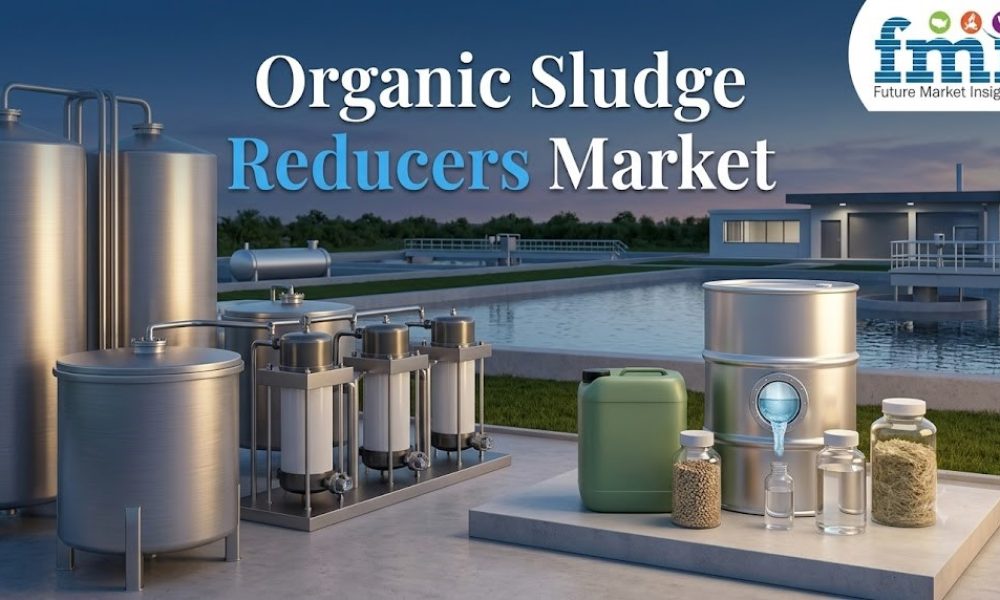
The global Organic Sludge Reducers Market is projected to grow from USD 720.6 million in 2026 to USD 1,327.5 million by 2036, expanding at a 6.3% CAGR during the forecast period, according to Future Market Insights. Demand is being supported by wastewater operators seeking to control accumulated organic solids, preserve treatment capacity and reduce the frequency of dredging, hauling and other sludge-management interventions.
Organic sludge reducers are increasingly evaluated as part of broader solids-management programs, particularly where accumulated sludge reduces useful basin volume or creates additional maintenance pressure. However, repeat purchasing depends on measurable operating outcomes and the ability of biological formulations to perform consistently under site-specific wastewater conditions.
Biological Treatment Gains Relevance in Wastewater Operations
- Bacterial sludge reducers account for 31.0% of the Product Type segment in 2026, making them the leading category. These formulations reinforce microbial processes involved in degrading biodegradable organic matter and can be evaluated in systems where operators already monitor aeration, retention time and solids behavior.
- The market also shows a strong preference for liquid formulations, which hold 41.0% of the Form segment in 2026. Liquid products can be directly dosed into wet treatment systems, reducing preparation requirements and allowing operators to adjust treatment frequency according to operating conditions.
- At the application level, wastewater lagoons represent 27.0% of the market in 2026. Organic bottom solids can reduce effective lagoon capacity and increase maintenance requirements, creating an opportunity for biological treatment programs designed to manage accumulation between physical interventions.
- Municipal wastewater accounts for 31.0% of End Use demand, reflecting the importance of solids management in routine plant operations. Meanwhile, water treatment distributors hold 35.0% of the Sales Channel segment, supported by their ability to combine product supply with dosing guidance, troubleshooting and recurring replenishment.
Get detailed market forecasts, competitive benchmarking, and pricing trends: https://www.futuremarketinsights.com/reports/sample/rep-gb-34850
Site-Specific Performance Remains a Key Adoption Consideration
The economic case for organic sludge reducers is closely linked to whether biological dosing can delay costly physical removal while maintaining treatment performance. Operators therefore need to establish a baseline, define dosing protocols and monitor results before expanding a treatment program.
“Buyers judge organic sludge reduction through operating outcomes. Suppliers need a baseline, dosing protocol and field measurement that show whether treatment can delay hauling or dredging while preserving effluent performance.”
— Anurag Sharma, Principal Consultant, Future Market Insights
Site conditions can materially affect biological performance. Temperature, dissolved oxygen, retention time and influent composition can influence microbial activity, creating a qualification burden for suppliers and buyers. A field-scale study published in Water Environment Research in November 2025 found no significant general performance improvement from continuous bioaugmentation in the tested aerated stabilization basins, reinforcing the importance of plant-specific evaluation.
At the same time, decentralized wastewater sites, aquaculture facilities and other dispersed treatment environments present opportunities for simple dosing formats supported by local technical expertise.
Asia-Pacific Markets Show Strong Growth Potential
Country-level forecasts indicate different growth trajectories across major markets. The Philippines is projected to expand at 7.3% CAGR from 2026 to 2036, followed by Indonesia at 7.0% and Vietnam at 6.7%. Brazil is projected to grow at 6.3%, Mexico at 6.0%, the USA at 5.6% and Japan at 4.8%.
In Vietnam, wastewater infrastructure investment is creating additional treatment capacity. In January 2024, the World Bank approved a USD 310.8 million water environment project in Binh Duong Province to expand wastewater services and improve environmental conditions for about 550,000 residents by 2032.
Indonesia combines wastewater demand with a substantial aquaculture sector. The Ministry of Marine Affairs and Fisheries reported 6.37 million tonnes of farmed fish output in 2024, representing a 13.64% increase from the previous year. Such activity creates additional sites where organic load and bottom solids require management.
Access the Complete Report in PDF Format: https://www.futuremarketinsights.com/reports/brochure/rep-gb-34850
Competitive Landscape Focuses on Biological Products and Treatment Support
The competitive environment includes integrated water-treatment providers and specialist biological suppliers. Notable companies include Ecolab / Nalco Water, Veolia Water Technologies, EnviroZyme / Betco, Microbial Discovery Group, Microbe-Lift, Aquafix, Bionetix International, Organica Biotech, Genesis Water Technologies and Hydrite.
Recent developments highlight continued product and application activity. In January 2026, Microbial Discovery Group introduced Biotifx AN for anaerobic digesters, combining micronutrients with Bacillus bacteria. In February 2026, Bionetix International reported a multi-month BIOBOOSTER SR lagoon trial involving sludge-volume reductions and comparisons with conventional dredging economics. Aquafix also published a Somerset, Kentucky lagoon case study in April 2025 covering five treatments over seven months.
As wastewater operators continue to balance treatment performance with solids-handling costs, demand for organic sludge reducers is expected to remain tied to measurable field performance, appropriate dosing practices and technical support.
Business Impact
FMI helps organizations transform market complexity into strategic clarity, enabling leadership teams to identify growth opportunities faster, optimize resource allocation, strengthen competitive positioning, and make high-stakes business decisions with confidence.
To explore how FMI Custom Research can support your strategic priorities, please connect with our team at – [email protected]
About Future Market Insights (FMI)
Future Market Insights, Inc. (FMI) is an ESOMAR-certified, ISO 9001:2015 market research and consulting organization, trusted by Fortune 500 clients and global enterprises. With operations in the U.S., UK, India, and Dubai, FMI provides data-backed insights and strategic intelligence across 30+ industries and 1200 markets worldwide.



