

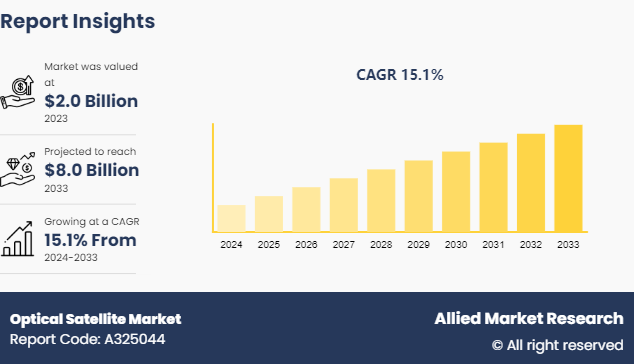
According to the report, the optical satellite market was valued at $2.0 billion in 2023, and is estimated to reach $8.0 billion by 2033, growing at a CAGR of 15.1% from 2024 to 2033.
Continuous advancements in satellite technology, including improvements in sensor resolution, image processing algorithms, and satellite miniaturization, drive market growth by enabling the development of more capable and cost-effective optical satellites. The growing demand for high-resolution satellite imagery for applications such as urban planning, agriculture monitoring, disaster management, and defense surveillance fuels market growth. Optical satellites play a crucial role in providing accurate and timely geospatial information for various industries and government agencies.
Request Sample of the Report on Optical Satellite Market Forecast 2033: https://www.alliedmarketresearch.com/request-sample/A325044
BY size, the large satellite segment is anticipated to experience faster growth in the optical satellite market due to large satellites typically having larger payloads and more advanced imaging systems, allowing them to capture high-resolution imagery with greater detail and clarity. This high-resolution imaging capability is essential for various applications such as urban planning, infrastructure monitoring, agriculture assessment, and defense surveillance, driving demand for large optical satellites.
By operational orbit, the MEO/GEO segment is anticipated to experience growth in the optical satellite market, due to MEO and GEO orbits providing global coverage, allowing them to serve a wide range of applications and customers worldwide. The expansive coverage area ensures that optical satellite data can be collected from virtually any location on Earth, making these orbits attractive for applications such as environmental monitoring, disaster management, and telecommunications.
Procure Complete Report (PDF with In-depth Insights, Charts, Tables, and Figures): https://www.alliedmarketresearch.com/checkout-final/840d757ec97d93e8f07a477ba7d0bb18
By application, the communication segment is anticipated to experience growth in the optical satellite market, due to the widespread demand for broadband internet access, telecommunication networks, and broadcasting services, leveraging the high-bandwidth data transmission capabilities of optical satellites in Medium Earth Orbit (MEO) and Geostationary Earth Orbit (GEO) .
By component, the optical communication system segment is anticipated to experience growth in the optical satellite market, due to its capability to provide high-speed data transmission, secure communication, and reliable connectivity, especially for applications such as broadband internet access, telecommunication networks, and data relay services, leveraging advanced optical technology and high-frequency spectrum allocation.
By end-user, the defense segment is anticipated to experience growth in the optical satellite market, due to the significant demand from defense and intelligence agencies for high-resolution imaging, reconnaissance, surveillance, and intelligence gathering capabilities provided by optical satellites. These satellites play a critical role in national security, military operations, border surveillance, and situational awareness, driving substantial investment and procurement from defense organizations worldwide.
North America to maintain its dominance by 2033.
Region wise, North America is expected to maintain its dominance in the optical satellite market by 2032 owing to the North America, particularly the U.S., is a leader in satellite technology, with a robust ecosystem of aerospace companies, research institutions, and government agencies. The region’s continuous advancements in satellite design, manufacturing, and launch capabilities enable North American companies to develop cutting-edge optical satellites that meet the demands of various industries. The U.S. government, through agencies such as NASA, the Department of Defense (DoD), and the National Reconnaissance Office (NRO), invests heavily in satellite programs and contracts, driving demand for optical satellite systems and services. Government contracts for defense, intelligence, and space exploration missions contribute significantly to the market share of North American companies.
Players in the optical satellite market
Airbus Defense and Space
Ball Aerospace & Technologies Corp.
Thales Alenia Space
Lockheed Martin Corporation
Maxar Technologies Inc.
Boeing Company
Northrop Grumman Corporation
Space Systems/Loral, LLC (SSL)
Mitsubishi Electric Corporation
Israel Aerospace Industries Ltd. (IAI)
The report provides a detailed analysis of these key players in the global optical satellite market. These players have adopted different strategies such as new product launches, collaborations, expansion, joint ventures, agreements, and others to increase their market share and maintain dominant shares in different regions. The report is valuable in highlighting business performance, operating segments, product portfolio, and strategic moves of market players to showcase the competitive scenario.
Recent Industry News
In April 2023, Ball Aerospace, Loft Orbital, and Microsoft have announced their collaboration on the Space Development Agency’s (SDA) NExt-generation (NExT) experimental testbed program, aiming to launch 10 satellites equipped with experimental payloads into orbit.
In March 2023, L3Harris Technologies, Inc. was awarded a contract by Maxar technologies to design and build a reflector antenna for two geostationary communication satellites.
In March 2023, Airbus won a contract from Angola for earth observation satellite Angeo-It is the first high-performance Angolan earth observation satellite, will be manufactured by airbus defense and space in France, thus strengthening the collaboration between the two countries.




