

In the early morning hours of August 8th, Beijing time, OpenAI held an online press conference lasting over an hour, officially launching its new flagship AI model, GPT-5. This model will power the company’s next-generation ChatGPT.
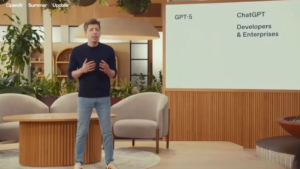
A more powerful GPT-5 model has been unveiled.
GPT-5 is available in four versions: GPT-5, GPT-5-mini, GPT-5-nano, and GPT-5-pro. Free users have a limited GPT-5 usage limit; after exceeding the limit, they will automatically be transferred to GPT-5-mini. GPT-5-pro is only available to Pro subscribers.
OpenAI CEO Sam Altman called GPT-5 a “significant upgrade” from the company’s previous AI models and said, “Talking to it truly feels like talking to an expert in any field.”

While GPT-4 enabled AI chatbots to provide intelligent responses to a wide range of questions, GPT-5 offers enhanced capabilities in coding, creative writing, and complex query reasoning, enabling ChatGPT to complete a variety of tasks on behalf of users, such as generating software applications, managing user schedules, and creating research briefs.
Anticipation for GPT-5 is extremely high, making it one of OpenAI’s most highly anticipated product releases since ChatGPT catapulted the company to fame in 2022. OpenAI claims that GPT-5 achieves state-of-the-art performance in multiple areas, slightly outperforming leading AI models from companies like Anthropic, Google DeepMind, and Elon Musk’s xAI on key benchmarks.
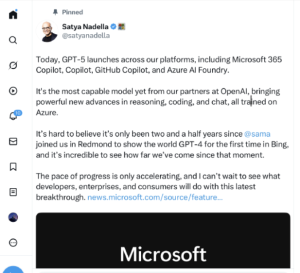
Microsoft Integrates GPT-5 into Enterprise Products
Meanwhile, strategic partner Microsoft (MSFT) immediately integrated OpenAI’s GPT-5 into its Copilot ecosystem, including Microsoft 365 Copilot, GitHub Copilot, Azure AI Foundry, and Copilot Studio, to enhance reasoning and task-specific responses.
Currently, GPT-5 has four versions optimized for logic, multi-step tasks, and multimodal enterprise applications. Developers can leverage GPT-5 through Azure AI Foundry, using its model router to ensure task-specific accuracy in AI-driven applications.
On the other hand, Google’s (GOOG) DeepMind recently released Genie 3, a world model that generates real-time, interactive 3D video streams based on text prompts.
In comparison, Genie 3 represents a significant leap forward, outputting highly realistic graphics at 720p 24fps. The environment remains completely consistent within a minute and “mostly” consistent within several minutes.
Notably, the virtual worlds generated by Genie 3 closely resemble the real world, with doors opening, moving objects displaying realistic dynamic shadows, and water surface disturbances producing special effects such as splashes and ripples.
WiMi Increases Investment in the Large AI Model Market
It’s undeniable that competition in the large AI model market is fierce. Data shows that Wimi Hologram Cloud Inc. (WIMI), an early entrant into the large model AI market, has continuously increased its investment in the field. Its AI technology now covers core areas such as vision, language, speech, knowledge graphs, machine learning, large models, and multimodal understanding and generation. Through the development of technical capabilities, computing power deployment, and ecosystem expansion, WiMi has gradually established a multi-dimensional competitive advantage.
Currently, after multiple expansions, WiMi’s AI team has built a technology system covering multimodal capabilities, including vision processing, natural language understanding, speech recognition, knowledge graph construction, and machine learning algorithm optimization. Furthermore, regarding computing infrastructure development, WiMi is promoting an “AI cloud computing” strategy, focusing on achieving full coverage of low, medium, and high computing power scenarios. By optimizing edge AI chip technology, WiMi is empowering diverse scenarios such as autonomous driving, intelligent interaction, and industrial quality inspection, further expanding its market influence.
End
After two years, OpenAI has finally released its next-generation large model, GPT-5. The previous generation, GPT-4, was released in March 2023. Although OpenAI released GPT-4o (the o stands for full-featured) and GPT-4o mini (a lightweight version) last year, these were still enhanced and simplified versions of GPT-4. Now, Altman has called GPT-5 “the world’s best model” and a “significant step” toward artificial general intelligence (AGI). So, let’s wait and see.




