
The global online grocery market has witnessed remarkable expansion in recent years as consumers increasingly prefer digital platforms for purchasing daily essentials. Online grocery services allow customers to order food, beverages, household supplies, and personal care products through websites or mobile applications with doorstep delivery. Growing internet penetration, rising smartphone usage, and the shift toward convenient shopping experiences are key factors accelerating the adoption of online grocery platforms across both developed and emerging economies.
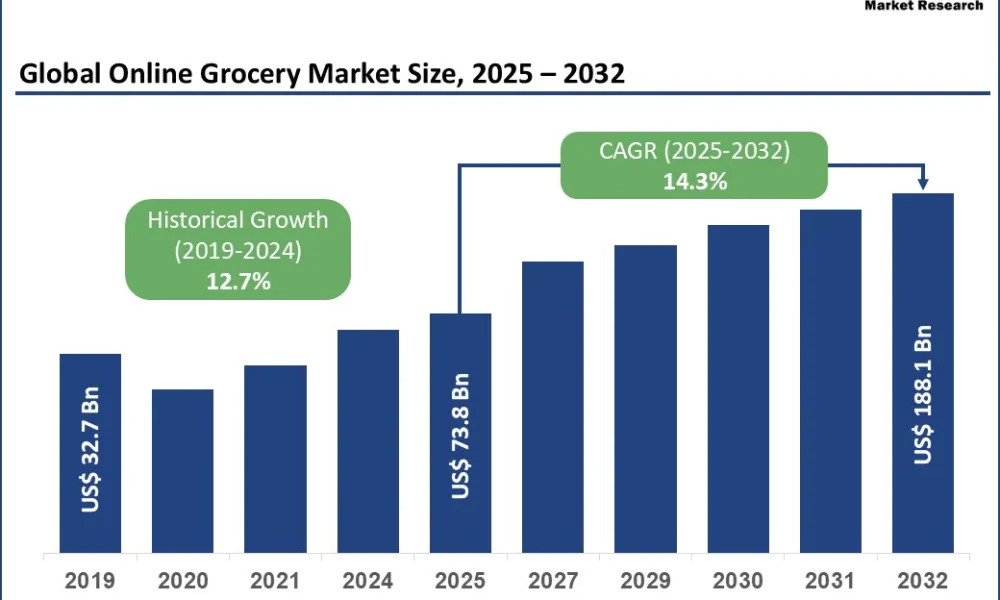
According to Persistence Market Research, the online grocery market size is likely to be valued at US$73.8 Bn in 2025 and is estimated to reach US$188.1 Bn in 2032, growing at a CAGR of 14.3% during the forecast period 2025–2032. The expansion of digital payment systems, quick commerce models, and rapid urbanization are major growth drivers for the industry. Fresh food and packaged grocery items remain the leading product segments due to consistent household demand, while North America currently dominates the market owing to advanced logistics networks, strong e-commerce penetration, and widespread consumer familiarity with online shopping.
Download Your Free Sample & Explore Key Insights : https://www.persistencemarketresearch.com/samples/35609
Key Highlights from the Report
- The online grocery market is projected to expand from US$73.8 Bn in 2025 to US$188.1 Bn by 2032.
➤ Rising consumer preference for contactless shopping and home delivery services is accelerating market growth.
• Increasing smartphone adoption and digital payment infrastructure is strengthening online grocery platforms globally.
➤ Quick commerce models offering same-day or rapid delivery are transforming the grocery retail landscape.
• Growth of subscription-based grocery services and digital loyalty programs is improving customer retention.
➤ Expansion of cold chain logistics and warehouse automation is improving efficiency in online grocery fulfillment.
Market Segmentation
The online grocery market can be segmented based on product type, platform type, and delivery model. Product categories include fresh produce, packaged food, dairy products, beverages, frozen items, and household essentials. Fresh produce and packaged groceries represent the leading segments because they form a large portion of routine household purchases. As consumers increasingly seek convenience, online platforms are expanding their product portfolios to include organic foods, ready-to-cook meals, and specialty dietary items to meet diverse consumer preferences.
From a platform perspective, the market is divided into pure-play online retailers and omnichannel grocery retailers. Pure-play platforms operate exclusively online, while omnichannel retailers combine physical stores with digital ordering and delivery services. Delivery models such as scheduled delivery, express delivery, and click-and-collect services have gained popularity. Express delivery services, particularly in urban regions, are gaining traction as consumers prioritize speed and convenience. The increasing use of AI-based inventory management and demand forecasting is further improving the efficiency of online grocery operations.
Customize This Report for Your Exact Requirements : https://www.persistencemarketresearch.com/request-customization/35609
Regional Insights
North America currently represents a leading region in the online grocery market due to its advanced digital infrastructure and widespread adoption of e-commerce platforms. Consumers in the United States and Canada are increasingly comfortable purchasing fresh and packaged groceries online. The presence of large retail chains with integrated online services, along with strong logistics networks and efficient last-mile delivery systems, has helped accelerate online grocery adoption across the region.
Asia-Pacific is emerging as one of the fastest-growing markets for online grocery services due to rapid urbanization and rising digital connectivity. Countries such as China, India, and Southeast Asian economies are experiencing strong demand for app-based grocery delivery platforms. Increasing smartphone penetration, growing middle-class populations, and expanding quick commerce models are contributing to the growth of online grocery shopping. Retailers in the region are also investing heavily in automated warehouses and hyperlocal delivery networks to support rising demand.
Market Drivers
One of the most significant drivers of the online grocery market is the growing consumer preference for convenience and time-saving shopping solutions. Modern lifestyles have become increasingly busy, leaving consumers with limited time for traditional grocery shopping. Online grocery platforms allow customers to browse products, compare prices, and place orders within minutes, making the process far more efficient. This convenience has made online grocery shopping particularly appealing for working professionals and urban households.
Another major driver is the rapid advancement of digital infrastructure and e-commerce technologies. The widespread availability of smartphones, improved internet connectivity, and secure digital payment systems have enabled consumers to confidently make online purchases. Additionally, retailers are investing in warehouse automation, AI-based supply chain management, and data analytics to enhance inventory accuracy and improve delivery efficiency. These technological developments are significantly strengthening the operational capabilities of online grocery platforms.
Market Restraints
Despite strong growth potential, the online grocery market faces several operational challenges. One key restraint is the complexity of last-mile delivery and logistics management. Delivering perishable items such as fruits, vegetables, dairy products, and frozen foods requires advanced cold chain systems and careful handling. Maintaining product freshness during transportation can increase operational costs and create logistical challenges for online retailers.
Another important limitation is consumer concerns related to product quality and substitution issues. Some customers hesitate to buy groceries online because they prefer personally selecting fresh produce and perishable items. Instances where ordered items are replaced with alternatives due to stock shortages can also affect customer satisfaction. To address these concerns, companies are investing in improved inventory systems, better packaging technologies, and customer-friendly return policies.
Market Opportunities
The rapid growth of quick commerce and hyperlocal delivery models presents a significant opportunity for the online grocery market. Companies are increasingly offering ultra-fast delivery services that deliver groceries within minutes or hours of placing an order. This model is particularly popular in densely populated urban areas where consumers prioritize convenience and speed. Expanding micro-fulfillment centers and dark stores can further enhance delivery efficiency and reduce order processing times.
Another major opportunity lies in personalized shopping experiences powered by data analytics and artificial intelligence. Online grocery platforms can analyze consumer purchasing patterns to recommend products, offer customized promotions, and optimize pricing strategies. Additionally, subscription-based grocery services and bundled product offerings are gaining popularity as they simplify the shopping experience and encourage long-term customer loyalty.
Checkout Now & Download Complete Market Report : https://www.persistencemarketresearch.com/checkout/35609
Company Insights
Key players operating in the online grocery market include:
Walmart Inc.
Amazon.com Inc.
Tesco PLC
Alibaba Group Holding Limited
Kroger Co.
Carrefour S.A.
Instacart
JD.com Inc.
Target Corporation
Ocado Group
Recent Developments
January 2024 – Walmart expanded its online grocery delivery services and enhanced automated fulfillment centers to improve delivery efficiency.
September 2023 – Amazon strengthened its grocery delivery network by expanding rapid delivery services in major metropolitan markets.
Future Opportunities and Growth Prospects
The future of the online grocery market looks highly promising as consumers increasingly embrace digital shopping platforms for daily essentials. Rapid developments in logistics technology, automated warehouses, and data-driven supply chain systems will continue to enhance the efficiency and scalability of online grocery operations. Retailers are also focusing on expanding product offerings, including organic foods, premium products, and ready-to-cook meal kits to cater to evolving consumer preferences.
In addition, growing investments in quick commerce infrastructure and hyperlocal fulfillment centers will further accelerate delivery speed and customer satisfaction. As internet connectivity expands and digital payment adoption continues to rise across emerging markets, online grocery platforms are expected to attract a broader consumer base. These developments will play a crucial role in shaping the long-term growth trajectory of the global online grocery market.




