
The global Offshore Repurposing & Repower Wind Upgrades Market is poised for significant expansion through 2036 as operators, utilities, asset owners, and governments accelerate efforts to extend the life, enhance performance, and improve economic returns of existing offshore wind farms. With a growing share of offshore wind assets approaching mid-life, repurposing and repowering strategies are emerging as cost-effective alternatives to decommissioning, enabling the reuse of foundations, electrical systems, and support infrastructure while integrating higher-capacity turbines, advanced control systems, and improved aerodynamic technologies.
Repowering and repurposing upgrades — including turbine replacements, blade retrofits, advanced pitch and yaw systems, foundation reinforcement, and electrical system enhancements — support higher energy yield, reduced maintenance costs, and improved grid performance. These initiatives align with broader renewable energy goals, lifecycle optimization strategies, and net-zero commitments by utilities and national energy planners, driving demand for specialized engineering services, high-performance components, and integrated project execution capabilities.
Market Outlook (2026–2036)
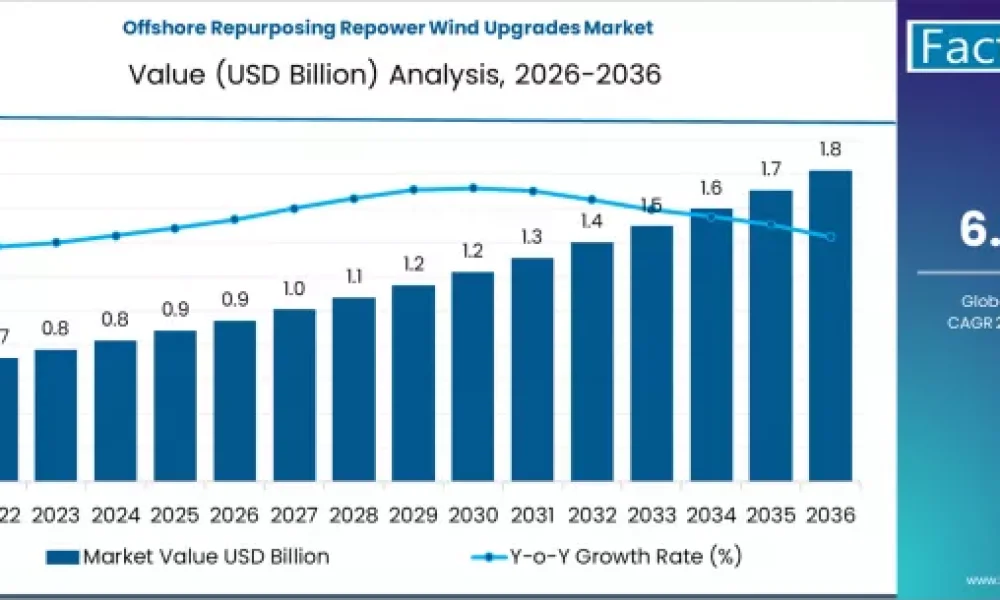
Market Value in 2026: Estimated at USD 3.1 Billion
Market Value in 2036: Projected at USD 11.2 Billion
Forecast CAGR (2026–2036): Approximately 14.5%
Leading Upgrade Segment: Turbine Repower with Higher-Rated Generators
Dominant Service Type: Engineering, Procurement, and Construction (EPC) for Refurbishment Projects
Primary Drivers: Aging wind assets, performance optimization mandates, sustainability targets
The market is expected to grow robustly as operators prioritize maximizing energy capture, reducing levelized cost of energy (LCOE), and complying with evolving regulatory and environmental frameworks.
To Access the Complete Data Tables & in-depth Insights, Request a Discount on this report: https://www.factmr.com/connectus/sample?flag=S&rep_id=13374
Market Overview
Offshore wind repurposing and repowering involve strategically updating or converting older wind farm assets to leverage modern technology and extend operational life. As the first generation of large-scale offshore wind farms enters maturity, many installations built with earlier turbine models are now less competitive in terms of capacity, reliability, and energy efficiency compared with state-of-the-art systems. Repowering typically entails replacing older turbines with newer, larger rotors and more efficient drivetrains, while repurposing may involve upgrading control systems, reinforcing structural components, or adapting foundations to support next-generation turbines.
These activities not only improve performance but also defer or avoid full decommissioning costs, reduce waste, and support circular economy objectives. Upgraded infrastructure can harness advances in materials science, predictive maintenance technologies, and digital twin modeling to optimize performance and reduce unplanned downtime — critical in harsh offshore environments where maintenance windows are limited and mobilization costs are high.
Key Market Drivers
1. Aging Offshore Wind Installations and Life Extension Needs
A significant share of existing offshore wind farms were commissioned in the early 2010s. As these assets approach their design life, repowering and repurposing options become financially attractive compared with full removal and replacement. Extending asset life through modernization supports stable energy supplies without the lead times associated with greenfield projects.
2. Technological Advancements and Higher Capacity Turbines
Modern offshore turbines have significantly larger rotor diameters, higher hub heights, and more efficient power conversion systems than earlier models. Repowering with these advanced units can substantially increase annual energy production and improve project economics. Integration of digital monitoring, predictive analytics, and advanced control systems further enhances reliability and output.
3. Regulatory and Policy Support for Renewable Energy Targets
National and regional renewable energy policies, carbon reduction mandates, and grid decarbonization commitments are driving reinvestment into existing offshore infrastructure. Repowering aligns with sustainability goals, enabling continued utilization of sites and grid interconnections that have already achieved permitting and environmental approvals.
4. Cost Efficiency and Levelized Cost of Energy (LCOE) Improvements
By repurposing existing site infrastructure, developers reduce expenditures associated with new site development, permitting, and seabed preparation. Upgrading turbines and electrical systems can lower LCOE by increasing production per installed megawatt and reducing maintenance and downtime costs.
Market Segmentation Insights
By Upgrade Type:
Turbine Replacement and Repower
Blade and Rotor System Upgrades
Power Electronics and Generator Enhancements
Structural Reinforcement and Foundation Upgrades
Digital Control and Monitoring Systems
By Service Type:
Assessment and Feasibility Studies
Engineering, Procurement, and Construction (EPC)
Installation, Commissioning, and Integration
Maintenance and Lifecycle Support
Decommissioning and Asset Transition Advisory
By Component:
High-Capacity Turbine Units
Advanced Gearboxes and Generators
Power Conversion and Grid Interface Systems
Blade Retrofit Kits
Sensor Networks and Predictive Maintenance Platforms
By End User:
Utility-Owned Offshore Wind Fleets
Independent Power Producers (IPPs)
Offshore Wind Service Providers
Government and Public Sector Renewable Agencies
Regional Demand Dynamics
Europe is expected to remain a leading market due to its early adoption of offshore wind, large installed base of aging assets, and strong policy support for renewable energy expansions. Countries with significant wind footprints — including the United Kingdom, Germany, the Netherlands, Denmark, and Belgium — are investing in repowering initiatives to maintain generation capacity and achieve ambitious climate targets.
Asia Pacific is projected to witness rapid growth as offshore wind deployment accelerates in China, Taiwan, South Korea, and Japan. As early projects in the region mature, demand for repowering and extension services will increase. Governments in the region are also prioritizing technological upgrading to support energy security and local manufacturing content.
North America is emerging as a dynamic market as offshore wind gains policy support and new capacity comes online. The United States and Canada are exploring repowering strategies for early pilot projects and integrating modernization plans into long-term offshore wind roadmaps.
Emerging markets in Latin America and Middle East & Africa are beginning to explore offshore wind opportunities, with repowering considerations likely to follow as project stock grows.
Competitive Landscape
The offshore repurposing and repower wind upgrades market is moderately competitive, featuring participation from turbine OEMs, offshore engineering firms, specialized retrofit service providers, and integrated energy solution companies. Key market players are focusing on expanding service portfolios to include digital assessments, predictive maintenance, and turnkey upgrade packages that minimize downtime and maximize energy yield.
Collaboration with original equipment manufacturers, strategic alliances with installation contractors, and investments in specialized vessel charters and offshore logistics capabilities are important differentiators. Companies are also investing in modular upgrade technologies and standardized retrofit systems that simplify integration and reduce project risk.
Future Outlook
The Offshore Repurposing & Repower Wind Upgrades Market is expected to sustain strong growth through 2036 as renewable energy capacities expand and asset modernization becomes a strategic priority. Continued technological innovation, supportive policy frameworks, and evolving financing mechanisms are enabling developers to extract greater value from existing wind infrastructure while meeting ambitious sustainability and decarbonization targets.
As offshore wind generations evolve and older fleets approach life cycle milestones, repurposing and repowering will become central strategies for maximizing energy output, improving economic returns, and preserving the environmental benefits of offshore renewable installations worldwide.
Have specific requirements or need assistance on report pricing or have a limited budget? Please contact [email protected]
About Fact.MR:
Fact.MR is a global market research and consulting firm, trusted by Fortune 500 companies and emerging businesses for reliable insights and strategic intelligence. With a presence across the U.S., UK, India, and Dubai, we deliver data-driven research and tailored consulting solutions across 30+ industries and 1,000+ markets. Backed by deep expertise and advanced analytics, Fact.MR helps organizations uncover opportunities, reduce risks, and make informed decisions for sustainable growth



