
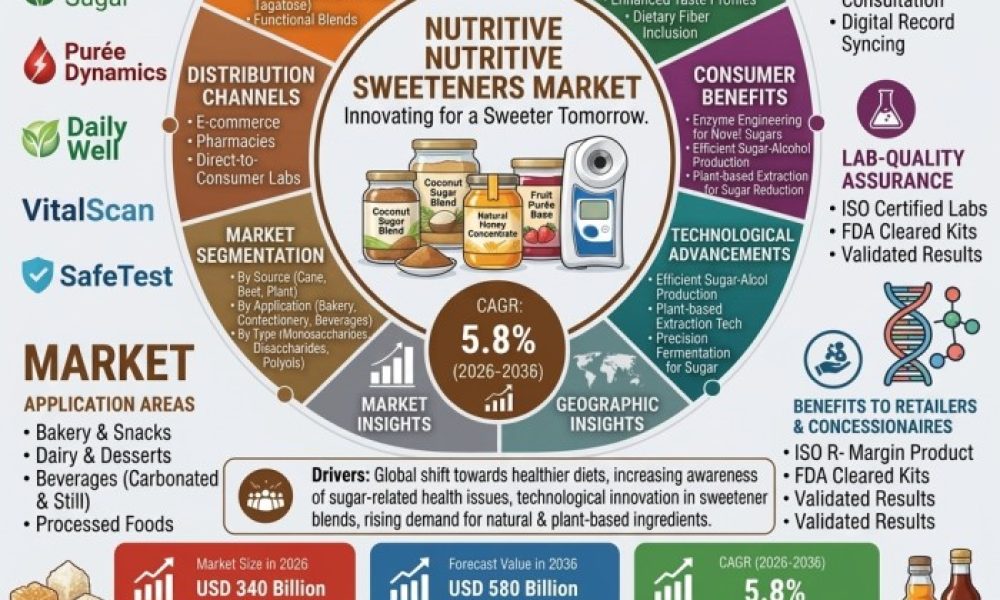
Rockville, Maryland — September 25, 2026 — The global nutritive sweeteners market is estimated at USD 2.7 billion in 2026 and is forecast to reach USD 5.1 billion by 2036, expanding at a CAGR of 6.6% from 2026 to 2036, according to Fact.MR. The market is supported by continued use of caloric sweeteners across food manufacturing, beverages, bakery, confectionery and other processed-food applications.
Get detailed market forecasts, competitive benchmarking, and pricing trends:
Industrial Food Processing Sustains Sweetener Demand
Food manufacturers continue to require sweeteners that provide predictable sweetness, body, texture and processing performance without requiring major recipe changes. Beverage producers also continue using syrup formats where existing wet-handling and dosing systems can accommodate liquid sweeteners. In bakery and confectionery production, sucrose remains important because it contributes not only sweetness but also browning, texture and crystal behavior.
The market is expected to create an absolute opportunity of USD 2.4 billion between 2026 and 2036. Direct industrial procurement is another important factor, as large food manufacturers increasingly purchase against defined specifications, delivery schedules and commercial terms. The report identifies application-specific liquid systems, syrup blend optimization and industrial supply agreements as areas offering additional opportunities for suppliers.
Sucrose Sweeteners Maintain Market Leadership
Sucrose sweeteners are projected to account for 68.40% of the market in 2026, making them the leading product category. Refined cane and beet sugar remain widely used as bulk ingredients in processed foods, bakery products and confectionery. Cane sugar provides established taste and color characteristics, while beet sugar remains an important supply source for European processors.
By application, bakery and confectionery is expected to hold a 37.80% share in 2026. The segment benefits from the functional contribution of sugar to browning and crystal control in baked and confectionery products. Food manufacturers lead by end use with a 74.10% share, reflecting substantial procurement volumes across packaged foods, beverages, bakery and confectionery.
Crystallization technology is estimated to represent 52.60% of the market in 2026, as refined sugar quality depends on characteristics including crystal uniformity, color and purity. Meanwhile, liquid sweetener systems are forecast to capture 45.30% of the formulation segment, supported by their compatibility with beverage lines and wet-mix processing. Direct industrial sales are expected to account for 63.70% of distribution, reflecting the importance of supply agreements for large-volume buyers.
Germany Leads Country Growth
Germany is projected to register a 5.2% CAGR through 2036, the highest among the countries covered in the report. Its growth is associated with industrial food processing and EU beet-sugar availability. The report also notes that German processors purchase sweeteners against tight specifications, with domestic wholesale price developments influencing procurement conditions.
Brazil is expected to expand at a 4.7% CAGR, supported by its substantial sugarcane processing base and established refining capabilities. Beverage, bakery and packaged-food manufacturers contribute to demand, while weather conditions and cane allocation can influence supply and pricing.
The UK market is forecast to grow at a 3.8% CAGR through 2036. Beet production, refined sugar imports and beverage formulation requirements shape demand. The report notes that the UK’s Soft Drinks Industry Levy threshold is scheduled to fall from 5 grams to 4.5 grams of sugar per 100 millilitres in January 2028, creating an additional formulation consideration for beverage producers.
Competitive Landscape
Key companies profiled in the nutritive sweeteners market include Cargill Inc., Archer Daniels Midland Company, Tereos SA, COFCO International, Wilmar International Limited, Tate & Lyle, Showa Sangyo Co. Ltd., Bannari Amman Sugars Limited and Bajaj Hindusthan Sugar Limited. These companies participate across sugar, syrup, starch-based and other nutritive sweetener supply chains.
In May 2026, Archer Daniels Midland announced a multimillion-dollar upgrade at its Clinton, Iowa corn-processing facility, including infrastructure supporting corn sweetener and starch production. Such investments illustrate continued attention to processing capacity and supply infrastructure within the broader sweetener industry.
As food and beverage manufacturers continue balancing sweetness, processing performance, procurement reliability and formulation requirements, suppliers have opportunities to strengthen direct industrial relationships and develop application-specific liquid and syrup systems. The full Fact.MR report provides detailed market segmentation, country analysis, competitive intelligence and forecasts for the nutritive sweeteners market through 2036.
Explore More Related Studies Published by Fact.MR Research:
Apricot Juice Concentrate Market
About Fact.MR
Fact.MR is a global market research and consulting firm, trusted by Fortune 500 companies and emerging businesses for reliable insights and strategic intelligence. With a presence across the U.S., UK, India, and Dubai, we deliver data-driven research and tailored consulting solutions across 30+ industries and 1,000+ markets. Backed by deep expertise and advanced analytics, Fact.MR helps organizations uncover opportunities, reduce risks, and make informed decisions for sustainable growth.
– Contact Us –
11140 Rockville Pike, Suite 400, Rockville,
MD 20852, United States
Tel: +1 (628) 251-1583 | [email protected]



