
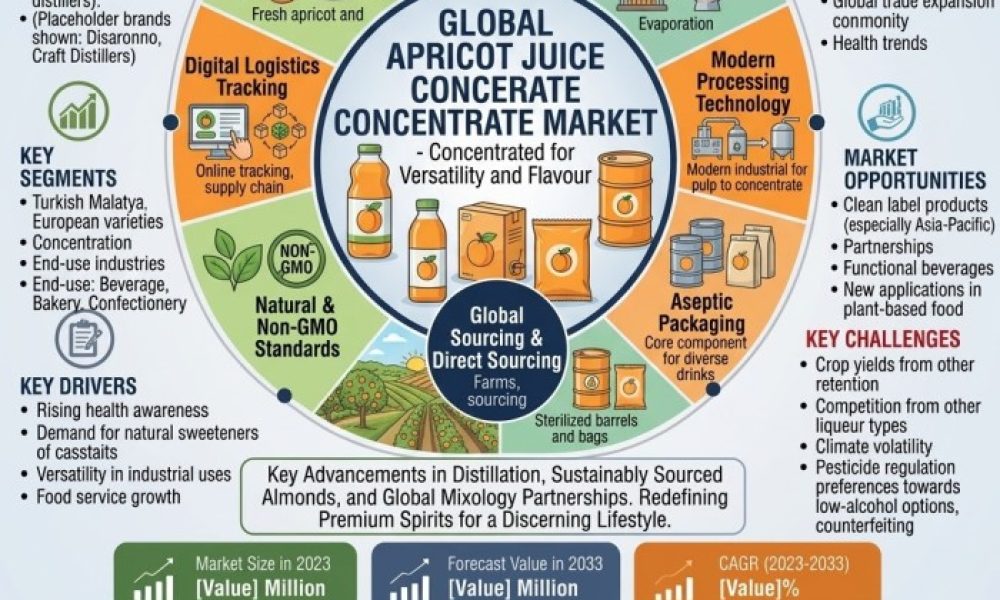
Brix 30° accounts for 42.5% of the 2026 market, while wine and beverage applications hold a 30.0% share
ROCKVILLE, Md. — September 22, 2026 — The global apricot juice concentrate market is projected to grow from USD 329.1 million in 2026 to USD 546.6 million by 2036, expanding at a 4.1% CAGR, according to a new report by Fact.MR. The market was valued at USD 316.1 million in 2025, with an estimated absolute opportunity of USD 217.6 million expected between 2026 and 2036.
Apricot juice concentrate is used as a fruit-based input in food and beverage formulations where manufacturers need controlled concentration, flavor consistency, and easier storage compared with fresh fruit material. Demand is being supported by beverage applications, processed food production, and wider distribution through foodservice and retail channels.
Get detailed market forecasts, competitive benchmarking, and pricing trends:
Brix 30° Leads the Product-Type Segment
Brix 30° is projected to account for 42.5% of the apricot juice concentrate market in 2026, making it the leading product type.
The concentration level provides a practical balance between processing requirements and formulation flexibility. Beverage and food manufacturers can use Brix 30° concentrate across recipes without making extensive process adjustments.
Brix 65° represents another important format, particularly for applications where higher concentration can improve shipping and storage efficiency. Other concentrate formats serve more specialized formulation requirements.
Wine and Beverage Applications Generate the Largest Demand
Wine and Beverages are projected to hold 30.0% market share in 2026, making this the leading application segment.
Liquid formulations provide a recurring use case for apricot concentrate because manufacturers can use the ingredient as a source of fruit flavor and sweetness. Beverage producers also evaluate color, sensory performance, Brix level, and consistency before approving a concentrate for repeat production.
Condiments, baked goods, spices, and other food applications provide additional avenues for market expansion. Suppliers that provide application guidance can help formulators determine the appropriate concentration and processing conditions for individual recipes.
What Is Driving Demand for Apricot Juice Concentrate?
The market is benefiting from growing use of concentrate formats that help food and beverage manufacturers manage flavor, storage, and recipe control.
Consistent sourcing and processing are becoming important purchasing considerations. Buyers increasingly evaluate product specifications and sensory characteristics across production lots before establishing recurring supply relationships.
Retail and online access is another development supporting market reach. Smaller buyers can access concentrate products through channels beyond traditional large industrial procurement arrangements, creating opportunities for suppliers with flexible packaging and order formats.
Supply and Specification Challenges Remain
Input price fluctuations and apricot availability can affect quotation stability for buyers requiring regular shipments. Seasonal supply conditions and processing costs may therefore influence purchasing decisions.
Regulatory and labeling differences across markets can also lengthen supplier-approval processes. Exporters may need market-specific documentation before their products can be introduced into new customer accounts.
Specification mismatch presents another challenge. Food manufacturers may continue using established ingredients unless an alternative concentrate demonstrates comparable flavor, color, processing behavior, and consistency.
Fact.MR identifies application guidance, smaller online pack routes, condiment and baked-goods use, and premium natural-positioned recipes as areas offering additional market opportunities.
UK Records the Highest Country Growth Rate
The UK is projected to register a 7.0% CAGR from 2026 to 2036, the highest among the countries profiled in the Fact.MR assessment.
Australia follows at 6.4%, while Canada is forecast to grow at 5.6%. The USA is projected to expand at 5.2%, followed by Germany at 4.2% during the forecast period.
In the UK, beverage formulation and channel readiness support demand for processed fruit ingredients. Australia’s market is shaped by beverage and packaged-food applications, while Canada’s growth reflects diversified food and beverage use.
The USA benefits from broad foodservice and food-processing applications. Germany represents a more mature market where supplier qualification, product documentation, and consistent quality remain important purchasing considerations.
What Does the Fact.MR Analyst Say?
Shambhu Nath Jha, Principal Consultant at Fact.MR, states:
“Apricot juice concentrate demand is expected to develop around product fit. Buyers are likely to compare Brix level and flavor behavior before they approve a supplier. Suppliers gain preference when they explain which concentrate format works best and keep product quality predictable across production lots.”
Competitive Landscape
The competitive landscape includes Coloma Frozen Foods, Lemon Concentrate, Muhtaroğlu Holding A.Ş., Solufruit, and Tunay Gida.
Competition is shaped by apricot sourcing, Brix accuracy, sensory consistency, processing capabilities, packaging reliability, and shipment performance. Suppliers serving industrial food and beverage manufacturers can differentiate through application-specific guidance and consistent product specifications.
Report Scope
The Fact.MR Apricot Juice Concentrate Market report analyzes the market by type, application, and region.
Type coverage includes Brix 30°, Brix 65°, and Others. Application categories include Wine and Beverages, Condiment, Baked Goods, Spices, and Others.
The geographic assessment covers North America, Latin America, Europe, East Asia, South Asia and Oceania, and the Middle East and Africa, with country-level analysis covering the UK, Australia, Canada, USA, and Germany.
The forecast period extends from 2026 to 2036. The research incorporates more than 120 sources, 35+ company portfolios, 25+ countries, and more than 20 industry interviews, according to Fact.MR.
Explore More Related Studies Published by Fact.MR Research:
Upcycled Carob Prebiotics Market
About Fact.MR
Fact.MR is a market research and consulting firm providing market intelligence, industry analysis, market sizing, competitive assessments, and strategic insights across multiple industries. Its research supports businesses in evaluating demand patterns, emerging opportunities, market structures, and competitive environments.
Media Contact
Fact.MR
11140 Rockville Pike, Suite 400
Rockville, MD 20852, United States
Phone: +1 (628) 251-1583
Email: [email protected]



