
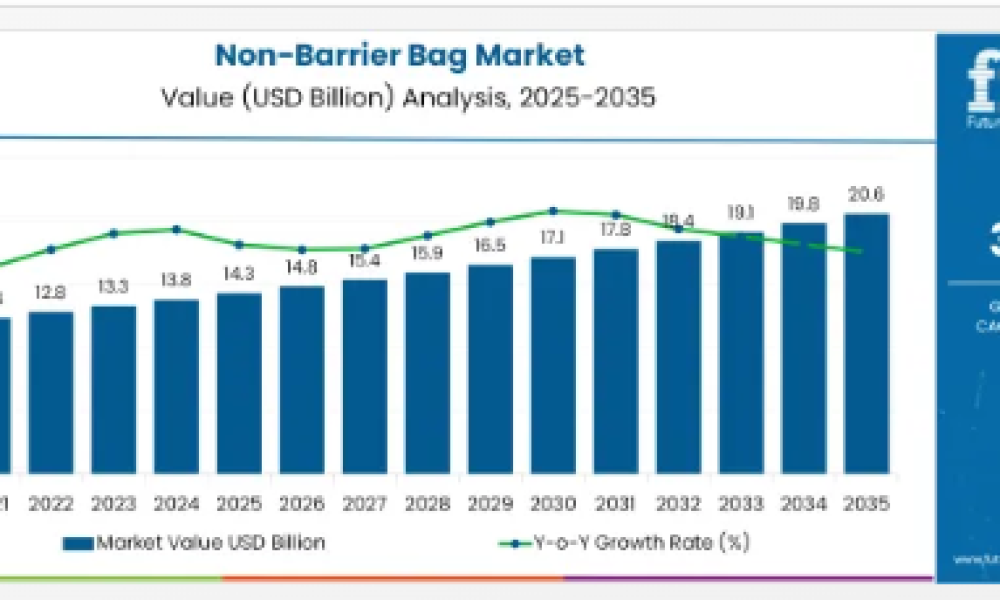
The global non-barrier bag market is on a steady upward trajectory, projected to grow from US$ 14.3 billion in 2025 to US$ 20.6 billion by 2035, representing a compound annual growth rate (CAGR) of 3.7% over the forecast period. This growth, as revealed in a new industry analysis, underscores how cost-effective, flexible, and recyclable packaging is rapidly scaling to meet the demands of sustainability-conscious manufacturers and consumers alike.
Key Market Insights at a Glance
Non-barrier bags—packaging formats that do not rely on specialized barrier layers for oxygen or moisture protection—are gaining prominence as the preferred solution for sectors with shorter shelf-life products. Their appeal lies in a balanced offering: lower production cost, mechanical strength, and ease of customization. Demand is being driven especially by foodservice, retail, and industrial players who prioritize recyclability and minimized environmental footprint over high-barrier protection.
Segment Overview
Analyzing by material type, polyethylene (PE) remains king, capturing 44% of the market share in 2025. PE’s dominance is rooted in its versatility, processability, and excellent cost-performance ratio; low-density and linear low-density PE variants enable high-speed production, reliable sealing, and efficient recycling. On the application side, food & beverages lead with nearly 48% of revenue share, as manufacturers lean toward lightweight, printed, portion-size, or takeaway packaging where barrier protection isn’t mission critical.
Regional Overview
Geographically, North America, Europe, and Asia-Pacific emerge as major hubs of growth. In North America, innovation-driven manufacturers and strong recycling infrastructure are propelling adoption. Europe’s market is bolstered by sustainability mandates, while Asia-Pacific benefits from rising urbanization, expanding retail networks, and increasing demand for flexible packaging in emerging economies.
Competitive Landscape
The competitive terrain is moderately consolidated. Tier-1 players such as Berry Global, Mondi Group, and Amcor Plc command significant share, leveraging global scale, R&D strength, and robust distribution networks. Tier-2 companies like Sealed Air, Coveris, and Huhtamaki cater to regional markets with flexible, high-recycled content, and branded bag options. Meanwhile, agile region-specific firms (Tier-3) account for a considerable portion of the market by tailoring solutions to local needs and sustainability trends.
Major players operating in this space include Bemis Company, Winpak Ltd., Kureha Corporation, Coveris Holdings, Schur Flexibles, Sealed Air Corporation, Flavorseal LLC, Flexopack S.A., Globus Group, BUERGOFOL GmbH, Allfo Vakuumverpackungen, among others. These companies are responding to market dynamics by ramping up investments in recyclable film technologies, mono-material bag structures, and advanced printing capabilities.
Market Outlook: Powering the Next Decade
Looking ahead, the non-barrier bag market is poised to benefit from the rising global emphasis on circular economy principles. As regulators tighten plastic waste rules and brands commit to plastic reduction targets, mono-material and recyclable non-barrier bags will become the go-to format. Concurrently, advances in resin formulation and extrusion will enhance strength, clarity, and printability—making these bags even more attractive for branding, retail, and take-away food applications.
The steady 3.7% CAGR suggests not a speculative bubble, but rather a sustainable growth trajectory driven by real-world demand. Beyond 2030, the market is expected to further diversify as companies explore compostable variants, lighter-weight films, and customized structures for e-commerce, personal care, and industrial use.
Recent Strategic Developments
In recent years, leading firms have accelerated innovation: large manufacturers are launching high-recycled content non-barrier bags, while others are introducing compostable fiber-based formats to meet ambitious sustainability goals. Partnerships and capacity expansions are underway, with the supply chain shifting toward mono-material recyclable solutions that comply with global circular economy best practices.
Key Players of the Sustainable Packaging Movement
At the heart of this transition are the market’s innovators. Berry Global is scaling up its eco-friendly, recycled-content bag lines. Mondi Group is pushing compostable and fiber-based offerings. Amcor continues to enhance its flexible packaging solutions for e-commerce and takeaway, focusing on durability and minimal energy use in production. Sealed Air and Coveris are also pioneering water-resistant and reusable designs—all contributing to a more sustainable packaging ecosystem.
Subscribe for Year-Round Insights → Stay ahead with quarterly and annual data updates: https://www.futuremarketinsights.com/reports/sample/rep-gb-13488
Have a specific Requirements and Need Assistant on Report Pricing or Limited Budget please contact us – [email protected]
About Future Market Insights (FMI)
Future Market Insights, Inc. (ESOMAR certified, recipient of the Stevie Award, and a member of the Greater New York Chamber of Commerce) offers profound insights into the driving factors that are boosting demand in the market. With a vast team of over 400 analysts worldwide, FMI provides global, regional, and local expertise on diverse domains and industry trends across more than 110 countries.



