
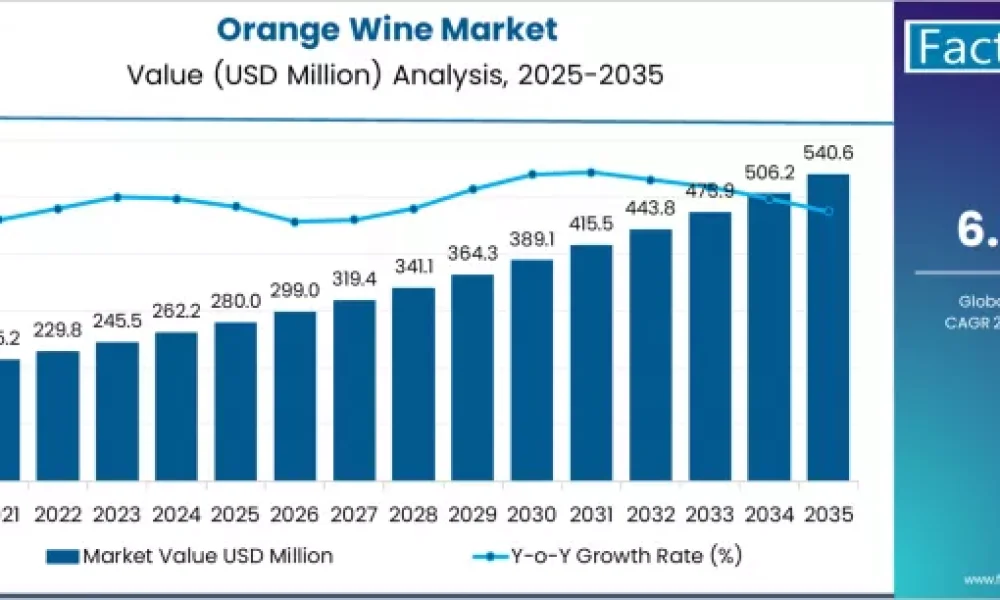
The global orange wine market is projected to grow significantly over the next decade, with its value expected to rise from USD 650 million in 2025 to approximately USD 1,058.8 million by 2035, representing a compound annual growth rate (CAGR) of about 5.0%. This surge is being driven by growing consumer interest in artisanal, heritage-style winemaking, as well as the increasing popularity of natural and skin-contact wines among millennial and Gen Z drinkers.
Orange wine—made by fermenting white grapes in contact with their skins—delivers a rich amber hue, complex flavor profile, and a sense of authenticity that resonates with modern wine enthusiasts. Its emergence as a popular segment reflects a broader trend toward sustainable production, minimal intervention techniques, and premiumization in the wine industry.
Key Market Insights at a Glance
2025 Market Value: USD 650 million
2035 Forecast Value: USD 1,058.8 million
CAGR (2025–2035): ~5.0%
Leading Type: Still Orange Wine (~65% share)
Top Grape Variety: Pinot Gris / Pinot Grigio (~40%)
High-Growth Regions: United States, China, Japan
Prominent Brands: Domaine Lucci, Radikon, Gravner, Vodopivec, La Stoppa
To access the complete data tables and in-depth insights, request a Discount On The Report here: https://www.factmr.com/connectus/sample?flag=S&rep_id=3675
Five Key Drivers Fueling Market Growth
Rising Affinity for Unique and Natural Wines
Consumers are increasingly drawn to wines with character and craftsmanship. Orange wine, with its skin-contact fermentation and ancient winemaking roots, offers a distinct alternative to traditional white, red, or rosé wines.Sustainability and Minimal Intervention Trends
Many orange wines are produced using organic or biodynamic grapes, native yeasts, and little to no sulfur. This aligns with the values of environmentally conscious consumers who prioritize clean-label and artisanal products.Premiumization and Experiential Consumption
Wine drinkers today are looking for more than just a beverage—they seek stories, lineage, and heritage. Boutique wineries, fine-dining restaurants, and wine bars are increasingly promoting orange wine for its depth, complexity, and visual appeal.Gastronomy and Food Pairing Appeal
With its fuller body, texture, and tannic structure, orange wine pairs excellently with a variety of dishes—from rich seafood and Asian cuisine to cheese boards and charcuterie—making it a favorite in restaurants and culinary settings.Digital Retail and Direct-to-Consumer Access
Online wine platforms, wine clubs, and digital wine communities are helping small-scale orange wine producers reach consumers globally. This has widened the market reach and introduced new demographics to this wine category.
Regional Outlook
United States: A fast-emerging market driven by lifestyle trends, social media exposure, and the presence of natural wine bars. Younger, adventurous consumers in urban areas are particularly receptive to orange wine.
China: Rapid growth is being seen as wine culture evolves, and more consumers seek unique, premium, and natural wine styles.
Japan: Demand is growing for artisanal wines and quality craftsmanship, with a strong emphasis on tradition, flavor complexity, and cultural authenticity.
Europe: Traditional wine-producing regions like Georgia, Italy, and Slovenia continue to lead in production, while specialty wine shops and sommeliers are promoting orange wine to discerning drinkers.
Market Segmentation Highlights
By Type
Still Orange Wine: The dominant style, accounting for around 65% of the market.
Sparkling / Other Styles: Emerging, but still niche.
By Grape Variety
Pinot Gris / Pinot Grigio: Most common, making up ~40% of production.
Other Varieties: Include indigenous and experimental grapes used in natural winemaking.
By Production Method
Skin-contact fermentation: Traditional method giving amber color and richness.
Natural / Biodynamic: Minimal intervention methods gaining popularity.
Challenges & Restraints
Limited Consumer Awareness: Many wine drinkers still do not understand what orange wine is, and education is needed to drive broader adoption.
Production Complexity: Skin-contact fermentation requires more careful handling, aging, and quality control, which can raise production costs.
Distribution Constraints: Boutique wineries may face challenges scaling their reach, especially in markets that lack mature natural-wine distribution infrastructure.
Recent Trends & Developments
Wineries are increasingly adopting organic and biodynamic farming to produce authentic orange wines.
Wine bars and restaurants are integrating orange wine into their premium menus, boosting visibility.
Direct-to-consumer channels and wine clubs are emerging as key distribution paths, helping smaller producers scale.
Winemakers are experimenting with native yeast fermentation, extended maceration, and aging to create complex, artisan-focused orange wines.
Competitive Landscape
The orange wine market is characterized by a blend of small, artisanal producers and niche, upscale wineries. Key players are focusing on:
Limited-batch production of skin-contact wines
Certification and transparency in natural, organic, or biodynamic practices
Storytelling and heritage branding to connect with consumers
Building partnerships with wine bars, specialty retailers, and online platforms
Educating consumers about the winemaking process to drive trial and loyalty
Market Outlook & Strategic Insights
Looking ahead to 2035, the orange wine market is poised for sustained growth as consumers continue to embrace uniqueness, heritage, and natural production methods. Producers that emphasize quality, authenticity, and sustainability will be best positioned to benefit from rising demand.
To succeed, stakeholders should focus on:
Educating consumers through storytelling, tasting events, and digital content
Strengthening distribution via e-commerce, wine clubs, and boutique channels
Scaling sustainable production without compromising artisanal values
Innovating with grape varieties, fermentation techniques, and aging practices to deepen the flavor profile
Orange wine is no longer a niche curiosity—it is establishing itself as a vibrant, premium segment within the global wine market.
Have specific requirements or need assistance on report pricing or have a limited budget? Please contact [email protected]
About Fact.MR:
Fact.MR is a global market research and consulting firm, trusted by Fortune 500 companies and emerging businesses for reliable insights and strategic intelligence. With a presence across the U.S., UK, India, and Dubai, we deliver data-driven research and tailored consulting solutions across 30+ industries and 1,000+ markets. Backed by deep expertise and advanced analytics, Fact.MR helps organizations uncover opportunities, reduce risks, and make informed decisions for sustainable growth.



