
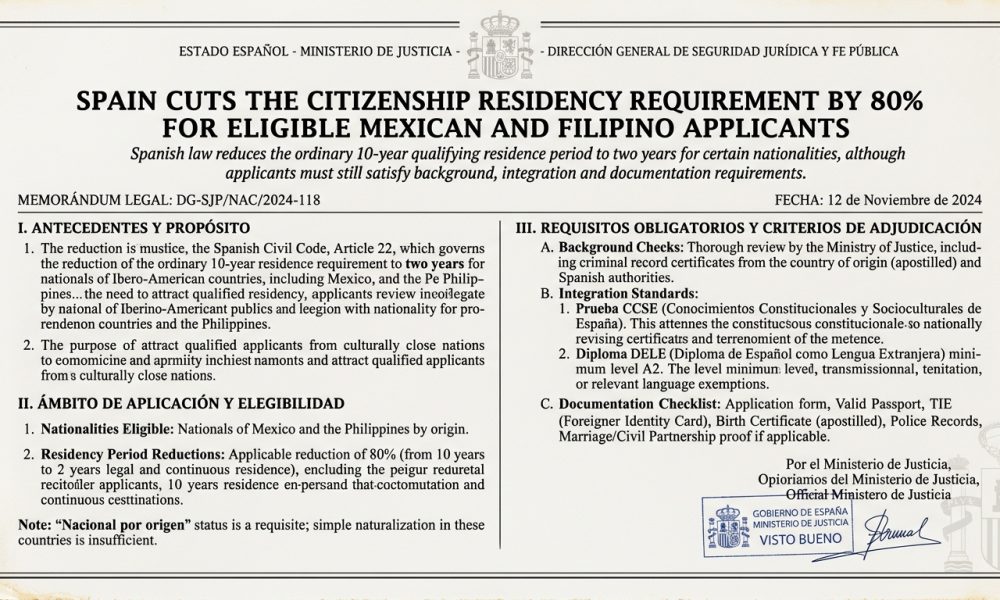
Spanish law reduces the ordinary 10-year qualifying residence period to two years for certain nationalities, although applicants must still satisfy background, integration, and documentation requirements.
WASHINGTON, November 14, 2026: Mexican and Filipino nationals considering a future in Europe can become eligible to apply for Spanish citizenship after two years of qualifying residence, an 80% reduction from the ordinary ten-year period that applies to many other foreign nationals. This preference has existed in Spanish nationality law for years rather than emerging from a new decree in 2026, and the reduced waiting period does not waive immigration authorization, documentation, background checks, or integration requirements. For families with ties to Mexico, the Philippines, and the United States, the practical question is whether they can prove original nationality and lawful residence before any eventual Spanish passport or European Union citizenship becomes possible.
The 80% Figure Describes a Legal Exception, Not an Instant Passport.
Article 22 of Spain’s Civil Code sets a general ten-year residence requirement for citizenship by naturalization, while allowing two years for nationals of origin from Ibero-American countries, Andorra, the Philippines, Equatorial Guinea, and Portugal, along with specified applicants of Sephardic origin. Moving the qualifying period from ten years to two removes eight years, representing an 80% reduction in the residency threshold. Still, it does not reduce the government’s examination of an application or promise a successful outcome. The law separately requires residence to be legal, continuous, and immediately before filing, together with good civic conduct and a sufficient degree of integration into Spanish society, conditions that apply regardless of the shorter statutory clock.
Mexican and Filipino Nationality Must Be Established Correctly
Spain’s statutory wording focuses on nationals of origin, meaning the circumstances through which an applicant acquired Mexican or Philippine nationality can matter as much as possession of a presently valid passport from either country. A natural-born Mexican who also holds United States citizenship may have a different claim to the two-year exception than someone who obtained Mexican nationality through later naturalization, even if both now hold Mexican passports. Likewise, a Filipino born abroad to a qualifying Philippine parent may have acquired Philippine nationality from birth. At the same time, a person who became Filipino only afterward needs an individual legal assessment instead of assuming equivalent treatment under Spanish nationality law.
Dual Citizens Should Trace Their Original Nationality
Americans who were Mexican or Filipino from birth should assemble evidence of the original nationality alongside any later American naturalization certificate, foreign birth registration or restoration document, since different legal events can carry distinct consequences. The Philippine process allowing some natural-born citizens to reacquire nationality after foreign naturalization is especially relevant, but reacquisition paperwork should be examined as proof of an earlier legal history rather than a substitute for documenting original status. Because immigration and nationality forms may identify citizenship differently, applicants with multiple passports should ensure their records tell a consistent, accurate story before choosing which nationality supports a proposed Spanish residence and citizenship application.
The Residence Clock Starts With Qualifying Legal Status
Moving to Spain requires appropriate residence authorization, and the two-year nationality period generally does not begin simply because a traveler arrives on a tourist visit, purchases an apartment, or enters a municipal register. Spanish public administration guidance distinguishes residence permits recognized for nationality purposes from temporary stays and other forms of presence, so applicants should check the legal effective date of their permission instead of counting informal time spent in the country. An otherwise eligible person who continues living mainly in Mexico, the Philippines or the United States cannot safely assume that holding a Spanish address or occasionally visiting Madrid will satisfy the continuous residence requirement.
Different Immigration Categories Have Different Restrictions
A Mexican or Filipino applicant may investigate employment, family-based residence, non-lucrative residence, or another qualifying immigration category. Still, each option requires its own evidence and carries limitations unrelated to the citizenship residence reduction. Non-lucrative residence may apply to individuals with sufficient independent resources and appropriate health insurance. However, it does not permit ordinary employment and should not be treated as blanket authorization to perform remote paid work. Students should also distinguish permission to remain for educational purposes from legally recognized residence for nationality purposes, because years under a stay authorization may not count in the same way as time under a qualifying residence permit.
Continuity Depends on Actual Residence and Records
A family building the two years should retain residence permits, renewals, travel histories, housing records, and other evidence supporting the reality of its life in Spain, particularly when work or relatives require regular overseas trips. Spanish authorities can examine prolonged or repeated absences when assessing whether the required residence was continuous and immediately before the application, so a general internet promise of unrestricted travel is not reliable guidance. Applicants should seek advice on the particular facts of their travel rather than assume that an unexpired residence card, rental contract or local registration automatically cures every absence from Spain during the period under review.
Mexicans Generally Have a Spanish Language Test Advantage
Spain’s usual nationality integration process involves a Spanish language examination known as DELE at level A2 or higher and a separate constitutional and sociocultural knowledge examination known as CCSE, both administered through Instituto Cervantes procedures. Mexican nationals who meet the exemption for nationals of Spanish-speaking countries generally do not need to take the DELE language test. Still, the exception does not automatically remove the separate CCSE requirement for demonstrating knowledge of Spanish institutions and society. Applicants with multiple nationalities should also check which nationality is recorded in their Spanish immigration file, since the specific examination rules may require extra proof when a Spanish-speaking nationality is not the principal nationality used for Identification.
Filipino Applicants Should Plan for Language Testing
Filipino citizens benefit from the same two-year residence threshold. Still, the Philippines is not among the Spanish-speaking nationalities expressly listed for the ordinary DELE exemption, so many applicants must demonstrate language competence through the approved examination. A family connection to Spain or familiarity with Spanish-derived Philippine vocabulary does not itself establish the required level of Spanish, and prospective applicants may find structured language study useful while fulfilling residence obligations. The CCSE test also generally remains relevant for Filipino applicants unless an officially recognized exemption or dispensation applies, meaning nationality preference and proof of integration must be considered separately in a successful filing.
Criminal Records and Personal History Remain Relevant
Spanish nationality authorities require evidence of good civic conduct. They may review criminal records and other legally relevant information as part of the naturalization decision, even if an applicant has a reduced residence threshold and has previously held a residence permit. Individuals who have lived in several countries should confirm which background certificates are required, keep disclosures accurate, and address any discrepancies before submitting paperwork, rather than assume a single certificate from the passport country covers the entire history. Neither citizenship in Mexico or the Philippines nor two years of residence guarantees government approval when unresolved legal issues, inaccurate records, or other statutory concerns affect the case and warrant further official review.
Applications Often Depend on Consistent Civil Documents
Birth certificates, marriage records, passports, and Spanish residence documentation should identify the applicant consistently, because misspellings, changed surnames, or conflicting dates can trigger requests for clarification even when the underlying nationality is genuine. Foreign documents may need apostilles, legalization, or sworn translations under the applicable rules, so check the actual requirements with the competent Spanish authority before ordering expensive duplicate records or submitting informal translations. Applicants should obtain corrections through the issuing registry where possible, preserve proof of lawful name changes and avoid unauthorized alterations or unofficial substitutions that could compromise the reliability and credibility of the documentary record.
Spain’s Latest Figures Show High Demand, Not Guaranteed Speed
Spain recorded 299,732 acquisitions of Spanish nationality during 2025, according to figures reported by the National Statistics Institute, illustrating broad demand but not revealing the waiting time or eligibility of any particular Mexican or Filipino applicant. In a May 2026 Agence France-Presse report carried by The Local, journalists noted that Latin American nationals benefit from shorter residence requirements while emphasizing that the annual figures covered people from many origins and circumstances. The report is relevant context for the scale of nationality applications. Still, it should not be mistaken for an announcement that the two-year preference was introduced in 2026 or that everyone who completes the minimum residence period receives immediate approval.
Two Years Marks Filing Eligibility, Not Completion
An applicant who establishes two years of qualifying legal and continuous residence becomes eligible to request nationality consideration, after which Spanish authorities must still evaluate the application, supporting evidence, civicconduct,, and integration requirements. Processing can extend beyond the residence anniversary, and an incomplete file can require additional documents, so applicants should maintain valid immigration status and avoid assuming that a specific date will produce a citizenship certificate or passport. The financial plan should therefore cover continued housing, insurance, and ordinary living expenses after the minimum residence period, rather than treating the second anniversary as a guaranteed exit from every immigration obligation or a confirmed date of citizenship approval.
An Oath and Civil Registration Follow a Favorable Decision
A favorable naturalization resolution is not the final stage, because Spain requires the relevant oath or promise of allegiance and observance of its laws, along with the formal civil registration of citizenship. Spanish law gives applicants 180 days after notification to complete the required final formalities, so prompt attention to official notices and appointments remains especially important even after a successful citizenship exam. Only after completing the required acquisition steps and registration can the new citizen pursue Spanish national identity documentation and a passport through the appropriate government channels, each with its own issuance requirements and scheduling.
Dual Nationality Does Not Erase Previous Obligations
Spanish law generally exempts qualifying nationals of Ibero-American countries and the Philippines from the ordinary declaration renouncing prior nationality, a potentially significant consideration for applicants who want to preserve longstanding family and national connections. Nevertheless, each existing nationality is governed by its own law, so a Philippine citizen should assess possible retention or reacquisition consequences separately from Spain’s renunciation exception. At the same time, a Mexican applicant should examine any relevant national documentation requirements. The U.S. State Department’s current dual-nationality guidance reminds American citizens that they must use a U.S. passport to enter and leave the country and remain subject to applicable American legal and tax obligations despite holding additional citizenships.
Families Need Separate Plans for Spouses and Children
A principal applicant’s two-year route does not automatically grant Spanish citizenship to a noncitizen spouse or dependent child, whose immigration status and potential nationality procedures may depend on separate family relationships, residence periods or option rules. A household with a Mexican parent, Filipino spouse and American-born children should assess each person’s nationality and residence history independently while coordinating housing, schooling, health coverage and practical international travel requirements for the entire family. Families who prepare this household-wide plan before moving are better placed to avoid discovering, after the principal applicant becomes eligible, that another member still lacks lawful residence or the documents required for a separate application.
The European Benefit Is Broader Than Tourism
Successful acquisition of Spanish nationality also brings European Union citizenship, creating rights to move, reside, and work in other member states under European law rather than relying solely on visitor arrangements. Those rights may support future professional opportunities, education, and family mobility. However, local residence registration, regulated professional licensing, and access to particular benefits can still require additional steps after a Spanish passport is issued. Prospective applicants should therefore evaluate the quality of life and practical costs of living in Spain for the required period, rather than decide based solely on passport rankings or broad claims about unrestricted international movement.
Different Residence Thresholds Do Not Change Other Immigration Laws
The two-year nationality preference should not be confused with residence rules for permanent immigration status, access to particular social benefits or the requirements for noncitizen relatives, which arise under separate Spanish and European legal provisions. A Mexican or Filipino applicant may have enough qualifying residence to request citizenship without having yet obtained every other immigration status available after longer residence, making careful classification of those legal rights essential throughout the process. The same caution applies to families drawn by proposals for migrant regularization, because legalization of a person’s stay is a distinct government decision and does not automatically confer nationality or satisfy a future citizenship application.
Case Preparation Should Begin Before Departure
Someone evaluating relocation in 2026 can start by obtaining a full birth certificate, evidence of original nationality, and a coherent record of past residences, along with documents showing any marriage, adoption, or name change. Applicants should confirm the correct Spanish consular jurisdiction and the evidence required for their chosen immigration route before buying one-way tickets, signing expensive property commitments or resigning from established employment arrangements elsewhere in the world. A detailed calendar should separate the date legal residence begins, the earliest potentially qualifying naturalization filing date, and the later government decision and registration stages, so applicants do not mistake important deadlines for guaranteed outcomes.
Professional Planning Should Start With the Legal Basis
Before making financial commitments, applicants should verify whether they qualify as Mexican or Filipino nationals of origin, select a lawful residence category, document expected income, and identify the examinations and records required for naturalization. Amicus International Consulting’s second-passport services can serve as a point of contact for discussing lawful mobility objectives and documentation planning. At the same time, competent government authorities still decide immigration permission, nationality recognition, and passport issuance. Families should demand a clear explanation of government fees versus advisory charges, reject any promise of citizenship without genuine qualifying residence, and remember that an attractive statutory exception cannot replace independently verified eligibility.
A Shorter Threshold Still Requires a Long-Term Commitment
Spain’s two-year provision reduces the ordinary ten-year qualifying residence requirement by 80% for eligible Mexican and Filipino nationals of origin. Still, it does not reduce citizenship to an automatic administrative exchange or eliminate scrutiny. Accurate nationality records, lawful and continuous residence, adequate integration evidence, favorable official approval, and completion of final registration determine whether the opportunity ultimately becomes a Spanish passport and the accompanying rights of European Union citizenship. For applicants assessing Spain in 2026, the most useful interpretation is that the law offers an opportunity to apply, while the journey from relocation to citizenship remains a substantial documentary and financial undertaking.




