
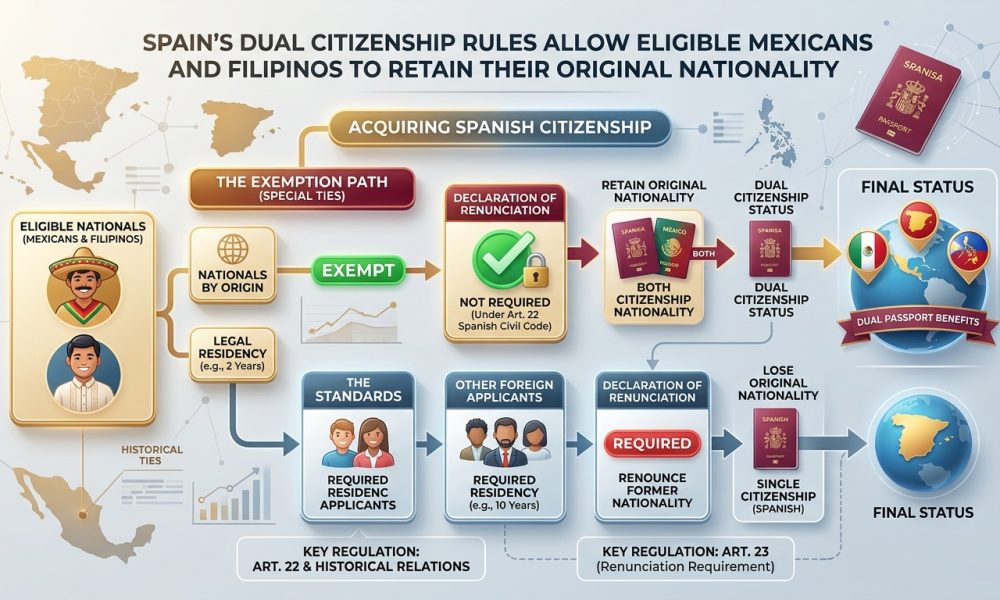
Spanish nationality legislation generally exempts qualifying Mexican and Philippine nationals from the declaration of renunciation ordinarily required of some foreign applicants acquiring Spanish citizenship.
WASHINGTON, November 14, 2026: Mexican and Filipino nationals exploring Spanish citizenship can benefit from a significant legal distinction that allows qualifying applicants to complete Spain’s naturalization process without making the declaration renouncing a previous nationality that the country ordinarily requires of many other applicants.
The exemption can support families seeking to preserve ties to their countries of origin while building a future in Europe. Still, its practical value depends on the separate citizenship laws of Spain, Mexico and the Philippines rather than a single passport application. For Americans who also hold Mexican or Philippine nationality, the analysis becomes more complex because United States citizenship adds another layer of passport requirements and legal obligations, even where Spanish authorities recognize an applicant under their special nationality provisions.
Spain’s Article 23 Contains the Renunciation Exception
Article 23 of Spain’s Civil Code normally requires a qualifying applicant who acquires nationality through residence, option, or discretionary grant to pledge allegiance to Spain, renounce a prior nationality, and complete the required civil registration.
The same article expressly excludes designated categories from the renunciation declaration, referring to people from countries named in Article 24 and to eligible Sephardic persons of Spanish origin. Hence, the requirement does not apply uniformly to every new citizen. Countries listed in Article 24 include Ibero-American nations, Andorra, the Philippines, Equatorial Guinea and Portugal, making the exemption relevant to qualifying Mexicans and Filipinos whose nationality status and personal circumstances satisfy the governing Spanish rules.
The Exemption Is Not a Newly Announced 2026 Policy
The preference is part of an established nationality framework, not a newly launched passport promotion. However, ongoing international migration and growing interest in multiple citizenships have brought renewed attention to how the rule works in practice.
In an October 2026 report on traveling with Spanish and foreign passports, The Local explained that Spain recognizes exceptions for nationals of specified countries and that the other country’s own rules remain essential to understanding whether dual nationality can be maintained. That distinction matters because a Spanish exemption from an administrative declaration cannot bind Mexico, the Philippines, or the United States, each of which applies its own legal standards to determine who remains a citizen.
Two Years of Residence and Renunciation Are Separate Questions
Article 22 establishes another benefit for qualifying nationals of origin from Ibero-American countries and the Philippines, permitting an application after two years of legal, continuous residence rather than the ordinary ten years imposed on many other foreign applicants.
The two provisions address different questions, since Article 22 concerns when a person may seek citizenship through residence. At the same time, Article 23 concerns the declarations and formalities required to acquire nationality after the relevant application has been approved. A person should not assume that being excused from a renunciation declaration automatically proves entitlement to the shorter residence period, because the statutory wording, nationality history and evidence relevant to each provision must be assessed independently.
Mexican Citizenship by Birth Has Constitutional Protection
Mexico’s Constitution distinguishes Mexican nationality by birth from nationality acquired through naturalization, and Article 37 provides that a Mexican by birth cannot be deprived of that nationality merely because they later acquire another citizenship.
This Protection can matter for someone born Mexican who later becomes Spanish, including a Mexican-American dual citizen. However, questions about nationality documentation, official Identification,, and passport use still warrant attention under Mexican rules. Mexico also reserves some public functions for people who meet particular nationality conditions, showing that retaining citizenship and exercising every public right associated with that citizenship are not necessarily the same in a multiple-nationality situation.
Naturalized Mexicans Face a Different Legal Position
The same Mexican Constitution provides circumstances under which nationality acquired by naturalization can be lost, including voluntary acquisition of another nationality, certain uses of foreign Identification, and continuous residence abroad for the specified period.
That difference matters even where Spain might accept a particular applicant’s circumstances for a different immigration or naturalization route, because the Spanish rule does not override consequences that Mexican law attaches to nationality acquired later in life. A person who became Mexican through naturalization should therefore obtain a country-specific opinion before pursuing Spanish citizenship, rather than assume that the protections afforded to Mexicans by birth automatically extend to the naturalized population.
Another important distinction concerns children born with more than one nationality, whose rights may arise under each parent’s citizenship law without an intervening naturalization, making it particularly important not to apply rules for adult foreign naturalization mechanically to minors.
Philippine Law Requires Its Own Retention Analysis
The Philippines has a separate statutory framework for natural-born Filipinos who become citizens of another country, including Republic Act 9225, the Citizenship Retention and Reacquisition Act, which addresses retention or reacquisition through a prescribed oath of allegiance.
A Filipino who obtains Spanish citizenship should not assume that Spain’s exemption from renunciation automatically establishes uninterrupted Philippine citizenship, since the Philippine legal effect of foreign naturalization and any necessary retention procedure requires separate examination. Relevant Philippine authorities may require documentation of original citizenship, foreign naturalization, and the necessary oath, and an individual who has already completed reacquisition after becoming American may need to assess reacquisition after a further citizenship event.
Natural-Born Filipino Status Is Not the Same as Ordinary Naturalization
Philippine constitutional law recognizes natural-born citizenship, including certain people born overseas to Philippine parents. At the same time, ordinary naturalization describes a different route through which someone who was initially a foreign national later becomes a citizen.
Republic Act 9225 primarily addresses individuals who were natural-born Filipinos before acquiring foreign nationality through naturalization, making proof of birthright status particularly important for people now holding both Philippine and United States passports. An individual who became Filipino only through ordinary naturalization cannot safely assume the same Philippine retention protections apply, just as Spanish officials must determine eligibility under Spain’s own statutory language and documentary rules.
Americans May Hold More Than Two Nationalities
The United States generally permits citizens to possess additional nationalities, and the State Department’s August 2026 guidance on dual nationality explains that acquiring another citizenship does not ordinarily require an American to surrender United States nationality.
American citizens must nevertheless use United States passports when entering and departing the country and remain subject to applicable legal duties, including relevant tax and financial reporting obligations regardless of their other passports. An American who is also Mexican by birth or natural-born Filipino should therefore treat prospective Spanish citizenship as a three-country legal review rather than assume that Spain’s renunciation exemption answers every remaining question.
Original Nationality Needs Documentary Verification
Applicants should assemble birth certificates, parentage records, prior passports, and documentation explaining any naturalization, retention, or reacquisition event, because how a person became a Filipino can affect Spanish residence preference and related nationality questions.
A Mexican passport issued after a name change or a Philippine passport obtained after reacquisition may accurately establish current nationality and explain the full historical status that government officials need to evaluate for a citizenship application. Where several nationalities appear in an applicant’s personal records, applicants should correct inconsistencies through authorized processes and document them transparently rather than ignore or adjust them informally, particularly when the evidence will be reviewed across countries.
In practice, a family holding several passports should create a separate written timeline for each nationality, recording whether it arose at birth, by registration, by naturalization, or through a later reacquisition procedure, and the dates supporting that reacquisition.
Spanish Residence Is Still Required for Ordinary Naturalization
The renunciation exemption does not dispense with Spain’s residence requirements, meaning eligible applicants ordinarily must obtain lawful residence, maintain the required continuity, and demonstrate that the relevant period immediately preceded the citizenship application.
Tourist entry, a property purchase, or an address maintained without actual residence should not be confused with a qualifying immigration authorization, and study-related stays may be treated differently from residence under Spanish nationality rules. Depending on individual circumstances, families may explore employment, family, or non-lucrative residence categories. Still, each option has separate conditions on financial means, insurance, permissible work, family reunification provisions, and the continued validity of immigration status.
A Spanish Language Exemption Does Not Cover Every Applicant
Spain ordinarily requires qualifying adult naturalization candidates to demonstrate Spanish-language competence through the DELE examination and constitutional and cultural knowledge through the separate CCSE assessment, subject to legally recognized exemptions, special accommodations and dispensations.
Mexican nationals of origin generally qualify for a language-examination exemption available to nationals of Spanish-speaking countries. At the same time, Filipino applicants typically must demonstrate Spanish proficiency despite sharing the shortened statutory residence pathway. Neither nationality automatically eliminates the separate civic knowledge requirement, so applicants should confirm their examination status and schedule any required tests early enough to avoid delays after their qualifying residence period ends.
Government Background Checks Remain Part of the Process
Spain’s naturalization procedure requires evidence of good civic conduct, and officials may assess criminal records and other relevant information before granting citizenship even when the applicant comes from a country covered by the renunciation exception.
A person who has lived in Mexico, the Philippines, the United States, or Spain may need several official records, with authentication and translation requirements depending on the documents and the receiving authority’s current instructions. The exemption should never be advertised as immunity from ordinary legal scrutiny or a way to bypass accurate identity information, because Spanish nationality ultimately depends on a government decision grounded in the complete application.
An Oath and Civil Registration Remain Essential
After a favorable nationality decision, an applicant generally must complete the required oath or promise of allegiance to Spain and obedience to its Constitution and laws, even if Article 23 waives the renunciation declaration.
Civil registration is also required, and the Civil Code ordinarily gives recipients 180 days after notification to complete the relevant concluding formalities, making official correspondence and appointment deadlines important even after approval. The exemption therefore concerns one specific declaration rather than every final procedural step, and an approved applicant does not automatically receive a Spanish passport before citizenship has been properly formalized and recorded.
Passport Use Can Create Confusion for Multiple Nationals
Once Spanish citizenship is established, an individual may need to use Spanish Identification when dealing with Spanish authorities. At the same time, another country may expect its citizens to enter and leave using that country’s documents under its own travel rules.
The distinction matters most for American dual nationals, whose United States passport requirement remains in effect, and for families traveling with children whose citizenships or birth registrations differ from those of accompanying adults. Maintaining accurate passports and civil records from each country can help avoid preventable travel disruption. Still, no traveler should assume that carrying several documents permits disregard of entry rules, custody orders, or official identity requirements.
Family Members Do Not Automatically Receive Spanish Passports
A qualifying Mexican or Filipino national who becomes Spanish cannot assume that a spouse and children simultaneously acquire Spanish citizenship, because family immigration and nationality rules depend on individual residence, relationships, ages and legally recognized parentage.
Children may have distinct nationality-by-option opportunities after a parent acquires Spanish citizenship. At the same time, a noncitizen spouse may need family residence permission or a separate naturalization route before independent citizenship rights arise under applicable law. Families planning a move should therefore assess each member’s current nationality and immigration position before relocating, rather than relying on one adult’s exemption from renunciation as a complete solution for the entire household’s citizenship and residence needs.
European Union Rights Come After Citizenship Acquisition
Spanish citizens also hold European Union citizenship, which can provide substantial rights to live and work in other member states under the applicable European rules. However, local registration and regulated professional qualifications can still matter.
Those rights can appeal to families seeking education, career flexibility, or long-term residence options across Europe. Still, a pending Spanish application or an existing Mexican or Philippine passport does not create the same status. Consider the practical value of Spanish citizenship alongside the financial and personal commitment of establishing legal residence in Spain, including housing, insurance, schooling needs, family obligations, and uncertain administrative processing times after filing.
Retaining Nationality Does Not Mean Avoiding Legal Obligations
People with multiple citizenships can face overlapping tax, reporting, registration, and public service obligations; obligations and rights available in one country do not erase obligations under another country’s law or from residence elsewhere.
A person who retains Mexican nationality while acquiring Spanish citizenship should separately examine any Mexican restrictions tied to particular public positions. At the same time,ile Filipinos should review the conditions associated with Philippine retention and political rights. American citizens must also continue evaluating their United States obligations, because neither Spain’s renunciation exception nor residence abroad automatically terminates citizenship-based duties, cancels relevant reporting requirements, or resolves every cross-border financial issue a family may encounter.
Overlapping obligations are a reason to seek accurate, country-specific advice before naturalization rather than afterward, particularly when an applicant expects to maintain financial accounts, property ownership, professional credentials, or family responsibilities in several jurisdictions simultaneously.
Early Legal Review Can Prevent Costly Assumptions
A sensible preparation sequence starts with establishing the applicant’s nationality at birth, recording any later citizenship changes, and checking the relevant requirements of Spain and the existing nationality country before making major relocation commitments.
Applicants can then identify the Spanish immigration category that genuinely fits their circumstances, organize birth and identity evidence, and plan for residence continuity, examination requirements,s and government processing after the minimum qualifying period. Families comparing legitimate mobility options may review Amicus International Consulting’s second-passport services for general planning context and help with documentation questions, while recognizing that only competent governments can determine nationality status, authorize residence, or issue passports.
Spain’s Exception Offers Flexibility Without a Universal Guarantee
Spain’s renunciation exemption can make naturalization more compatible with maintaining established Mexican or Philippine nationality. Still, the decisive distinction is that Spanish administrative requirements and the foreign country’s citizenship-retention rules remain legally separate.
For Mexicans by birth, constitutional protections are particularly relevant. At the same time, naturalized Mexicans face different provisions, and natural-born Filipinos must consider the retention or reacquisition rules governing foreign naturalization and reacquisition official documentation. In 2026, applicants who verify those distinctions before relocating can make informed decisions about a future Spanish passport and European Union citizenship without mistaking a valuable statutory accommodation for an automatic guarantee of three compatible nationalities.




