
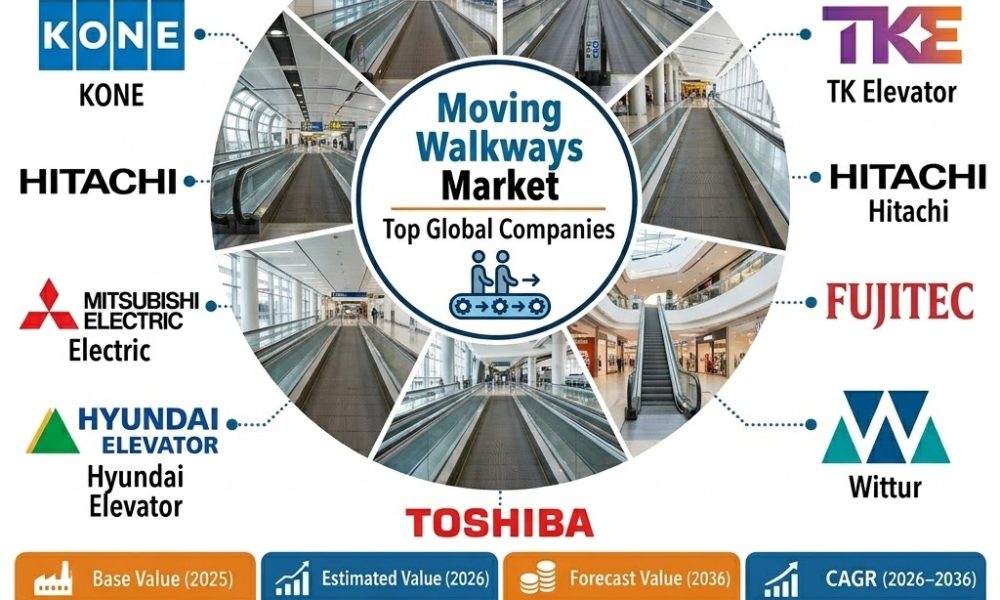
The global moving walkways market is projected to grow from USD 5.26 billion in 2026 to USD 7.21 billion by 2036, expanding at a compound annual growth rate (CAGR) of 3.2%, according to Fact.MR. The market was valued at approximately USD 5.1 billion in 2025 and is expected to create an additional USD 1.95 billion in market opportunity between 2026 and 2036.
Transportation hubs account for 52.1% of the application segment, while horizontal moving walkways represent 49.5% of product share in 2026. These segments reflect the importance of airport infrastructure, passenger movement requirements and established equipment formats in shaping demand.
Get detailed market forecasts, competitive benchmarking, and pricing trends: https://www.factmr.com/connectus/sample?flag=S&rep_id=4604
Infrastructure investment and connected systems shape procurement
Airport expansion and modernization programs remain important demand drivers across established and emerging markets. Fact.MR identifies airport terminal development in Germany, France and the United Kingdom, alongside large-scale airport construction in China, as important regional demand factors. In Mexico, airport expansion, commercial building construction and transit infrastructure development support the country’s projected growth.
Technology requirements are also changing purchasing decisions. Building operators increasingly seek moving walkways that integrate with building management systems (BMS). These systems can support centralized monitoring of equipment operation, energy consumption, fault detection and maintenance scheduling. Internet of Things (IoT) sensors can provide operational status information and maintenance indicators.
For airport authorities, transit operators and commercial property developers, these capabilities make energy efficiency, monitoring functions and long-term maintenance support relevant considerations alongside initial equipment cost.
Where growth is fastest
Fact.MR’s country-level forecasts identify Mexico as the fastest-growing market among the five countries listed in its analysis.
- Mexico — CAGR 3.5%: Airport expansion, commercial construction and transit infrastructure development are expected to support demand through 2036.
- Germany — CAGR 3.1%: Airport terminal expansion, transit station modernization and replacement of aging systems support procurement. Energy-efficiency requirements also influence drive-system specifications.
- France — CAGR 3.0%: Airport modernization at Charles de Gaulle and Orly, transit investment and commercial building development support demand.
- United Kingdom — CAGR 2.9%: Airport expansion, transit station modernization and replacement of aging walkway infrastructure underpin market growth.
- South Korea — CAGR 2.8%: Airport and transit investment, commercial construction and the competitive position of domestic manufacturers support demand.
The growth rates are based on Fact.MR’s country-level analysis for 2026–2036. The report identifies airport expansion and modernization as recurring demand factors across several markets, while the relative importance of replacement procurement and smart-building integration varies by country.
What leads the market
The market’s leading segments reflect demand for established walkway formats and components used in transportation infrastructure.
- Horizontal moving walkways — 49.5% of product share in 2026: This segment benefits from established buyer preferences, compatibility with existing infrastructure and applications across major end-use categories.
- Drive systems — 32.6% of component share in 2026: Drive systems represent the largest component category identified in the report, with energy efficiency and integration capabilities relevant to equipment specifications.
- Medium-duty walkways — 45.8% of capacity share in 2026: This category covers systems handling 3,001 to 9,000 persons per hour.
- Transportation hubs — 52.1% of application share: Airports represent the largest installation base within this application category, alongside railway stations and metro stations.
New installations are expected to influence medium-term market growth as infrastructure projects expand and technical specifications evolve. Replacement and retrofit projects also form part of the market’s installation scope.
The hurdle: Cost pressure and procurement uncertainty
Price competition remains a constraint, particularly in entry-level segments where buyers are sensitive to initial equipment costs. Fact.MR also identifies supply-chain concentration and material availability as sources of procurement uncertainty.
Regional differences in specifications and regulatory compliance can increase the cost of entering new markets. For manufacturers, competing solely on purchase price may leave less room to differentiate on lifecycle operating costs, energy consumption, maintenance support and system integration.
These pressures are relevant to procurement teams comparing equipment across multiple suppliers. Project evaluation needs to account for installation requirements, operating expenditure, maintenance arrangements and compliance obligations rather than relying on initial quotations alone.
Industry investment and recent developments
The Fact.MR report lists the following company developments by year. The supplied report page does not provide exact months or independently linked announcements for these items.
- Schindler — 2025: The report describes the introduction of a moving walkway platform featuring regenerative drive technology and IoT-enabled condition monitoring. It states that the platform reduces energy consumption by 25% compared with the previous generation. The underlying product announcement and comparison basis should be confirmed before publication.
- KONE — 2025: The report describes enhancements to moving walkway integration with building management systems, including centralized monitoring, predictive maintenance and passenger-flow analytics.
- Otis — 2026: The report states that Otis secured walkway supply contracts for multiple airport expansion projects in the Middle East, including long-term maintenance agreements. The specific projects and contract announcements are not named on the supplied page.
The market is served by global manufacturers with established installation and maintenance networks. Fact.MR identifies the following companies in its competitive analysis:
Schindler, Otis, KONE, TK Elevator, Hitachi, Mitsubishi Electric, Fujitec, Hyundai Elevator, Toshiba and Wittur.
The report describes competition as being shaped by installed-base references, project execution capability, maintenance relationships, pricing and the ability to supply energy-efficient systems with building-management integration. It also notes that Chinese manufacturers are beginning to compete internationally on price in mid-specification tenders.
Analyst perspective
Shambhu Nath Jha, Principal Consultant at Fact.MR, says:
“The moving walkways market is fundamentally tied to airport and transit infrastructure investment, which provides structural demand visibility across multi-year construction programs. The competitive landscape is concentrated among five to six global players with the project execution capability and reference installations required for major infrastructure tenders. Energy efficiency, smart building integration, and predictive maintenance capability are becoming specification differentiators rather than premium options. Vendors that can deliver connected, efficient systems with global maintenance support will maintain pricing power, while those competing solely on initial equipment cost will face margin compression as Chinese manufacturers expand their international presence.”
What this means for infrastructure buyers
- Evaluate total cost of ownership. Compare equipment purchase prices with energy consumption, maintenance requirements, expected operating costs and the availability of long-term service support. These factors are particularly relevant where price competition is strong.
- Include integration requirements in tender specifications. Airport authorities, transit operators and commercial property developers should establish requirements for building-management connectivity, equipment monitoring, fault detection and maintenance data before selecting suppliers.
- Match equipment capacity to passenger demand and project needs. The report identifies medium-duty walkways as the leading capacity segment by share. Buyers should assess expected passenger volumes, site conditions, installation type and future infrastructure requirements when preparing procurement specifications.
These considerations can help procurement teams compare bids on operational and technical criteria while accounting for the regional differences and supply constraints identified in the report.
About the report
Fact.MR’s Moving Walkways Market Analysis and Forecast by Fact.MR examines global and regional market size, forecasts for 2026–2036, product and component categories, capacity and speed, applications, installation types, country-level growth and competitive positioning.
Top Trending Reports:
About Fact.MR
Fact.MR is a market research and consulting firm that provides market analysis, forecasting and industry research across a range of sectors. Its research combines secondary sources, primary interviews and forecasting models to assess market size, demand patterns, competitive positioning and industry developments.



