
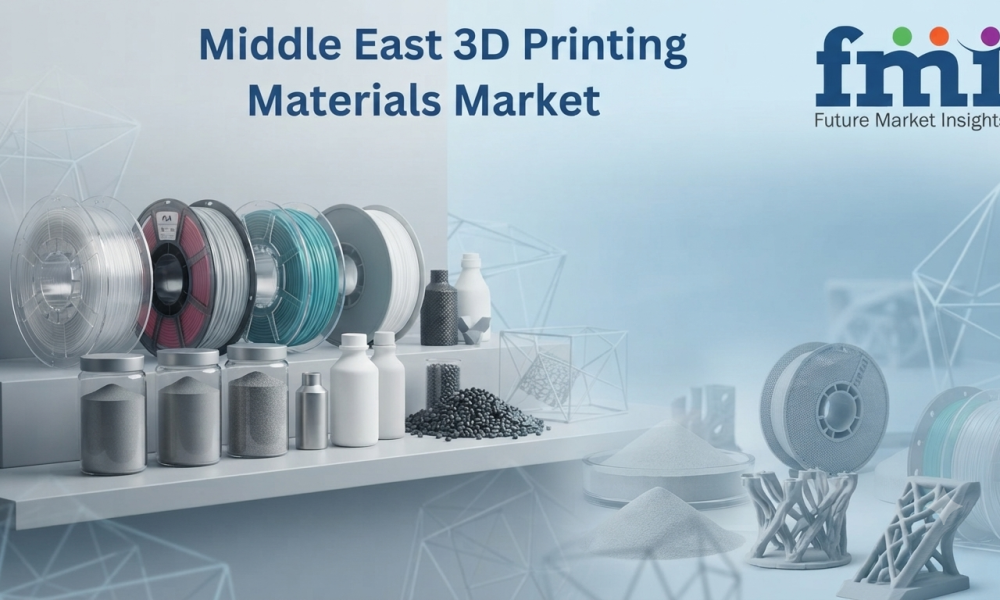
The Middle East 3D printing materials market is expected to increase from USD 1.69 billion in 2022 to USD 7.91 billion by 2032, registering a 16.7% CAGR during the forecast period. Rising manufacturing activity, wider use of additive manufacturing in healthcare, and the growth of e-retail channels are creating new demand for 3D printing materials across the region.
Manufacturing and E-Retail Create New Demand
The expansion of regional manufacturing is supporting greater use of 3D printing materials across industrial production environments. Manufacturers are increasingly adopting 3D printing to improve design flexibility and lower production costs. The transition from conventional production and printing methods to 3D printing can help reduce overall operational costs by almost 50%, supporting wider consideration of additive manufacturing for industrial applications.
E-retail is also becoming an important part of the regional supply chain. Online retailers selling 3D printed products are helping connect material suppliers and manufacturers with end users. This development can reduce supply-chain gaps and improve product accessibility, supporting sales of 3D printing materials across Middle Eastern markets.
The establishment of new 3D printing manufacturing units and the emergence of technology-focused start-ups are further strengthening the region’s industrial manufacturing ecosystem. As more businesses explore additive manufacturing, demand is expected to extend beyond early-stage experimentation and prototyping toward production-linked applications.
Get detailed market forecasts, competitive benchmarking, and pricing trends: https://www.futuremarketinsights.com/reports/sample/rep-gb-1345
Healthcare Applications Support Material Consumption
Healthcare represents another important area of opportunity for the Middle East 3D printing materials market. The technology is increasingly being considered for cost-effective medical production and replacement-organ applications. In the GCC, the healthcare industry is expected to expand at a 13.4% CAGR during the forecast period, creating additional potential for 3D printing technology and related material consumption.
PLA filament is particularly relevant to medical applications because it can degrade into lactic acid in the body. This characteristic supports its use in healthcare-related applications and contributes to its leading position within the filament category.
PLA Filament Leads the Filament Segment
By filament type, the market includes ABS, PLA, HIPS and PVA, nylon, PET, ceramics, and other materials. PLA filament is estimated to account for 22.3% of the Middle East 3D printing materials market value in 2026 and is projected to register a 16.7% CAGR during the forecast period.
Its established use in medical and bio-compatible applications is a key factor behind its leading position. Meanwhile, ABS and nylon continue to serve functional prototyping and industrial part development. Ceramic and specialty materials are also gaining attention as manufacturers explore higher-value applications for additive manufacturing.
UAE Leads the GCC While Israel Records Fastest Growth
The geographic landscape covers the Gulf Cooperation Council and Levant regions. The GCC includes Kingdom of Saudi Arabia, United Arab Emirates, Oman, Qatar, Kuwait, and Bahrain, while the Levant includes Cyprus, Egypt, Turkey, Israel, Jordan, Syria, Palestine, Iraq, and other Levant countries.
The United Arab Emirates is expected to remain the dominant country-level market within the GCC throughout the forecast period. Stronger adoption of 3D printing and supportive policies are contributing to its leading position.
Israel stands out for its growth rate among the Levant countries. The country is expected to register the highest CAGR in the Levant at 20.4%, supported by advanced manufacturing activity and a growing start-up ecosystem. Cyprus, Egypt, Turkey, Jordan, Syria, Palestine, Iraq, and other countries form part of the wider regional market, although individual CAGR figures for these countries were not provided in the supplied report.
Competitive Landscape
The competitive environment includes established global 3D printing technology and material companies such as 3D Systems, Stratasys Ltd., Beijing Tiertime Technology Co., Ltd., and ExOne Co. Other companies identified in the market include 3D Filament Manufacturing, Coex LLC, and MatterHackers Inc.
Market participants are pursuing collaborations and partnerships with regional distributors and retailers to strengthen their presence across Middle Eastern countries. These relationships can help companies improve product visibility, expand distribution reach, and respond more effectively to regional demand.
Access the Complete Report in PDF Format: https://www.futuremarketinsights.com/reports/brochure/rep-gb-1345
Industry Outlook
The Middle East 3D printing materials market is moving toward broader industrial and healthcare adoption as manufacturing capacity, technology start-ups, and digital retail channels expand. However, the relatively high cost of 3D printing materials remains a challenge that could influence adoption. Suppliers that develop adaptable material portfolios and strengthen regional distribution networks are positioned to participate in the market’s expanding applications.
Nikhil Kaitwade, Principal Consultant for Chemicals and Materials at FMI, notes that the market is shifting toward broader industrial use as local manufacturing and healthcare applications expand, while regional distribution depth and adaptable filament portfolios become increasingly important.
For manufacturers, material suppliers, distributors, and technology providers, the full Middle East 3D printing materials market report provides detailed analysis of market growth, filament segments, country-level developments, demand drivers, challenges, and competitive dynamics through 2032.
Business Impact
FMI helps organizations transform market complexity into strategic clarity, enabling leadership teams to identify growth opportunities faster, optimize resource allocation, strengthen competitive positioning, and make high-stakes business decisions with confidence.
To explore how FMI Custom Research can support your strategic priorities, please connect with our team at – [email protected]
About Future Market Insights (FMI)
Future Market Insights, Inc. (FMI) is an ESOMAR-certified, ISO 9001:2015 market research and consulting organization, trusted by Fortune 500 clients and global enterprises. With operations in the U.S., UK, India, and Dubai, FMI provides data-backed insights and strategic intelligence across 30+ industries and 1200 markets worldwide.



