
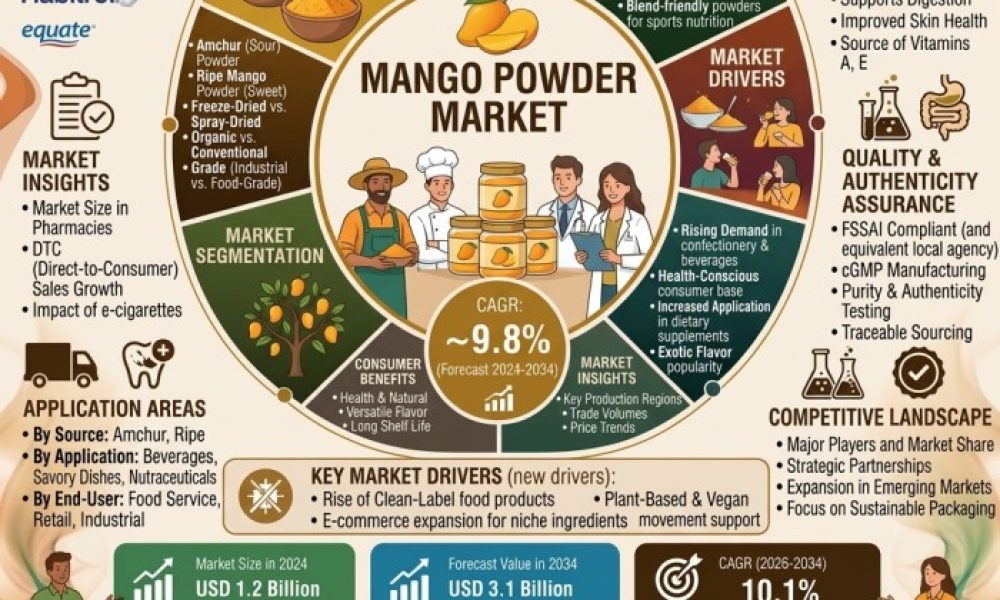
Rockville, Maryland — October 5, 2026 Mango powder demand is set for sustained expansion over the 2026–2036 forecast period, with the global market valued at USD 986.4 million in 2026 and projected to reach USD 1,800.1 million by 2036, advancing at a 6.2% CAGR. Fact.MR’s latest analysis indicates an absolute opportunity of USD 813.7 million as dried mango-based souring ingredients gain wider use across household cooking, spice blends, processed foods, beverage formulations, and commercial food preparation.
Get detailed market forecasts, competitive benchmarking, and pricing trends:
What is driving demand for mango powder?
Familiar souring applications remain central to market development. Amchur powder continues to benefit from its established role in recipes that require tart mango flavor in a dry, easy-to-handle form. Culinary and seasoning applications also support adoption because mango powder can add controlled sourness to curries, gravies, chutneys, and pickles without introducing additional moisture. Food and beverage processors are increasingly relevant as manufacturers seek ingredients that can deliver consistent flavor across seasoning bases, drink mixes, and finished products.
Which mango powder segment leads the market?
Amchur Powder is projected to hold 39.0% of the product-type segment in 2026, maintaining its lead because of established household and spice-blend use. By application, Culinary and Seasoning accounts for 33.0% share, supported by the ingredient’s compatibility with curries and gravies as well as chutneys and pickles. The Food and Beverage Industry represents 49.0% of end-use demand, while B2B and Ingredient Suppliers capture 57.0% of distribution-channel demand. Spray-Dried mango powder leads the drying-process category with a 56.0% share, reflecting its suitability for commercial-scale output, flowability, and storage performance.
How are key countries shaping market growth?
India is the fastest-growing country covered in the report, recording a 6.8% CAGR through 2036. Its position reflects the established culinary role of amchur and seasoning applications. China follows at 6.5% CAGR, with food and beverage processing and B2B ingredient supply supporting expansion. The USA is forecast to grow at 6.3% CAGR, aided by food manufacturing scale and online specialty access. Mexico, Thailand, and the UAE are also included in the country assessment, recording CAGRs of 6.1%, 5.9%, and 5.7%, respectively. The relatively compact country-growth range highlights differing channel routes, recipe familiarity, processing capabilities, and ingredient distribution structures.
What opportunities and challenges are emerging?
B2B pack optimization offers a notable opportunity as larger formats can better match distributor purchasing and food processor handling requirements. Seasoning-blend expansion may create additional demand where manufacturers need sourness without altering the texture of dry mixes, while online specialty retail can improve product discovery among consumers searching for recipe-specific ingredients. Premium dried mango formats also offer longer-term potential in markets such as Thailand and the UAE.
At the same time, raw mango supply variability remains a key restraint because seasonal availability can affect input consistency and powder costs. Moisture and clumping control are additional concerns for processors and storage sites, particularly where buyers require free-flowing powder. Channel price pressure and limitations in switching between formats may also influence purchasing decisions.
Who are the leading mango powder companies?
The competitive landscape includes Foods and Inns Limited, Mevive International, Vinayak Ingredients (India) Pvt. Ltd., Medikonda Nutrients, Kanegrade Ltd., NutraDry Pty Ltd., Z Natural Foods, Paradise Fruits Solutions, Van Drunen Farms, and Saipro Industries. These companies participate across mango powder, fruit ingredients, dried-fruit formats, retail channels, and bulk or specialty applications.
Fact.MR’s Mango Powder Market report provides coverage across product type, application, end use, distribution channel, drying process, regions, and country-level outlooks for 2026–2036. The study draws on 120+ sources, 35+ company portfolios, 25+ countries, and more than 20 industry interviews, giving procurement teams, ingredient suppliers, food manufacturers, and market participants a detailed basis for evaluating growth opportunities.
The report also distinguishes commercial powder from fresh mango, puree, pulp, and generic spice mixes, keeping the assessment focused on products sold specifically as dried mango-based souring ingredients. This scope helps decision-makers compare formats and channels on a consistent commercial basis while assessing procurement, formulation, distribution, and market-entry priorities across covered regions and applications.
For detailed market values, segment analysis, country forecasts, competitive intelligence, and strategic insights, access the full Fact.MR Mango Powder Market report.
Explore More Related Studies Published by Fact.MR Research
About Fact.MR
Fact.MR is a global market research and consulting firm, trusted by Fortune 500 companies and emerging businesses for reliable insights and strategic intelligence. With a presence across the U.S., UK, India, and Dubai, we deliver data-driven research and tailored consulting solutions across 30+ industries and 1,000+ markets. Backed by deep expertise and advanced analytics, Fact.MR helps organizations uncover opportunities, reduce risks, and make informed decisions for sustainable growth.
– Contact Us –
11140 Rockville Pike, Suite 400, Rockville,
MD 20852, United States
Tel: +1 (628) 251-1583 | [email protected]



