
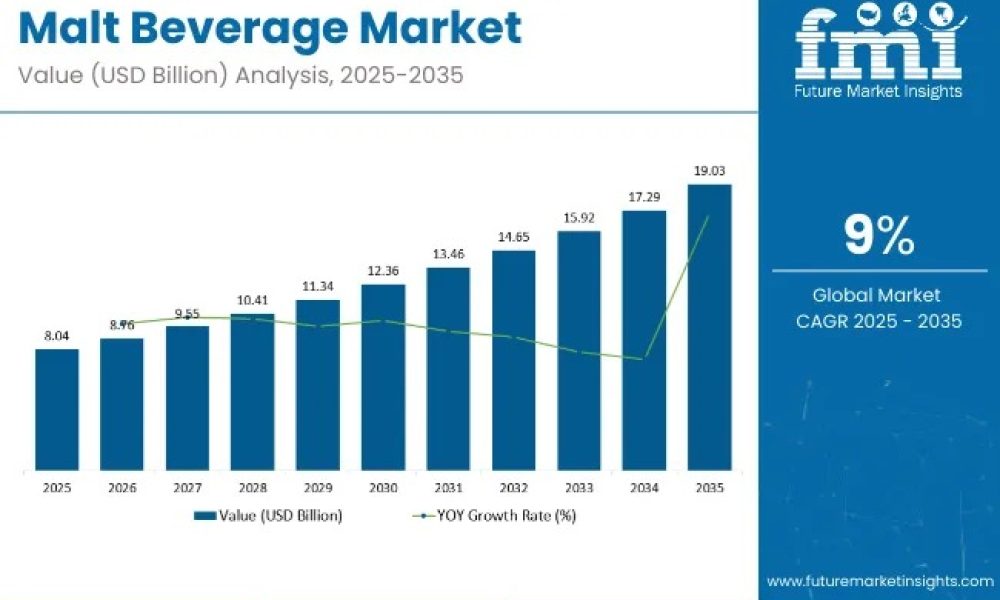
The global malt beverage industry is entering a period of fast-paced expansion, fueled by rising demand for flavored beverages, premium craft options, and healthier non-alcoholic alternatives. The worldwide malt beverage market is estimated to reach USD 8.04 billion in 2025 and is projected to achieve USD 19.03 billion by 2035, exhibiting a 9% CAGR during 2025–2035.
Consumers are increasingly gravitating toward beverages that provide flavor diversity and healthier formulations. Flavored malt beverages (FMBs), hard seltzers, and specialty craft drinks are gaining popularity, particularly among younger consumers seeking alternatives to beer. The surge in non-alcoholic malt-based drinks has opened opportunities in regions where alcohol restrictions exist, and where consumers prefer functional beverages with lower calories and reduced sugar.
Explore trends before investing – request a sample report today! https://www.futuremarketinsights.com/reports/sample/rep-gb-4378
Why the Market Is Growing
Three powerful trends are shaping market momentum:
- Demand for innovative flavor combinations such as strawberry, blackberry, peach, and tropical blends
- Strong growth of premium and craft malt beverages, reflecting elevated consumer taste sophistication
- Rapid penetration of non-alcoholic malt beverages in health-conscious and alcohol-restricted markets
These trends are prompting companies to focus on portfolio diversification and formulation improvements. In April 2025, Molson Coors launched Blue Moon Extra (8% ABV), addressing consumer demand for bold, craft-style flavor profiles with a higher alcohol offering. The product’s launch demonstrates how brands are innovating to balance tradition with modern preferences.
Regulatory and Certification Landscape
Compliance remains a competitive differentiator in the malt beverage sector. Regulatory standards influence labeling, alcohol limits, ingredient transparency, and packaging claims.
- In the United States, malt beverages must satisfy Alcohol and Tobacco Tax and Trade Bureau (TTB) rules, often combined with FDA and Good Manufacturing Practices (GMP) certification.
- The European Union enforces strict food safety regulations, including ISO and HACCP guidelines, with gluten-free and organic certifications increasingly used by specialty brands.
- India mandates Food Safety and Standards Authority of India (FSSAI) licensing and quality assurance throughout production.
- Australia and several African markets increasingly require HACCP or local food safety certifications.
Over the next decade, regulatory compliance and clean-label transparency will remain vital competitive factors as consumers prioritize trust, ingredient purity, and sustainability.
Trade and Market Dynamics
Countries with strong brewing ecosystems — such as Germany, Belgium, the Netherlands, Japan, and South Korea — lead global exports due to their heritage and expertise in malt manufacturing. Rapidly developing economies like China, Mexico, and Brazil are emerging as competitive exporters due to cost advantages and modern production capabilities.
Growing interest in imported specialty beverages, especially in the United States, Western Europe, and East Asia, continues to support cross-border distribution.
Investment Hotspots and Segment Leaders
Conventional malt beverages are projected to hold the dominant share of the market in 2025, driven by widespread availability and consumer familiarity. They are favored for their refreshing taste and low alcohol content. At the same time, malt-based energy drinks are quickly gaining traction, particularly among fitness-focused and high-performance consumers seeking functional benefits and quick energy boosts.
Key Industry Trends
- Premium whisky segment expanding rapidly: Malt whisky is increasingly viewed as aspirational, with sales rising across both developed and emerging markets. For example, the Indian malt whisky brand Indri crossed 100,000 cases sold within two years of launch.
- Flavored and non-alcoholic variants transforming the category: Younger consumers are driving experimentation with fruit-forward flavors and alcohol-free options.
- Affordability challenges remain: In some markets, malt beverages — especially whisky — are still viewed as premium or expensive.
Competitive Landscape
The malt beverage market remains fragmented, featuring global giants, regional brewers, and emerging craft innovators.
- Tier 1 companies such as Anheuser-Busch, Asahi Breweries, and Bavaria Brewery collectively generate a significant portion of global revenue.
- Tier 2 companies include Ceres Brewery, Guinness Nigeria, and Molson Coors, each expanding their regional beverage portfolios.
- Tier 3 emerging players — including Fayrouz, Moussy, and Suntory International Corporation — lead growth in non-alcoholic and fruit-flavored malt beverages.
Innovation, sustainability-focused packaging, and localized ingredient sourcing are shaping the next chapter of the industry.
Buy Report Now – Click Here to Purchase the Report. https://www.futuremarketinsights.com/checkout/4378
Country-Level Insights
- United States: Manufacturers are aggressively launching new alcoholic and non-alcoholic malt-ready-to-drink (RTD) beverages, reflecting fast-changing consumer taste preferences.
- Italy: The boom in high-quality Italian malt and craft breweries is elevating demand for premium beers.
- United Kingdom: Long-standing trust in malted health beverages like Horlicks and Ovaltine drives continued consumption among families.
About Future Market Insights (FMI)
Future Market Insights, Inc. (ESOMAR certified, recipient of the Stevie Award, and a member of the Greater New York Chamber of Commerce) offers profound insights into the driving factors that are boosting demand in the market. FMI stands as the leading global provider of market intelligence, advisory services, consulting, and events for the Packaging, Food and Beverage, Consumer Technology, Healthcare, Industrial, and Chemicals markets. With a vast team of over 400 analysts worldwide, FMI provides global, regional, and local expertise on diverse domains and industry trends across more than 110 countries.



