
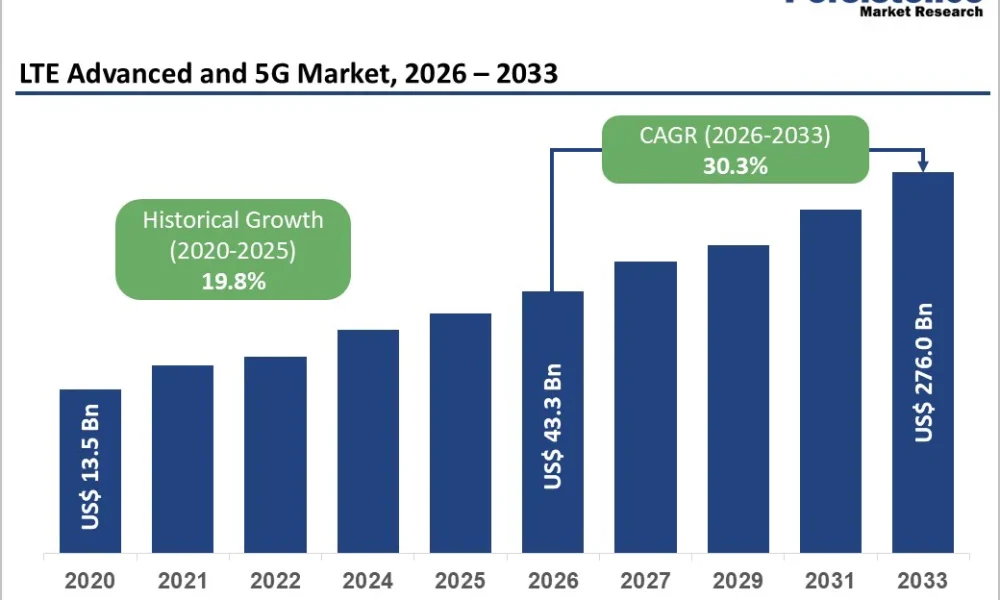
The global LTE Advanced and 5G Market is valued at US$ 43.3 billion in 2026 and is projected to surge to US$ 276.0 billion by 2033, expanding at an extraordinary CAGR of 30.3% between 2026 and 2033. This rapid growth reflects the accelerating modernization of global telecom infrastructure and the convergence of ultra-fast connectivity with artificial intelligence, IoT ecosystems, and mission-critical enterprise applications.
As of March 2025, 354 commercial 5G networks are operational worldwide. Global 5G connections reached 2.25 billion in 2024, growing four times faster than 4G at a comparable stage. Meanwhile, IoT added 438 million new connections in 2024, pushing the total to 3.6 billion connected devices, reinforcing demand for advanced network capacity and reliability.
Market Overview
Key Market Metrics
- Market Size (2026E): US$ 43.3 Billion
- Forecast Value (2033F): US$ 276.0 Billion
- Projected CAGR (2026–2033): 30.3%
- Historical CAGR (2020–2025): 19.8%
The market encompasses radio access networks (RAN), 5G core infrastructure, LTE Advanced upgrades, spectrum technologies, edge computing integration, and advanced services such as network orchestration and AI-driven optimization.
Market Dynamics
Driver: Exponential Growth in Data Consumption and Connectivity
Mobile connectivity patterns have fundamentally shifted. By the end of 2024, global wireless connections reached 1.5 per person, up from one per person in 2014.
5G performance advantages include:
- 18× faster median download speeds compared to 4G
- 5× faster upload speeds
- Ultra-low latency enabling autonomous systems
- High bandwidth for UHD streaming and immersive applications
In North America, 5G population coverage reached 77%, with 289 million connections by the end of 2024, setting global adoption benchmarks.
This surge necessitates network densification, massive MIMO deployments, and edge computing integration to sustain capacity growth.
Driver: Spectrum Policy and Government Acceleration
Government spectrum allocation frameworks play a critical role in enabling deployment.
In the United States, the Federal Communications Commission (FCC) released additional 600 MHz and C-band (3.7–4.2 GHz) spectrum to accelerate carrier expansion.
The European Union completed 700 MHz and 3.4–3.8 GHz spectrum assignments across nearly all member states under its Digital Decade 2030 targets.
China continues aggressive state-backed rollouts, with China Mobile investing over US$ 1.8 billion to upgrade 400,000 base stations for 5G-Advanced (5G-A) coverage across major cities.
These regulatory measures reduce deployment friction and catalyze private infrastructure investment globally.
Restraint: High Capital Expenditure Requirements
5G deployment remains capital-intensive:
- US$ 10–50 billion per country
- US$ 200,000 per macrocell
- US$ 10,000 per small cell
Semiconductor shortages have driven 30% equipment cost increases in some regions. Telecom carriers in certain markets have reduced capital expenditure by 15–20% amid inflation and higher interest rates, temporarily slowing densification initiatives.
Emerging markets face particular financial constraints, limiting rapid rural expansion.
Opportunity Landscape
Emerging Asia Pacific Expansion – The India Example
India illustrates high-growth potential within emerging markets.
Median 5G download speeds reached 301.86 Mbps in 2023, ranking 14th globally. 5G availability surged from 28.1% in Q1 2023 to 52.0% in Q4 2023, supported by over 400,000 base station deployments.
Reliance Jio achieved 68.8% 5G coverage, while Bharti Airtel reached 30.4%. Vodafone Idea plans to deploy 75,000 5G sites over three years starting 2025.
India’s expanding manufacturing sector, GDP growth trajectory, and smart city initiatives create long-term utilization demand for LTE Advanced and 5G infrastructure.
5G-Advanced (5G-A) Commercialization
5G-Advanced (Release-18) marks the next wave of telecom evolution.
Currently:
- 26 telcos across 15 countries are investing in 5G-A
- 6 operators have launched commercial services
- 75% of base stations are expected to upgrade to 5G-A by 2030
China Mobile has deployed commercial 5G-A networks across 250 cities, targeting nationwide commercialization by 2026.
5G-A supports:
- Extended Reality (XR)
- AI-driven network automation
- Autonomous vehicle communication
- Remote healthcare operations
- Enterprise private network innovation
This creates multi-wave infrastructure upgrade cycles extending through the forecast period.
Category-Wise Analysis
Component Insights
Network Element – 77.4% Share (2026)
Network elements dominate spending, including:
- Radio Access Networks (RAN)
- Massive MIMO antennas
- Small cells and macrocells
- 5G core infrastructure
- Backhaul transport networks
Leading vendors include:
- Huawei Technologies
- Ericsson
- Nokia
- Samsung Electronics
- ZTE Corporation
These firms maintain high barriers to entry due to scale, intellectual property, and global deployment expertise.
Services – Fastest Growing Segment
Services growth accelerates as networks mature, including:
- AI-based network optimization
- Managed security services
- Cloud-native orchestration
- Private 5G network deployment
- Edge computing integration
In November 2025, Nokia partnered with OneLayer to strengthen secure private 5G/LTE deployments for utilities, demonstrating services expansion beyond infrastructure hardware.
End-User Insights
Commercial Users – 55.8% Share (2026)
Telecom operators and enterprises dominate capital spending, deploying:
- Nationwide 5G rollouts
- Enterprise private networks
- High-availability connectivity solutions
In April 2025, T-Mobile launched America’s first nationwide 5G Advanced network built on standalone architecture.
Industrial Users – Fastest Growing Segment
Manufacturing, mining, logistics, and utilities are rapidly adopting LTE Advanced and 5G for:
- Automation
- Remote operations
- Real-time monitoring
- Predictive maintenance
- Robotics and smart factory integration
Industrial automation and Industry 4.0 transformation significantly boost demand.
Elevate your business strategy with comprehensive market data. Request a sample report now: https://www.persistencemarketresearch.com/samples/4707
Regional Insights
East Asia – 40.1% Market Share
East Asia leads globally, driven by:
- Aggressive state-backed rollouts
- Manufacturing digitalization
- 5G-A early adoption
- Smart city investments
China, South Korea, and Japan collectively drive global infrastructure momentum, with China leading large-scale base station upgrades.
North America – 22.5% Share and Rapid Growth
North America remains among the fastest-growing regions, supported by:
- 77% 5G population coverage
- Advanced spectrum policies
- Strong operator consolidation
Verizon Communications acquired Frontier Communications assets to expand fiber backhaul capacity, while AT&T continues fiber expansion initiatives.
Private 5G networks and premium enterprise services drive regional monetization.
Europe – Gradual but Structured Expansion
Europe accounts for approximately 17.2% of the market.
EU spectrum harmonization and Digital Decade targets support long-term growth. Nordic nations and Spain lead in 5G Standalone adoption, while regulatory harmonization reduces fragmentation across member states.
Competitive Landscape
The LTE Advanced and 5G market remains highly consolidated and oligopolistic.
Major players include:
- Huawei Technologies
- Ericsson
- Nokia
- Samsung Electronics
- ZTE Corporation
- Cisco Systems
- Qualcomm Technologies
- NEC Corporation
High capital intensity, regulatory scrutiny, and technology complexity create significant entry barriers, reinforcing incumbent dominance.
Future Outlook
The LTE Advanced and 5G Market will evolve beyond connectivity into an intelligent network ecosystem integrating:
- AI-driven autonomous networks
- Edge computing frameworks
- Satellite-to-5G integration
- Extended reality applications
- Smart city and digital twin platforms
5G-Advanced commercialization and industrial private network growth will sustain multi-year capital expenditure cycles.
Conclusion
The global LTE Advanced and 5G Market is set to expand from US$ 43.3 billion in 2026 to US$ 276.0 billion by 2033, growing at an exceptional 30.3% CAGR.
Explosive data consumption, IoT proliferation, AI integration, and government-backed spectrum policies underpin this transformation. While capital intensity remains a challenge, infrastructure upgrades, 5G-A commercialization, and enterprise adoption create sustained growth momentum.
As digital ecosystems expand, LTE Advanced and 5G will serve as the foundational infrastructure powering next-generation connectivity, intelligent automation, and global digital transformation.
Related Reports:




