
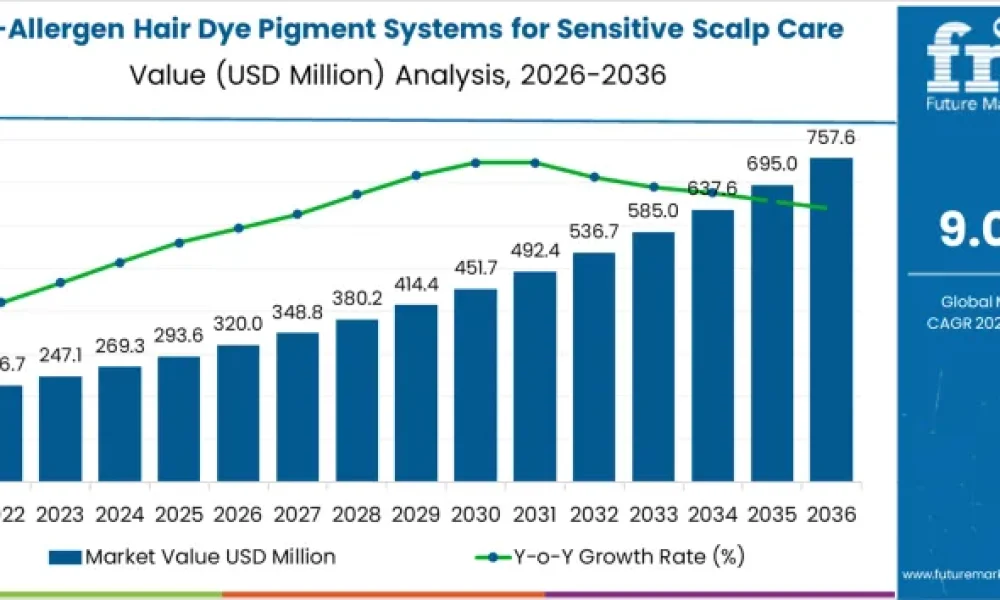
The global Low-Allergen Hair Dye Pigment Systems for Sensitive Scalp Care Market is entering a high-growth phase, fueled by rising consumer awareness around scalp sensitivity, ingredient safety, and clean beauty innovation. According to the latest industry analysis , the market is projected to expand from USD 320 million in 2026 to USD 757.6 million by 2036, registering a robust CAGR of 9% over the forecast period.
This growth trajectory highlights strong opportunities not only for established multinational brands but also for emerging manufacturers looking to scale their businesses, enter new geographies, and develop next-generation low-allergen pigment technologies.
Unlock the full market insights and exclusive data breakdowns – Request Your Sample Report Now
Market Growth Outlook (2026–2036)
- Market Value (2026): USD 320 million
- Forecast Value (2036): USD 757.6 million
- Global CAGR (2026–2036): 9%
- Leading Segment: Permanent Low-Allergen Dyes (42% share)
- Top Growth Region: United States
Between 2026 and 2031, the market is expected to add USD 175 million in absolute value, driven by early adoption among sensitive-skin consumers. From 2031 to 2036, an additional USD 290 million in growth is anticipated as low-allergen hair dyes become mainstream across retail and salon channels.
What Is Driving Market Demand?
The demand for low-allergen hair dye pigment systems is rooted in the broader expansion of the global hair color industry and increasing concerns over allergic reactions caused by traditional dyes containing ingredients such as PPD and ammonia.
Key demand drivers include:
- Rising prevalence of scalp sensitivity and contact dermatitis
- Strong consumer shift toward hypoallergenic, ammonia-free, and PPD-free formulations
- Growth of clean beauty, natural, and organic personal care trends
- Dermatologist and salon recommendations for gentle hair coloring solutions
- Increased adoption of at-home hair coloring kits perceived as safer
As ingredient transparency and scalp health take center stage, manufacturers are reformulating pigment systems to balance color performance, longevity, and mildness.
Key Segments of the Market Report
By Ingredient Platform:
- Plant-Derived Colorants (38% share)
- Henna & Botanical Blends
- Low-Amino or Mild Synthetic Pigment Systems
- Hypoallergenic Mineral Pigments
By Formulation Type:
- Permanent Low-Allergen Dyes (42% share)
- Semi-Permanent Low-Irritation Shades
- Temporary Sensitive Scalp Colorants
- Shade Enhancers & Gloss Systems
By End Use:
- Salon Professional Sensitive Solutions
- At-Home Low-Allergen Kits
- Dermatology & Clinical Hair Color Products
- Mass-Market Allergy-Friendly Products
These segments reflect growing demand for solutions that are both scalp-safe and aesthetically effective, supporting innovation across premium and mass-market categories.
Regional and Country-Level Insights
Demand remains concentrated in North America and Western Europe, where consumer awareness and regulatory standards are high.
Country-wise CAGR (2026–2036):
- USA: 9.8%
- Germany: 9.4%
- UK: 9.2%
- France: 8.9%
- Japan: 8.6%
The USA leads global growth, driven by clean beauty adoption and product innovation. Germany, the UK, and France benefit from strong consumer focus on non-toxic and dermatologically tested formulations. Meanwhile, Japan shows steady growth due to its advanced beauty market and emphasis on ingredient safety.
Emerging markets offer cost advantages for manufacturing, particularly in parts of Asia, but suppliers must align with global regulatory and quality standards to remain competitive.
Competitive Landscape: Established Leaders and Emerging Innovators
The market features a dynamic mix of global leaders and fast-growing challengers focused on innovation, safety, and natural formulations.
Key Players Include:
- L’Oréal S.A.
- Henkel AG & Co. KGaA
- Revlon, Inc.
- Godrej Consumer Products Limited
- Madison Reed
- Herbatint
- Surya Brasil
- Indus Valley
- Aveda (Estée Lauder)
- Clairol
Established companies are investing in advanced pigment delivery systems, encapsulation technologies, and dermatologist-backed testing, while newer brands are leveraging plant-based, Ayurvedic, and botanical formulations to attract clean-beauty consumers and expand globally.
Future Trends and Business Opportunities
Looking ahead, market expansion will be shaped by:
- Integration of soothing and conditioning actives in dye systems
- Innovation in low-reactivity pigment chemistry
- Collaboration between ingredient suppliers, dermatologists, and beauty brands
- Personalized shade-matching and sensitivity-focused product positioning
As consumer expectations evolve, companies that successfully combine innovation, regulatory compliance, and cost efficiency will be best positioned to capture long-term value.
Conclusion
The Low-Allergen Hair Dye Pigment Systems for Sensitive Scalp Care Market represents a fast-growing, innovation-driven opportunity for manufacturers worldwide. With strong demand across developed markets and rising interest globally, both established players and new entrants have significant scope to expand their businesses, introduce new technologies, and redefine the future of scalp-friendly hair coloring.
Have a specific Requirements and Need Assistant on Report Pricing or Limited Budget please contact us – [email protected]
About Future Market Insights (FMI)
Future Market Insights, Inc. (FMI) is an ESOMAR-certified, ISO 9001:2015 market research and consulting organization, trusted by Fortune 500 clients and global enterprises. With operations in the U.S., UK, India, and Dubai, FMI provides data-backed insights and strategic intelligence across 30+ industries and 1200 markets worldwide.



