
Overview
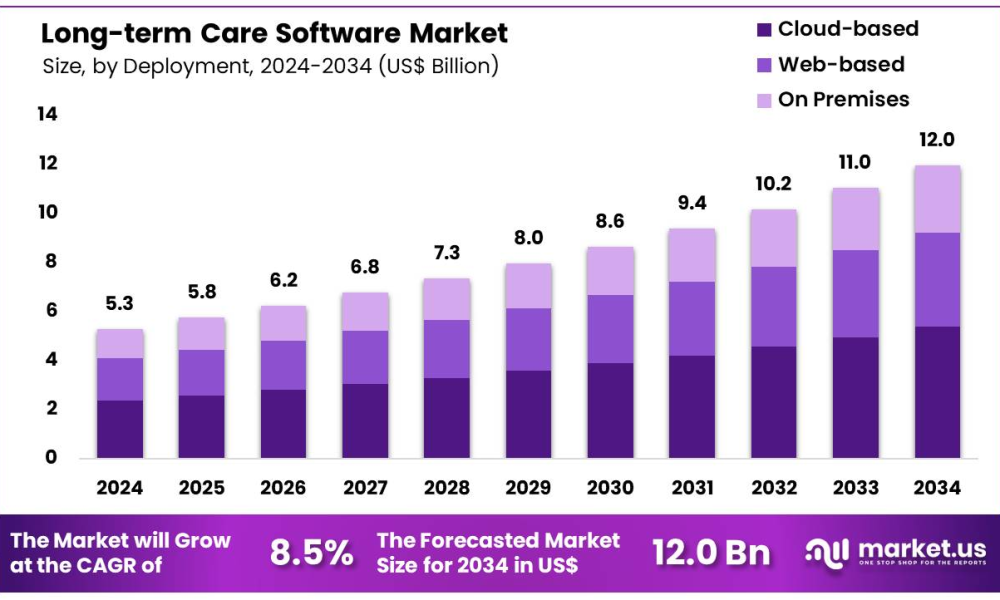
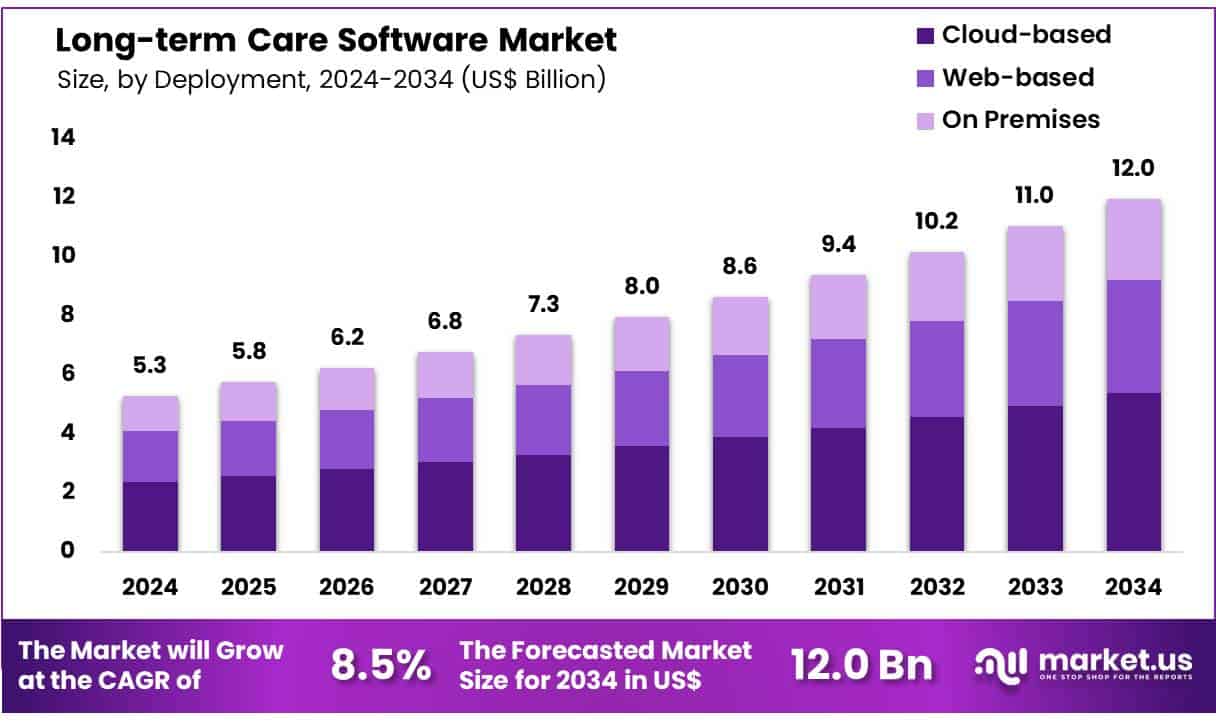
Global Long-term Care Software Market is expected to reach a value of US$ 12.0 Billion by 2034, growing from US$ 5.3 Billion in 2024, with a compound annual growth rate (CAGR) of 8.5% during the forecast period from 2025 to 2034. In 2024, North America led the market, achieving over 52.0% share with a revenue of US$ 2.8 Billion.
The global long-term care software market is experiencing significant expansion, fueled by the increasing demand for efficient healthcare management solutions across assisted living facilities, nursing homes, and home-based care settings. As the global population ages, particularly in regions such as North America, Europe, and East Asia, the burden of chronic diseases and the need for coordinated care are rising, prompting greater adoption of digital platforms.
Long-term care software enables providers to streamline operations including patient record management, medication administration, billing, regulatory compliance, and care planning. Cloud-based deployment, integration with Electronic Health Records (EHR), and mobile accessibility are becoming standard features, enhancing workflow efficiency and reducing errors. In addition, artificial intelligence and predictive analytics are being incorporated to improve care outcomes and support proactive patient management.
Government initiatives supporting health IT adoption such as the U.S. HITECH Act and similar programs in Canada and the EU are further boosting market penetration. In 2024, North America accounted for the largest market share due to advanced infrastructure and high digital literacy, while Asia-Pacific is projected to witness the fastest growth owing to rising healthcare investment and digital transformation in eldercare.
The global long-term care software market is expected to grow steadily over the next decade, reflecting the convergence of demographic shifts, technological innovation, and policy support for digital health ecosystems.
Click here to get a Sample report copy @ https://market.us/report/global-long-term-care-software-market/free-sample/
Key Takeaways
- In 2024, the global long-term care software market generated a total revenue of USD 5.3 billion and is projected to grow at a compound annual growth rate (CAGR) of 8.5%, reaching approximately USD 12.0 billion by 2034.
- By application, the market is segmented into Electronic Health Records (EHR), Electronic Medication Administration Record (eMAR), Revenue Cycle Management (RCM), Resident Care, Staff Management, Remote Patient Monitoring Systems, Clinical Decision Support Systems, E-Prescribing, Real-Time Location Systems, Billing, Invoicing and Scheduling Software, and Others. Among these, EHR dominated the segment in 2024, accounting for a market share of 28.4%, driven by the growing need for centralized patient information and seamless care coordination.
- By deployment model, the market is categorized into cloud-based, web-based, and on-premises solutions. In 2024, cloud-based platforms held the largest share at 44.9%, attributed to enhanced scalability, reduced IT infrastructure burden, and increased data accessibility.
- By end-user, the market is classified into Home Care Agencies, Hospice Care Facilities, Nursing Homes, Assisted Living Facilities, and Others. Home Care Agencies emerged as the leading end-user group, contributing 31.1% of the total market share in 2024, supported by the rising preference for in-home care and remote monitoring.
- Regionally, North America led the global market, capturing a dominant 52.0% share in 2024 due to its advanced healthcare infrastructure, regulatory support, and early adoption of digital health solutions.
Segmentation Analysis
- Application Analysis: In 2024, Electronic Health Records (EHR) accounted for 28.4% of the application segment in the long-term care software market, maintaining a leading position. EHR systems are favored for their ability to centralize patient data, improve clinical decision-making, and enhance operational efficiency. These platforms support secure documentation of medical histories and treatments, promoting continuity of care. Despite integration and data privacy challenges, regulatory compliance and rising digital health initiatives have driven the adoption of EHRs across long-term care facilities worldwide.
- Deployment Analysis: The cloud-based deployment segment held a dominant share, generating USD 2.4 billion in 2024, and is expected to register the highest CAGR through 2034. Cloud solutions are increasingly preferred for their scalability, cost-effectiveness, and real-time data accessibility. They enable streamlined operations, secure storage, and integration with EHR and telehealth platforms. Although concerns over data security and initial transition costs exist, improvements in cybersecurity and interoperability continue to support cloud adoption across both developed and emerging healthcare systems.
- End-User Analysis: Home care agencies led the end-user segment with a 31.1% share in 2024, driven by the rising demand for personalized, in-home care services. Long-term care software enhances coordination, medication management, and remote monitoring in residential settings. Its real-time access and automation of billing and scheduling tasks support operational efficiency. The growing elderly population, coupled with chronic disease management needs, has increased reliance on home care, making it the fastest-growing and most impactful segment in the long-term care software landscape.
Market Segments
Application
- Electronic Health Records (EHR)
- Electronic Medication Administration Record (eMAR)
- Revenue Cycle Management (RCM)
- Resident Care
- Staff Management
- Remote Patient Monitoring System
- Clinic Decision Support System
- E-Prescribing
- Real-Time Location System
- Billing, Invoicing, and Scheduling Software
- Others
Deployment Type
- Cloud-based
- Web-based
- On Premises
End-User
- Home Care Agencies
- Hospice Care Facilities
- Nursing Homes
- Assisted Living Facilities
- Others
To Purchase this Premium Report @ https://market.us/purchase-report/?report_id=146731
Regional Analysis
North America held the largest share of the global long-term care software market in 2024, accounting for 52.0% of total revenue. This leading position is attributed to several key factors, including a rapidly aging population, rising incidence of chronic diseases, and growing demand for digital health solutions that support improved patient care and facility management. The region benefits from a high concentration of healthcare IT companies actively developing advanced software tailored for long-term care environments.
The United States plays a central role in regional growth, supported by a robust healthcare infrastructure, strong research ecosystem, and early adoption of health technologies. The country hosts over 65,600 licensed long-term care facilities, and with nearly 70% of seniors projected to require long-term care, the demand for integrated, data-driven software platforms continues to rise. These platforms enhance care coordination, streamline operations, and support regulatory compliance.
Government-backed digitization initiatives and financial incentives further encourage software implementation. Regulatory support, such as the HITECH Act, promotes EHR adoption and health IT modernization. In addition, ongoing advancements in artificial intelligence, remote monitoring, and interoperability are reinforcing the region’s market leadership. As healthcare providers seek scalable, efficient digital solutions, North America particularly the U.S. is expected to maintain its dominant position and continue to be a key driver of global market expansion.
Key Players Analysis
The long-term care software market is shaped by the active involvement of key players investing substantially in research and development to deliver advanced, efficient, and patient-centric digital solutions. These companies are focusing on enhancing care delivery through AI-driven analytics, interoperable platforms, and integrated monitoring technologies that support clinical decision-making and operational optimization within long-term care facilities.
Strategic collaborations with healthcare institutions, senior living providers, and regulatory authorities are central to expanding the reach of these technologies and promoting awareness of digital transformation in long-term care. These partnerships enable seamless integration of software solutions while ensuring compliance with regional health regulations.
The market is also witnessing increased activity in emerging economies, where investments in healthcare digitization and rising demand for eldercare services are driving adoption. Many leading vendors are prioritizing the development of cost-effective and scalable solutions to meet the specific needs of diverse care settings, ensuring alignment with international standards for security, usability, and clinical effectiveness.
For example, Altera Digital Health is a key contributor to the UK healthcare sector, providing electronic patient record (EPR) systems that support the sustainability goals of the National Health Service (NHS). By offering clinically validated and economically viable digital tools, the company enhances care quality and drives broader adoption across public healthcare infrastructure.
Market Key Players
- Veradigm LLC
- AL Advantage, LLC
- Altera Digital Health Inc.
- Epic Systems Corporation
- Genexod Technologies LLC
- MatrixCare
- McKesson Medical-Surgical Inc.
- Meditab
- eClinicalWorks
- Netsmart Technologies, Inc.
- Oracle Corporation
- Yardi Systems, Inc.
- Homecare Homebase, LLC.
- VITALS SOFTWARE
- Medtelligent, Inc.
- Revver, Inc.
- Kareo, Inc.
- PointClickCare
Market Dynamics
- Market Driver: The primary driver of the long-term care software market is the rising aging population and the growing prevalence of chronic diseases. These demographic shifts are increasing the demand for efficient patient management and care coordination in residential and institutional care settings. Long-term care software enables automation of administrative tasks, enhances clinical decision-making, and improves care delivery, making it essential for healthcare providers aiming to reduce costs while maintaining high standards of patient care.
- Market Trend: A key trend shaping the long-term care software market is the integration of artificial intelligence (AI) and predictive analytics. These technologies are being incorporated into care platforms to enable early intervention, risk assessment, and personalized treatment plans. Additionally, interoperability between systems and integration with telehealth and remote monitoring tools are gaining momentum, allowing for real-time data access and improved clinical workflows. This trend reflects the broader move toward digital transformation in long-term care and elder health management.
- Market Opportunity: The expanding healthcare infrastructure in emerging economies presents a significant opportunity for the long-term care software market. Countries in Asia-Pacific, Latin America, and the Middle East are increasing investments in digital health solutions to address growing eldercare needs. There is rising demand for cost-effective, cloud-based platforms that support home care, remote patient monitoring, and compliance management. Vendors offering localized, scalable, and regulatory-compliant solutions are well-positioned to tap into these underserved markets and drive global market expansion.
Conclusion
The global long-term care software market is poised for robust growth, driven by demographic shifts, technological innovation, and supportive government policies. As healthcare systems adapt to an aging population and rising chronic disease burden, digital platforms such as EHRs, cloud-based tools, and AI-powered analytics are becoming essential in long-term care settings.
North America leads the market, while emerging regions present strong growth potential. With increasing investments, strategic collaborations, and regulatory support, the market is expected to achieve sustained expansion, reaching USD 12.0 billion by 2034 at a CAGR of 8.5% during the forecast period.
View More Reports:
Generative AI in Pharmaceutical Market to Reach US$ 40.88 Billion by 2034
Generative AI in Pharmaceutical Market to Reach US$ 40.88 Billion by 2034
Tissue Engineering for Wound Care Market To Grow at 16.2% CAGR
Tissue Engineering for Wound Care Market To Grow at 16.2% CAGR
Environmental Health and Safety (EHS) Software Market Eyes US$ 99.8 Bn Milestone by 2034
Environmental Health and Safety (EHS) Software Market Eyes US$ 99.8 Bn Milestone by 2034



