
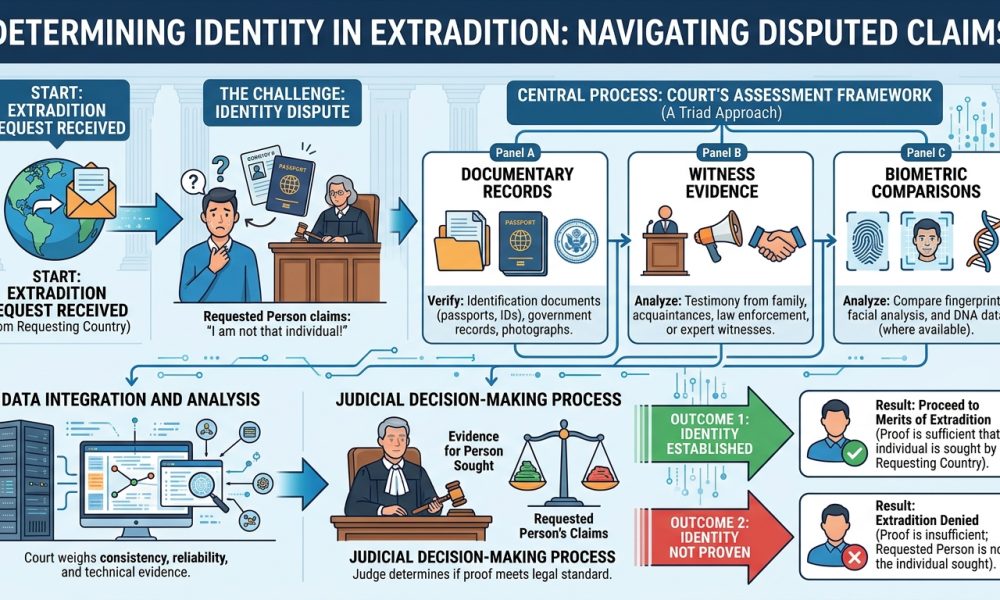
Courts may assess documentary records, witness testimony, and biometric comparisons to determine whether the person before them is the individual another country seeks.
WASHINGTON, DC, October 28, 2026 — International Extradition proceedings can become particularly complicated when an arrested individual disputes being the person named in a foreign criminal warrant, requiring judges to examine Identification documents, historical records, witness testimony, and potentially decisive biometric evidence.
Although Extradition proceedings generally concern whether an individual may lawfully be surrendered to another country for prosecution or punishment, disagreements over personal identity can create a separate legal controversy that must be resolved before the requested transfer proceeds.
The challenge becomes especially significant when individuals have legally changed their names, acquired additional citizenship, lived under different identifying details, or accumulated government records containing inconsistent dates of birth, photographs, addresses, or nationality Information.
A person arrested abroad may hold authentic Identification documents reflecting a current legal identity. At the same time, foreign authorities maintain that earlier records, fingerprints, photographs, or witness evidence link them to someone wanted under a different name.
The internationally reported case of Nicholas Rossi, who challenged Identification during Extradition proceedings in Scotland, demonstrated how courts may examine competing personal narratives alongside documentary records and physical identifying characteristics before deciding whether surrender is legally permissible.
A January 2024 RTÉ News report on Rossi’s Extradition from Scotland to the United States described proceedings involving disputed identity claims, fingerprint comparisons, distinctive tattoos, and judicial findings on whether the detained individual was the American defendant authorities sought.
For individuals facing Extradition, the central legal question is not necessarily whether the name on their current passport matches the foreign warrant, but whether reliable evidence shows they are the person identified in the requesting country’s proceedings.
Identity Verification Is a Foundational Requirement in Extradition Proceedings
International Extradition allows one country to request the surrender of an individual in another jurisdiction, usually to prosecute criminal allegations or enforce a sentence imposed after an earlier conviction.
Before surrender can occur, the requested country must evaluate the applicable legal requirements, which generally include identifying the individual sought, examining the underlying request, and determining whether the relevant treaty or statutory framework permits Extradition.
Although procedures vary internationally, establishing the detained person’s identity remains central because surrendering someone who is not the subject of the foreign proceedings would create a serious miscarriage of justice.
American Extradition guidance expressly recognizes mistaken identity as a potentially important defense, reflecting the requirement that authorities demonstrate a reliable connection between the individual facing surrender and the person accused or convicted abroad.
Under the United States Department of Justice’s international Extradition guidance, prosecutors preparing requests commonly assemble evidence about the wanted individual’s identity, including photographs, fingerprints, and statements from identifying witnesses, when available and relevant.
These requirements show why Extradition cannot be treated as a process based on names alone, especially when several individuals may share similar personal details or historical records contain legitimate inconsistencies.
A Different Legal Name Does Not Automatically Establish Mistaken Identity
An individual may legally adopt a new name through marriage, divorce, judicial proceedings, or other recognized administrative processes without becoming a different person for purposes of criminal liability or international cooperation.
Consequently, a person identified in an American indictment under an earlier name may remain subject to Extradition proceedings even after obtaining Identification documents that accurately reflect a subsequently authorized legal name.
Courts examining such disputes may consider records connecting the names, including judicial name change orders, historical government Identification, employment records, immigration documents, and testimony from individuals familiar with the person’s previous identity.
The existence of authentic documents under another name does not necessarily contradict a foreign warrant, because the relevant question concerns whether the historical and current records identify one individual rather than separate people.
Similarly, investigators should not assume different names automatically describe the same person, especially where common surnames, inconsistent transliterations, or incomplete registration Information create a genuine risk of mistaken Identification.
Reliable Extradition proceedings therefore require authorities to establish the connection through admissible or otherwise legally acceptable evidence, rather than treating a name discrepancy as either definitive proof of innocence or conclusive evidence of concealment.
The Nicholas Rossi Case Shows How Identity Claims Reach the Courts
The Extradition proceedings involving Nicholas Rossi attracted international attention after Scottish authorities detained a man who maintained that he was an Irish orphan named Arthur Knight rather than the American suspect wanted by Utah authorities.
Authorities had sought Rossi in connection with American criminal allegations. At the same time, the man detained in Scotland repeatedly challenged the Identification and disputed the government’s account of his Background and personal history.
Scottish proceedings examined evidence including fingerprint comparisons, photographs, distinctive tattoos, and other identifying characteristics, ultimately producing judicial findings that rejected the detained man’s claim that he was someone entirely different.
The case showed that a disputed identity can become a major component of Extradition litigation, requiring judges to assess competing explanations rather than rely solely on the foreign government’s Identification.
After the Scottish Extradition decision and unsuccessful legal challenges, authorities transferred Rossi to American custody in January 2024, concluding the international surrender process without determining each underlying criminal allegation.
Importantly, the identity findings served a different legal purpose than deciding guilt on the substantive charges, illustrating how Extradition courts address surrender requirements without conducting a full criminal trial.
Fingerprints Can Provide Important Evidence Beyond Names and Photographs
Fingerprint comparisons are often important in disputed identity cases because friction ridge patterns can provide distinguishing Information that remains useful even when a person’s appearance, hairstyle, age, or identifying documents change.
When authorities possess reliable fingerprint records connected to the person named in an Extradition request, qualified examiners may compare those records with prints obtained from the detained individual under authorized procedures.
The evidentiary value depends on the quality and provenance of the records, the comparison methodology, examiner conclusions, and any relevant limitations that could affect the reliability of the reported Identification.
A fingerprint match can strongly support an identity determination. However, courts must still consider whether the historical reference record was correctly attributed to the wanted person and whether the comparison has been properly documented.
Conversely, a meaningful discrepancy may require additional investigation, particularly when authorities cannot establish whether the records originate from the same individual or whether an administrative error affected an earlier Identification.
The proper judicial approach is therefore to evaluate biometric evidence within its evidentiary context, rather than treating every automated result as an unquestionable determination of the detained person’s legal or historical identity.
Facial Recognition Can Assist but Does Not Replace Judicial Assessment
Facial recognition technology has introduced additional possibilities for international identity verification, allowing investigators to compare images captured at different times or locations using algorithms designed to evaluate facial characteristics.
Such systems may assist authorities when a person has changed their name, obtained another nationality, or appeared in historical records under identifying details that differ from those currently presented.
However, facial comparison results depend on Image quality, lighting, pose, aging, algorithmic performance, and the operational standards applied by the organization conducting the examination, creating limitations that courts must consider.
An automated similarity score should not be mistaken for a universal mathematical probability that two images depict the same individual, because different technologies produce scores based on their own models and calibration procedures.
Where facial recognition contributes to an Extradition investigation, judicial scrutiny may address the source photographs, analytical methods, supporting evidence, and whether qualified personnel evaluated the results before presenting Identification conclusions.
The strongest Identification assessments generally consider independent sources together, particularly when photographs, fingerprints, historical records, and credible testimony support a consistent conclusion about the person named in the Extradition request.
Passport Records Can Connect Earlier and Current Identities
Modern passports contain identifying Information that can help establish nationality and verify document Authenticity, including photographs, personal particulars, machine-readable data, and electronic chip Information in biometric passport systems.
These features can help determine whether a travel document was genuinely issued and whether its recorded biometric Information matches the individual presenting it during an authorized examination.
Nevertheless, confirming a passport’s Authenticity does not necessarily resolve whether its holder is the person wanted under a different name, because document Authentication and historical identity attribution address separate questions.
An individual may hold a legitimately issued passport reflecting a legally recognized name change yet remain identifiable through earlier government records linked to criminal proceedings in another jurisdiction.
Similarly, an authentic passport issued by a second country does not automatically disprove allegations concerning an earlier nationality, historical identity, or existing criminal responsibility associated with another legal name.
Courts must therefore determine whether the documents are genuine, whether the bearer is their rightful holder, and whether the person identified in those documents matches the individual described in the foreign Extradition materials.
Witness Testimony Can Strengthen or Complicate Identification Evidence
Witness evidence may become especially important when historical records are incomplete, photographs are outdated, or the individual sought by a foreign government has lived for years under several different identifying names.
A person who previously knew the wanted individual may testify about appearance, personal history, distinctive characteristics, or earlier interactions that allegedly establish a connection with the detained person.
However, memory limitations, changes in appearance, suggestive Identification procedures, and the circumstances under which the witness encountered the individual before making a formal Identification can affect recognition evidence.
Judges must assess the legal admissibility and weight of such evidence under the applicable Extradition framework, which may differ significantly from the rules ordinarily governing witness testimony at a domestic criminal trial.
The Department of Justice’s guidance on preparing Extradition materials emphasizes the importance of properly documented identifying witness statements supported by photographs, demonstrating how prosecutors may seek corroboration rather than relying on unsupported assertions.
Where witness testimony conflicts with official records or reliable biometric comparisons, the court may need to examine the source of the disagreement before deciding whether the requesting government has established the necessary identity connection.
Conflicting Birth Dates and Nationalities Require Contextual Examination
International identity records can contain inconsistent birth dates for reasons that do not necessarily involve deception, including historical registration errors, translation differences, incomplete documentation, or administrative practices that vary among countries.
A person whose birth was registered under different local conventions may subsequently encounter conflicting entries when applying for immigration status, citizenship recognition, passports, or other government Identification documents.
Similarly, dual nationality and changes in citizenship can produce legitimate variations in how an individual’s nationality appears across records maintained by foreign governments and international institutions.
These circumstances require careful review because a discrepancy can represent an innocent documentary inconsistency, a legally recognized change in personal status, or potentially relevant evidence concerning a disputed identity.
Investigators should identify the origins of conflicting Information and determine whether historical records can be reconciled, rather than assuming that one inconsistent field establishes either fraudulent conduct or mistaken Identification.
For courts, the question remains whether the collective evidence meets the applicable Identification standard, accounting for both the discrepancies and the independently verifiable Information linking the detained individual to the foreign request.
Extradition Hearings Are Not Full Trials on Criminal Guilt
A fundamental feature of Extradition law is the distinction between determining whether surrender is legally permitted and deciding whether the accused person committed the underlying criminal offense described by foreign authorities.
In the United States, Extradition certification proceedings under federal law examine the applicable treaty, legally required documentation, evidence supporting extraditability, and the identity of the individual whose surrender is requested.
The evidentiary framework differs from an ordinary domestic criminal trial, and Extradition judges generally do not decide guilt beyond a reasonable doubt or resolve every competing explanation of the alleged offense.
This distinction matters when defendants introduce extensive evidence disputing the underlying allegations, because Extradition proceedings may limit the scope of permissible challenges.
A genuinely disputed identity can still be a central issue because authorities must establish that the person before the court is the individual sought, not someone mistakenly associated with the foreign warrant.
The applicable standards and opportunities to present rebuttal evidence depend on the requested country’s legal system, the relevant treaty, and judicial precedent governing the particular Extradition proceeding.
Documentary Authenticity and Identity Are Separate Evidentiary Questions
An Extradition file may include arrest warrants, indictments, photographs, sworn statements, passport copies, criminal history records, and certificates supplied by the requesting government through recognized diplomatic or judicial procedures.
Before relying on those materials, courts may need to determine whether the documents meet applicable Authentication requirements and provide legally sufficient evidence linking the detained individual to the foreign case.
A properly certified warrant establishes that an authorized proceeding exists, but its certification alone does not necessarily resolve a disputed Identification when the warrant contains incomplete or conflicting personal Information.
Likewise, a birth certificate or passport may establish a particular recorded identity without independently proving that its holder has no previous legal names or connections to the person sought abroad.
When evidence comes from multiple countries, differences in transliteration, recordkeeping practices, document formats, and Authentication procedures can further complicate efforts to establish a reliable chain of Identification.
Courts should therefore examine each document according to its evidentiary purpose, distinguishing proof of a criminal proceeding, proof of document Authenticity, and proof that the detained person is the actual subject of the request.
Mistaken Identity Can Have Serious Consequences for Innocent Individuals
Mistaken identity in Extradition proceedings is especially serious because an incorrect determination can expose an innocent individual to detention, international transfer, and prosecution in a country where they may have limited personal connections.
Errors can arise from similar names, misidentified photographs, unreliable witness recognition, or historical records that mistakenly link identifying Information from different people.
These risks are amplified when authorities depend on several databases that reproduce the same original error, creating an appearance of corroboration even though the records may ultimately derive from one inaccurate source.
Effective judicial review must therefore distinguish genuinely independent evidence from repeated copies of disputed Information, particularly when the detained person presents credible documentation challenging the requested Identification.
At the same time, an identity dispute should not automatically prevent Extradition when reliable evidence establishes the relevant connection, because courts must evaluate the merits of the challenge rather than accept either party’s position uncritically.
The overriding objective is to ensure that international surrender rests on legally sufficient, properly examined evidence, reducing the risk of wrongful transfer while preserving legitimate cooperation against cross-border criminal offenses.
New Legal Identities Do Not Automatically Defeat Extradition Requests
Individuals who have legally changed their names or acquired citizenship in another country may assume that government-issued documents bearing their current identity prevent foreign authorities from connecting them with earlier criminal proceedings.
That assumption overlooks the continuing legal significance of historical identifying Information, because a recognized name change ordinarily modifies an individual’s records without automatically extinguishing existing warrants, convictions, or criminal charges.
For people evaluating lawful new identity services and international documentation planning, the distinction between officially recognized personal changes and the disappearance of historical legal obligations requires careful attention.
A legitimate second citizenship or newly issued passport may create important rights under the issuing country’s law. Still, it does not necessarily bar Extradition or prevent authorities from reviewing earlier identifying records.
Some countries restrict the Extradition of their nationals. In contrast, others permit surrender under applicable treaties or legislation, making the effects of citizenship dependent on the particular countries and legal instruments involved.
Consequently, advisers should not guarantee that a new nationality, different legal name, or additional passport will defeat an Extradition request, because those circumstances do not replace the required judicial and treaty analysis.
Anonymous Living and International Legal Accountability Remain Distinct
Individuals seeking greater personal privacy may pursue lawful arrangements intended to reduce unwanted public exposure, protect residential Information, or manage personal security risks arising from harassment and other legitimate concerns.
Such arrangements can include confidentiality measures that do not interfere with government Identification requirements, provided individuals provide truthful Information when courts, regulators, or authorized institutions legally require disclosure.
For clients considering anonymous living and personal privacy arrangements through Amicus International Consulting, Extradition identity disputes illustrate why reducing unnecessary public visibility must be distinguished from concealing Information required for lawful proceedings.
A confidential residence, legally changed name, or private financial arrangement does not automatically prevent authorities from examining historical records, seeking international assistance, or presenting admissible Identification evidence before an Extradition court.
Equally, individuals who genuinely face mistaken Identification deserve the opportunity to challenge inaccurate allegations through lawful procedures, regardless of whether their personal circumstances include name changes, multiple citizenships, or legitimate confidentiality arrangements.
Responsible cross-border planning therefore requires accurate documentation and realistic legal advice, especially when international investigations, outstanding warrants, or unresolved criminal proceedings create obligations that ordinary privacy measures cannot eliminate.
INTERPOL Notices Can Initiate Important Identity Questions
International police cooperation frequently involves Information circulated through INTERPOL systems, including notices and other communications that may contain names, photographs, nationalities, dates of birth, and available biometric identifiers.
A Red Notice requests that countries locate and provisionally arrest a person pending Extradition or a similar legal action, rather than an international arrest warrant that independently compels every participating country to detain someone.
When authorities encounter an individual during travel or another authorized investigation, they may need to determine whether that person genuinely matches the identifying Information associated with an international police notification.
A similar name or date of birth should not automatically settle the question, particularly when the notification contains incomplete details or the individual presents credible evidence suggesting that a mistaken association has occurred.
National authorities remain responsible for applying their domestic laws and relevant international arrangements, including the requirements governing detention, identity verification, judicial review, and any subsequent formal Extradition request.
These safeguards matter because international alerts can trigger serious legal consequences, while competent national authorities ultimately determine whether someone is properly identified and extraditable.
Extradition Decisions Often Involve Judicial and Executive Stages
In many international Extradition systems, the judicial process determines whether the legal conditions for surrender are met, while a separate executive Authority decides whether to authorize the requested transfer.
In the United States, a judicial officer certifies extraditability under the applicable framework and forwards the certification to the Secretary of State, who exercises the executive Authority to authorize surrender.
Identity evidence may therefore play a decisive role during the judicial phase, although the available review procedures and potential executive considerations depend on the particular statutory and treaty arrangements.
A judicial finding that the detained person is the individual sought does not necessarily resolve every remaining issue concerning surrender, because applicable law may provide additional avenues for legal challenge or executive consideration.
Conversely, an executive decision cannot cure a legally insufficient identity determination, underscoring the distinct roles of courts and executive authorities in the process.
International reporting should consequently distinguish a provisional arrest, judicial certification, executive surrender decision, and completed transfer, rather than describing every favorable ruling for the requesting country as an accomplished Extradition.
Reliable Identification Protects Both Defendants and Judicial Institutions
The expanding use of biometric Identification, interconnected government records, and international information-sharing arrangements has increased authorities’ ability to investigate disputed identities, while also making evidentiary reliability and appropriate legal safeguards increasingly important.
For prosecutors, corroborated documentation can strengthen an Extradition request by showing that the person detained abroad is the individual actually accused or convicted in the requesting jurisdiction.
For defense attorneys, examining the provenance and accuracy of Identification evidence remains essential, particularly when factual discrepancies raise credible questions about whether officials have connected the correct individual with the underlying criminal proceedings.
Courts must balance these competing responsibilities without treating technological evidence as infallible or assuming that differences in names, citizenship, and identifying documents automatically establish that authorities have detained the wrong person.
Ultimately, disputed identities can become central to Extradition hearings because international surrender requires more than a matching name; it demands legally sufficient evidence that the person before the court is genuinely the person another country seeks.
The most defensibleExtraditionn decisions rest on accurate records, reliable Identification evidence, applicable treaty protections, and independent judicial assessment, ensuring that international criminal cooperation operates alongside meaningful safeguards against mistaken Identification and wrongful surrender.




