
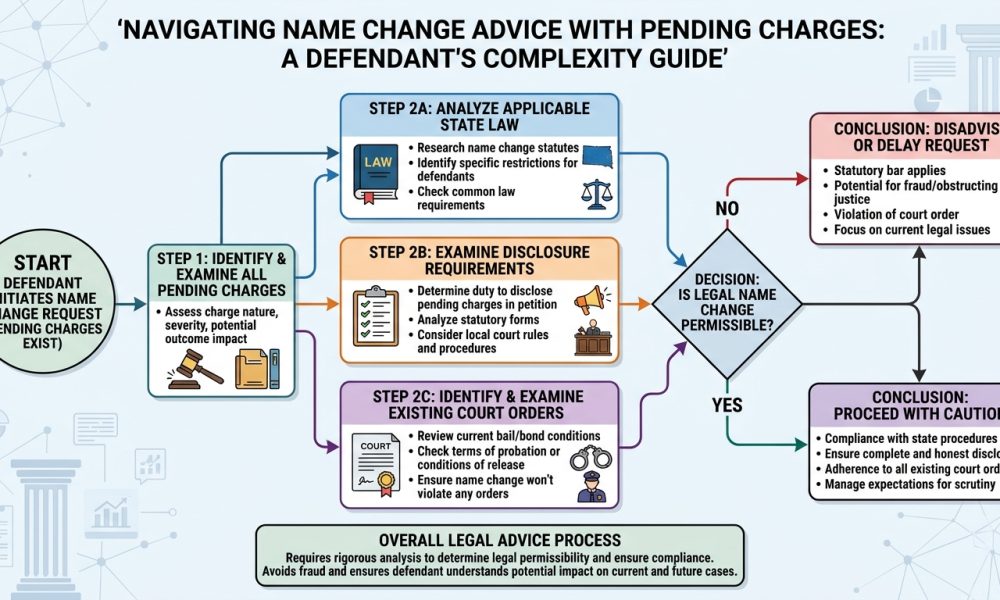
Before concluding that a defendant can change a legal name, review applicable state law, disclosure requirements, and any existing court orders.
WASHINGTON, DC, October 28, 2026 — Americans facing pending criminal charges may face much more complicated legal requirements when seeking to change their names, especially when state disclosure laws, judicial supervision conditions, and ongoing criminal proceedings intersect with standard civil name-change procedures.
Although changing a legal name is generally recognized as a legitimate personal decision throughout the United States, individuals in unresolved criminal proceedings cannot assume that a new identity document will automatically be approved or that it will relieve them of obligations arising from an existing case.
The distinction has become increasingly important as state legislatures reconsider name change restrictions, balancing personal autonomy, privacy protections, public safety, and the ability of courts and law enforcement agencies to maintain accurate records identifying criminal defendants.
A November 2025 NPR Illinois report on changes to the state’s legal name-change procedures highlighted reforms addressing privacy and criminal history, including circumstances in which individuals with pending charges may petition for judicial approval.
For defendants, attorneys, and privacy advisers, the underlying question is not simply whether an individual may adopt another name, but whether the proposed change complies with applicable criminal disclosure obligations, judicial restrictions, and legitimate identity verification requirements.
A pending charge also differs fundamentally from a criminal conviction, so legal restrictions based on an adjudicated offense should not automatically apply to someone whose allegations remain unresolved before the appropriate criminal court.
Nevertheless, the absence of a conviction does not eliminate potential reporting requirements or judicial scrutiny, especially where state legislation specifically addresses pending felony charges, misdemeanor proceedings, outstanding warrants, or attempts to avoid existing legal obligations.
Pending Criminal Charges Do Not Automatically Eliminate Name Change Rights
Legal name changes in the United States are primarily governed by state statutes and judicial procedures, creating significant differences in eligibility, disclosure, publication requirements, and the circumstances under which a court may reject an application.
A person facing an unresolved criminal accusation may therefore have a lawful opportunity to petition for a name change in one jurisdiction while encountering additional administrative restrictions, notification obligations, or judicial review procedures elsewhere.
Importantly, filing criminal charges does not establish guilt, and courts reviewing name change applications must distinguish an accusation from the separate legal consequences of a conviction.
However, name change courts may still consider pending proceedings when state law makes that Information relevant, particularly where an Application involves concerns about fraud, deliberate concealment, conflicting identities, or interference with existing judicial processes.
For example, an individual charged with a financial offense may face questions about whether the proposed name change could complicate Identification in financial records. At the same time, a defendant subject to a protective order may have separate disclosure responsibilities.
Neither circumstance automatically creates a prohibition, but both show why a defendant’s legal position should be reviewed individually rather than reduced to generalized statements suggesting that criminal accusations either prohibit or permit every name change.
Attorneys evaluating these applications should review the governing civil statute alongside the criminal case, paying close attention to whether the defendant remains subject to pretrial release conditions, mandatory court appearances, or specific identity-reporting provisions.
Illinois Demonstrates How States Balance Eligibility and Criminal Disclosure
Illinois offers a practical example of how lawmakers can recognize legitimate name-change interests while preserving disclosure requirements that protect public institutions and maintain the reliability of criminal justice records.
Under the state’s revised legal framework, individuals with pending criminal charges are not necessarily disqualified from requesting a name change. However, their applications can trigger notification procedures and give prosecutors opportunities to raise objections.
The Illinois General Assembly’s Code of Civil Procedure provisions governing legal name changes require petitioners to disclose specified criminal history Information, including arrests without filed charges and pending felony or misdemeanor proceedings.
When the required disclosure identifies relevant criminal history or a pending accusation, the circuit court clerk must notify designated state authorities, providing an established mechanism for prosecutors to review the petition before the court approves it.
The State’s Attorney may then object under the statutory procedures, while the reviewing judge remains responsible for determining whether the Application meets applicable legal requirements and should ultimately be granted.
These procedures show that criminal disclosure is not necessarily equivalent to automatic rejection, because the statutory framework allows relevant Information to be reviewed before an individualized judicial determination.
Illinois also requires certain approved name changes involving criminal histories to be reflected in official records, helping establish a documented connection between previous and current names without automatically eliminating the petitioner’s ability to use the newly authorized identity.
For defendants considering a similar Application elsewhere, the Illinois example shows why current state-specific legislation deserves careful review rather than reliance on outdated assumptions about felony restrictions, criminal proceedings, or mandatory waiting periods.
Court Orders Can Create Separate Restrictions Before a Name Change
A defendant’s ability to petition for a legal name change must be considered separately from obligations imposed by the court handling the criminal prosecution, because the two proceedings may involve different legal standards and administrative responsibilities.
Pretrial release conditions may require defendants to stay in contact with supervising authorities, attend scheduled hearings, provide accurate identifying Information, or obtain permission before changing specified circumstances involving residence, travel, or other regulated activities.
Some defendants remain free without extensive supervision, while others must comply with detailed restrictions established through bond orders, release agreements, electronic monitoring requirements, or other conditions intended to ensure their continued participation in proceedings.
These distinctions matter because changing a legal name does not automatically alter a defendant’s obligations under an existing criminal court order, even when a separate civil court authorizes the requested change.
When a release order requires notification of changes to identifying Information, a defendant must comply, and an attorney should review the exact language before advising whether additional disclosure or judicial permission is necessary.
Even when an order does not expressly address legal names, lawyers should evaluate whether separate reporting obligations, bond conditions, or governing criminal procedures require updating identifying Information maintained by the court or supervising agency.
Failing to comply with applicable release conditions can create complications unrelated to the merits of the name change petition, potentially affecting the defendant’s standing before the criminal court or the terms of continued release.
Consequently, responsible advice should start with a review of the court documents, rather than assuming that general civil name-change eligibility gives unrestricted Authority to make changes during an active prosecution.
Criminal Disclosure Requirements Differ Across State Jurisdictions
One of the biggest challenges facing defendants is the lack of a single nationwide procedure governing name changes involving pending charges, because states set their own disclosure standards, evidentiary requirements, and judicial responsibilities.
Michigan, for example, incorporates criminal history Information into its name change procedures, including fingerprint-based record checks for applicants meeting statutory criteria and reviews designed to identify relevant convictions or unresolved criminal accusations.
New York maintains additional notification rules for certain convicted individuals, particularly when specified serious offenses and correctional supervision are involved, showing how the legal treatment of a criminal conviction can differ from an unresolved charge.
Nevada likewise requires disclosure of felony convictions and provides procedures for judicially reviewing proposed adult name changes, demonstrating that criminal history requirements may focus on completed convictions rather than imposing identical rules for every pending accusation.
Arizona court forms also require applicants to disclose outstanding criminal charges, showing how local petition documentation can request Information beyond final judgments and include cases awaiting adjudication.
These differences make the applicant’s jurisdiction, current criminal status, and applicable petition requirements essential to any legal assessment, especially when a defendant has lived in or faced proceedings in multiple states.
Attorneys should verify whether the relevant statute requires disclosure of arrests, pending charges, outstanding warrants, prior convictions, previous names, or earlier name change orders, since the scope of required Information can vary substantially.
Applicants must also distinguish between Information the petition expressly requires and facts that may become relevant during judicial review, ensuring sworn representations remain accurate without assuming requirements the governing law does not impose.
Name Changes Cannot Be Used to Escape Criminal Proceedings.
A legal name change does not dismiss an indictment, invalidate an arrest warrant, terminate criminal prosecution, or prevent a court from exercising jurisdiction over a defendant properly identified in an existing proceeding.
Criminal cases remain associated with underlying individuals and relevant identifying Information, rather than depending exclusively on whether a defendant continues using the exact name appearing on the original charging documents.
Consequently, a properly authorized change may require official records to reflect both names, allowing courts and government authorities to preserve accurate case Information while recognizing the individual’s newly established legal Identification.
The distinction becomes especially important when defendants believe that obtaining new Identification, moving to another jurisdiction, or acquiring additional nationality will automatically separate them from allegations filed under an earlier name.
Such assumptions can have serious legal consequences because criminal jurisdiction, outstanding judicial orders, and authorized information-sharing arrangements are not ordinarily extinguished merely because an individual updates their identifying documents.
Courts may also scrutinize petitions that suggest an intention to deceive creditors, frustrate legal proceedings, conceal relevant criminal history, or misrepresent identity when accurate disclosure is legally required.
A legitimate name change Application should therefore explain the requested change truthfully and comply with the applicable legal process, without presenting the new name as a way to defeat law enforcement Identification.
Defendants seeking a different personal or professional future should address the pending criminal proceeding through appropriate counsel while independently determining whether a name change Application is permissible.
Personal Safety and Privacy Can Be Legitimate Considerations
Not every defendant seeking a legal name change is attempting to avoid accountability, because individuals involved in criminal proceedings may also experience harassment, threats, family conflict, unwanted publicity, or serious personal security concerns.
Some applicants may wish to restore a previous family name, adopt a spouse’s surname, reflect their gender identity, or establish personal Identification consistent with longstanding cultural, religious, or family circumstances.
Others may have faced extensive online exposure after an arrest, even when the accusations remain unproven, or the eventual outcome could be dismissal, acquittal, or another resolution.
Courts evaluating these circumstances may need to consider whether the proposed change serves a legitimate purpose while maintaining the integrity of applicable disclosure procedures and existing obligations arising from an active prosecution.
State law may also provide confidentiality mechanisms for qualifying applicants, including restricted publication requirements or sealed proceedings where public disclosure would create a legally recognized personal safety concern.
Such protections generally require compliance with the governing statute and relevant judicial procedures, rather than allowing individuals to unilaterally conceal Information from prosecutors, courts, or agencies entitled to receive it.
For people researching anonymous living and lawful personal privacy planning, the distinction between reducing unnecessary public exposure and concealing legally required Information is especially important when unresolved criminal proceedings remain active.
Effective personal security planning can include reasonable confidentiality measures, careful management of public-facing Information, and legitimate residential privacy arrangements, provided those measures do not interfere with mandatory disclosures or judicial supervision.
Changing a Name Does Not Erase Criminal History Records
Another important distinction concerns the relationship between civil name change proceedings and the criminal history records maintained by courts, police departments, correctional authorities, and other government agencies responsible for identifying defendants.
When a name change is approved, applicable procedures may require associating the new legal name with earlier records, preserving the historical connection needed for criminal case administration and authorized Background verification.
Illinois expressly provides for criminal history updates in specified circumstances, showing how a state can recognize a New Legal Identity while retaining Information that connects the individual to previous identifying details.
This continuity does not mean that every member of the public automatically receives unrestricted access to every historical record, because disclosure, sealing, expungement, and access rules depend on the records and governing jurisdiction.
Nevertheless, people should not confuse a name change order with an expungement order, a record-sealing determination, a pardon, an acquittal, or a judicial dismissal of charges, since each procedure serves a different legal function.
A defendant whose case is later dismissed may have separate opportunities to examine whether eligible records can be sealed or expunged. Still, those possibilities require analysis under the appropriate state or federal framework.
Similarly, an individual acquitted of an offense may still encounter historical records of the prosecution, subject to applicable access restrictions and any lawful procedures available for correcting or limiting the dissemination of those records.
Advisers should therefore avoid promising that a new name will automatically produce a clean Background check, eliminate fingerprints, or create an employment history disconnected from earlier government records.
Federal Identification Systems Create Additional Administrative Responsibilities
Federal agencies maintain identity-related records for purposes that extend beyond state civil proceedings, including Social Security administration, passport issuance, tax reporting, immigration documentation, and financial compliance obligations affecting individuals who change their legal names.
A name change recognized under state law may support a request for updated federal Identification documents. However, the agency reviewing the Application must still apply its own statutory requirements and documentary verification procedures.
For defendants facing federal proceedings, additional complications may arise when judicial release conditions, passport restrictions, international travel limitations, or other orders affect the practical use of newly issued Identification documents.
A defendant with a valid passport should not assume the document alone authorizes international departure when a criminal court has imposed travel restrictions or requires prior permission from the supervising Authority.
Likewise, receiving an updated Social Security card or driver’s license does not show that existing criminal charges have been resolved, because these documents serve administrative Identification functions separate from adjudicating criminal responsibility.
When federal and state records require updating, applicants should provide accurate documentation through the appropriate channels to ensure legitimate identity corrections do not create inconsistent statements to government authorities.
The broader principle is straightforward: a lawful name change may be recognized across numerous institutions, but that recognition does not automatically replace the independent legal requirements governing criminal defendants or regulated identity records.
Legal Counsel Should Review Both Civil and Criminal Proceedings
An attorney advising a defendant about a potential name change should review the criminal docket, existing release orders, pending motions, and relevant state legislation before concluding eligibility or the appropriate timing of an Application
The review should distinguish a pending misdemeanor from a felony accusation, determine whether prosecution remains active, and identify any court-imposed restrictions that could affect reporting obligations or the defendant’s lawful use of Identification documents.
Counsel should also consider whether a separate civil petition would require notifying prosecutors, disclosing existing charges, conducting a criminal Background investigation, or holding a judicial hearing to address the applicant’s stated reasons for requesting the change.
Where the defendant has legitimate privacy concerns, the attorney can examine whether the applicable statute provides confidentiality protections and whether requesting them would affect the petition’s documentation or notification requirements.
Importantly, advice should account for how the criminal case and the civil Application may interact, particularly when sworn statements, inconsistent identifying Information, or proposed changes in residence could raise additional legal questions.
A carefully coordinated approach may also involve communicating through appropriate legal channels with the relevant court or supervising Authority, ensuring that required disclosures occur without unnecessarily prejudicing the defendant’s legitimate privacy interests.
This does not mean that every defendant must postpone a name change until prosecution concludes. Stilat timing should reflect the actual legal circumstances rather than assumptions about eligibility.
International Relocation Adds Another Layer of Legal Complexity
Defendants considering relocation abroad or additional citizenship must distinguish the legal Authority to change a name from the separate rules governing international travel, immigration admission, passport issuance, and unresolved criminal proceedings.
Even where a foreign jurisdiction recognizes a legally changed name, that recognition does not necessarily eliminate existing American court orders, outstanding warrants, Extradition arrangements, or legally required disclosures concerning earlier identities.
Immigration authorities may require applicants to disclose previous names, criminal accusations, prior convictions, or pending proceedings, depending on the destination country’s legislation and the particular residence or citizenship Application.
Providing inaccurate Information can lead to separate immigration or criminal consequences, including potential application refusal, status cancellation, or further legal proceedings under the laws of the relevant jurisdiction.
Individuals considering lawful new identity and cross-border documentation services should therefore ensure that any proposed arrangement relies on authentic documentation, truthful applications, and compliance with both domestic and foreign legal obligations.
A change in nationality or the acquisition of another passport should never be presented as a guaranteed way to avoid Identification, defeat an Extradition request, or escape the jurisdiction of an existing criminal court.
Instead, legitimate international planning requires coordination among qualified criminal defense, immigration, and civil attorneys who can assess the applicable laws without confusing personal privacy objectives with immunity from legal accountability.
Accurate Legal Advice Requires Individual Assessment
The growing complexity of state name change legislation shows why defendants cannot reliably determine eligibility from generalized internet claims, especially when those claims overlook pending charges, criminal history disclosures, or the precise wording of court orders.
Someone facing an unresolved accusation may remain eligible to petition in a particular jurisdiction. At the same time, another applicant could face restrictions based on a specific conviction, supervision condition, statutory registration requirement, or finding of improper intent.
For people whose legal circumstances are uncertain, the most reliable starting point is a jurisdiction-specific assessment identifying the governing statute, the status of the prosecution, the applicant’s disclosure obligations, and any applicable judicial restrictions.
That assessment should preserve the presumption of innocence while recognizing that unresolved charges can still create procedural duties independent of whether the prosecution ultimately proves its allegations beyond a reasonable doubt.
Ultimately, a legal name change and a pending criminal prosecution are separate legal matters that may intersect, requiring accurate disclosure, careful interpretation of state law, and respect for existing court orders before any Application proceeds.
The central distinction remains that changing a name may be a legitimate exercise of personal autonomy. Still, neither a new identity document nor a civil court order automatically extinguishes outstanding criminal proceedings or associated legal obligations.




