
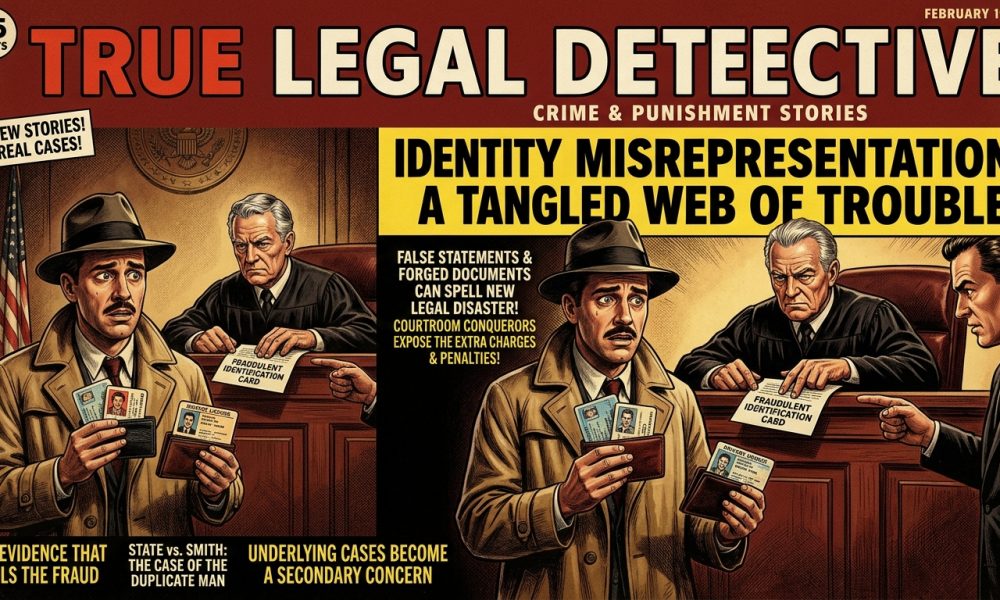
False statements and fraudulent documents can create consequences separate from an underlying case, depending on the conduct, evidence and applicable law.
WASHINGTON, DC, October 28, 2026 — Americans seeking to change their names, obtain replacement Identification documents, or increase personal privacy while facing unresolved criminal proceedings may face serious additional legal exposure when inaccurate statements, fabricated records, or unauthorized identities become part of those efforts.
Although lawful identity changes remain available under appropriate circumstances, the distinction between legitimate personal reinvention and criminal misrepresentation depends on the accuracy of Information supplied, the Authenticity of supporting documents, and the legal requirements governing each particular transaction.
Federal prosecutors can pursue false statement offenses, Identification document fraud, passport violations, and identity theft independently of an existing criminal prosecution, meaning conduct undertaken after an original arrest may create separate allegations that require their own legal defense.
A 2025 Associated Press investigation into a federal fraud prosecution involving allegedly fabricated business records showed how accusations of false statements, forged documents, and identity misuse can appear together in a broader criminal case, even when defendants contest the government’s interpretation of their conduct.
For individuals considering legal name changes, new Identification documents, anonymous living arrangements, or international relocation, the central issue is whether proposed actions involve truthful disclosures and properly authorized documentation rather than efforts to mislead institutions responsible for verifying identity.
False Identity Claims Can Become Independent Criminal Allegations
An individual facing criminal charges may assume any subsequent identity-related problem will become another issue in the original prosecution. Still, federal and state laws can establish separate offenses involving independently prohibited statements or documents.
For example, someone accused of financial misconduct might later submit an Identification Application containing deliberately fabricated personal Information, creating a potential new legal issue even if the original financial allegations ultimately remain unproven or are dismissed.
Prosecutors would still need to establish the required elements of any additional offense, including applicable mental states, jurisdictional requirements, and the significance of allegedly false Information, rather than relying exclusively on the defendant’s existing criminal status.
This distinction matters because criminal liability generally depends on what the person actually did, what the law prohibits, and what evidence establishes the required elements, not merely on whether investigators view a name change as suspicious.
The practical consequence is that a defendant who might otherwise qualify for a lawful name change could nevertheless create additional legal exposure by submitting false records or intentionally misrepresenting material facts during an administrative or judicial proceeding.
Federal False Statement Laws Cover More Than Forged Documents
One of the principal federal statutes addressing dishonest representations is 18 U.S.C. § 1001, the federal false statements law, which prohibits specified knowing and willful material falsehoods and concealment in matters within the jurisdiction of the United States government.
The statute can apply to materially false representations, certain deliberate concealment schemes, and the knowing use of documents containing materially inaccurate Information, subject to statutory exceptions and the specific circumstances establishing federal jurisdiction.
An important distinction concerns materiality, because federal criminal law does not automatically transform every inaccurate statement or minor administrative mistake into a prosecutable offense merely because the Information appeared on a government form.
Prosecutors generally must show that the alleged misrepresentation had a natural tendency to influence, or could have influenced, the relevant government decision or function, even when officials did not actually rely on the disputed statement.
Federal law also imposes important limitations on certain statements made by parties or their counsel in judicial proceedings, showing why the precise setting and applicable statutory provisions matter before concluding that particular conduct violates Section 1001.
Intent and Knowledge Matter When Evaluating Identity Discrepancies
Identity records sometimes contain inconsistent spellings, outdated addresses, transcription mistakes, incomplete family Information, or differences arising from translation and historical registration practices, none of which, on their own, establish an intentional criminal misrepresentation.
A person who unknowingly submits inaccurate Information may present a fundamentally different legal situation from someone who deliberately supplies invented personal details to induce a government Authority to issue a document that would otherwise be unavailable.
Investigators examining a suspected offense may consider Application materials, prior statements, official records, relevant communications, and surrounding circumstances when assessing whether an individual knew that particular Information was false or acted with the required criminal intent.
The legal significance of those facts depends on the specific offense charged, because different statutes define prohibited conduct and mental elements differently, making it inappropriate to assume that every inconsistency requires the same proof.
Defendants and applicants who discover genuine errors should seek advice about the appropriate correction process, ensuring that subsequent explanations remain accurate and that any required amendments comply with the rules governing the institution involved.
Fraudulent Identification Documents Raise Separate Federal Concerns
Federal Identification fraud provisions address numerous forms of unauthorized conduct involving government Identification documents, including counterfeit credentials, unlawfully produced documents, stolen identifying Information, and prohibited transfers or possession.
Under 18 U.S.C. § 1028, liability depends on the statutory category of conduct and applicable jurisdictional requirements, meaning that merely discussing alternative names or possessing multiple legitimately issued credentials does not automatically establish a federal Identification offense.
A counterfeit driver’s license, altered passport, or fabricated government identity card may still create serious legal exposure when the elements are present, especially when documents are produced or used to further deception.
The distinction between authentic issuance and superficial document appearance is critical, because professional printing, convincing security features, or electronic readability cannot independently establish that the purported issuing Authority lawfully created a particular Identification record.
For individuals considering replacement Identification or another lawful identity arrangement, the key question is whether the documents come from authorized government processes and contain truthful Information that meets applicable legal requirements.
Passport Applications Require Accurate Citizenship and Identity Information
Passport fraud is another area where identity misrepresentation can have consequences separate from an existing criminal proceeding because passport applications require specific representations about citizenship, identity, supporting evidence, and entitlement to receive the requested travel document.
Federal statutes separately address false statements in passport applications and certain forms of passport forgery or misuse, reflecting the importance of reliable citizenship documentation and identifying Information within international travel administration.
A defendant legally eligible to request a passport may still face criminal exposure if an Application contains knowingly false Information that satisfies an applicable offense, regardless of whether the applicant ultimately receives the document.
Conversely, an applicant who accurately discloses a legally recognized name change should not automatically be treated as committing fraud merely because earlier government records identify that individual under a previous name.
These distinctions matter most when criminal courts have imposed passport surrender conditions or international travel restrictions, since updated documentation alone does not authorize conduct prohibited by an enforceable judicial order.
Legal Name Changes Must Be Distinguished From Identity Fraud
Changing a legal name through an authorized state procedure generally establishes a new, legally recognized name for an existing individual, rather than creating an entirely different person with an invented history or unrelated government records.
The change ordinarily preserves legally relevant connections to earlier tax records, employment history, court proceedings, financial obligations, and government Identification, even when updated documents display the person’s newly authorized name.
Problems can arise when applicants deliberately provide false Background Information, omit disclosures required by applicable law, or submit fraudulent supporting documents to create an appearance of eligibility for a name change.
However, states differ in their procedures, and some applicants may lawfully seek confidentiality protections or restricted access to records, particularly when disclosure of previous names would expose them to harassment or credible personal danger.
The distinction therefore rests on compliance with governing law and accurate representations to authorized institutions, rather than an assumption that every attempt to reduce public visibility constitutes improper concealment.
Pending Criminal Charges Require Particular Attention to Disclosure Duties
Defendants facing unresolved criminal proceedings may remain eligible to seek legal name changes. Still, courts must evaluate their applications alongside applicable state disclosure requirements and any court orders governing the disclosure of identifying Information.
Some jurisdictions require petitioners to identify pending prosecutions, prior convictions, or other specified criminal history Information, while others establish different thresholds or notification procedures for informing prosecutors about proposed changes.
A defendant who deliberately answers a legally required question falsely may therefore create an issue separate from the original charge, subject to the offense’s applicable elements and available evidence.
At the same time, pending charges do not automatically authorize authorities to demand every conceivable personal detail, because applicants remain entitled to the protections and limitations established by the applicable legal framework.
Defense counsel should therefore review the specific questions, required certifications, governing statutes, and existing judicial restrictions before advising whether a disclosure is mandatory or whether additional clarification is appropriate.
Pretrial Release Conditions Can Complicate Document Applications
Federal and state judges may impose conditions requiring defendants to report to supervision authorities, maintain approved residences, surrender passports, restrict travel, or obtain permission before undertaking activities specifically addressed in their release orders.
A defendant who seeks new identity documents while subject to these restrictions should distinguish between actions requiring prior judicial authorization and actions that merely involve providing updated Information under the applicable supervision arrangements.
An unauthorized document Application may become relevant to a release violation when it conflicts with an express condition. However, the Application itself does not automatically establish a separate criminal offense without additional statutory elements.
Similarly, submitting false Information to a supervising Authority may trigger scrutiny under applicable criminal laws or release provisions, depending on the statement’s nature and the legal requirements governing that communication.
When uncertain, review the written order and relevant law for each case, rather than relying on generalized assumptions that all defendants are prohibited from changing Identification or that every such change is unrestricted.
Using Another Person’s Identity Creates Additional Risks
Identity theft concerns become particularly serious when a person uses identifying Information belonging to someone else, because the conduct may involve deception affecting financial institutions, government agencies, employers, or the individual whose Information was appropriated.
Federal law recognizes several offenses involving another person’s identifying Information, with requirements that vary depending on whether the alleged conduct involves identity fraud, access devices, financial transactions, or aggravated identity theft.
Under applicable aggravated identity theft provisions, qualifying misconduct involving another actual person’s means of Identification during and in relation to specified predicate crimes can result in additional mandatory imprisonment, subject to statutory requirements and controlling judicial interpretations.
The distinction between selecting a legally permissible new name and unlawfully assuming another person’s identity is therefore fundamental, especially when applicants obtain supporting records or attempt to establish financial and professional relationships.
A legally authorized name change does not confer ownership of another person’s Social Security number, citizenship records, birth registration, or financial identity. It cannot justify providing those details as though they belonged to the applicant.
Financial Institutions Have Independent Identification Requirements
Banks and other regulated financial institutions generally operate under customer Identification and anti-money-laundering requirements that may require accurate identifying Information, documentary verification, and additional investigation when an applicant’s records appear inconsistent.
A person who legally changes their name may need to update account Information and provide appropriate supporting evidence. Still, the change does not automatically extinguish existing debts, beneficial ownership interests, or tax reporting responsibilities.
Deliberately misrepresenting identity to obtain credit, conceal ownership, or induce a financial institution to process a transaction can create additional legal problems when the conduct satisfies applicable fraud or false statement provisions.
Individuals pursuing legitimate financial privacy should distinguish confidentiality from misrepresentation, because financial institutions may be required to identify account holders and certain beneficial owners even where public-facing arrangements provide some discretion.
For this reason, identity planning should preserve accurate records linking the individual to lawful transactions while respecting applicable financial disclosure requirements and the legitimate privacy interests recognized in the relevant jurisdiction.
Anonymous Living Does Not Require False Government Identification
Growing concerns about digital exposure, harassment, unwanted publicity, and personal security have encouraged greater interest in lawful anonymous living arrangements, including confidential residential planning and reduced public disclosure of personal Information.
These arrangements can involve legitimate privacy decisions without requiring fabricated Identification, misrepresented citizenship, or an invented criminal history, although the available protections depend on local law and the services involved.
Individuals examining anonymous living and personal privacy planning through Amicus International Consulting should distinguish permissible discretion from attempts to deceive courts, immigration authorities, financial institutions, or other organizations entitled to accurate Information.
For someone facing pending charges, this distinction matters because relocation, changes in public-facing Identification, or confidential personal arrangements may intersect with specific judicial restrictions and mandatory reporting obligations.
A responsible privacy strategy must therefore evaluate which Information may lawfully remain confidential and which Information must be disclosed, avoiding unsupported promises that an alternative identity automatically eliminates legal or financial responsibilities.
International Identification Documents Require Independent Verification
International relocation and second-citizenship arrangements can raise additional legal questions because different countries apply their own requirements for birth registration, naturalization, residence, passport issuance, and recognition of foreign identity documents.
A document that appears authentic does not necessariproveish lawful issuancespeciallyrly when supporting records contain invented facts or the purported citizenship was obtained through materially inaccurate representations to an issuing Authority.
For individuals evaluating legal identity changes and supporting documentation services, independent verification of eligibility, official issuance, and the legal accuracy of underlying records remains essential before relying on any proposed identity arrangement.
Foreign citizenship or a newly issued passport also does not automatically terminate an American criminal proceeding, invalidate an outstanding warrant, or eliminate disclosure obligations arising under applicable Extradition, immigration, or judicial procedures.
Legitimate cross-border planning therefore requires attention to both the issuing country’s requirements and the applicant’s existing legal responsibilities, particularly where inaccurate representations could create additional proceedings in more than one jurisdiction.
False Statements Can Affect the Original Criminal Case
When prosecutors discover allegedly fraudulent identity documents or materially false representations during an ongoing investigation, they may evaluate whether the conduct supports independent charges, affects pretrial supervision, or has evidentiary significance within the original case.
The legal consequences are not automatic because courts must distinguish unproven allegations from established violations and apply relevant evidentiary rules, procedural protections, and statutory requirements before imposing sanctions or admitting disputed evidence.
A defendant’s alleged misrepresentation may support arguments about compliance or the risk of nonappearance. Still, its significance depends on what happened, what the controlling order required, and whether the government can support its allegations.
Defense attorneys must also consider the potential consequences of explanations offered in response to accusations, ensuring that clients understand their legal rights while avoiding new inaccuracies in formal applications or required communications.
A carefully documented and lawful approach to identity updates can reduce unnecessary complications while preserving the defendant’s ability to contest existing charges and address legitimate personal, professional, or safety concerns.
Accurate Documentation Remains the Strongest Legal Safeguard
The primary reason individuals seek name changes or greater privacy is that lawful identity management depends on accurate Information, properly authorized documentation, and an understanding of the distinct obligations different institutions impose.
An individual may have legitimate reasons to change a name, relocate, protect a residential address, or obtain updated Identification. Still, those objectives must be pursued through procedures that recognize existing legal duties.
Identity misrepresentation can create criminal exposure independent of an original prosecution. At the same time, a properly documented legal name change does not, by itself, establish wrongdoing or demonstrate an intention to evade accountability.
For defendants, privacy advisers, and legal professionals, the critical distinction remains between exercising lawful personal rights and knowingly supplying false Information when accurate Identification or disclosure is legally required.
Ultimately, preserving the integrity of official records while respecting legitimate privacy interests provides a more defensible foundation for personal reinvention than reliance on fraudulent documents, misleading representations, or unsupported claims that a new identity can erase existing obligations.




