
Leather Goods Market Overview:
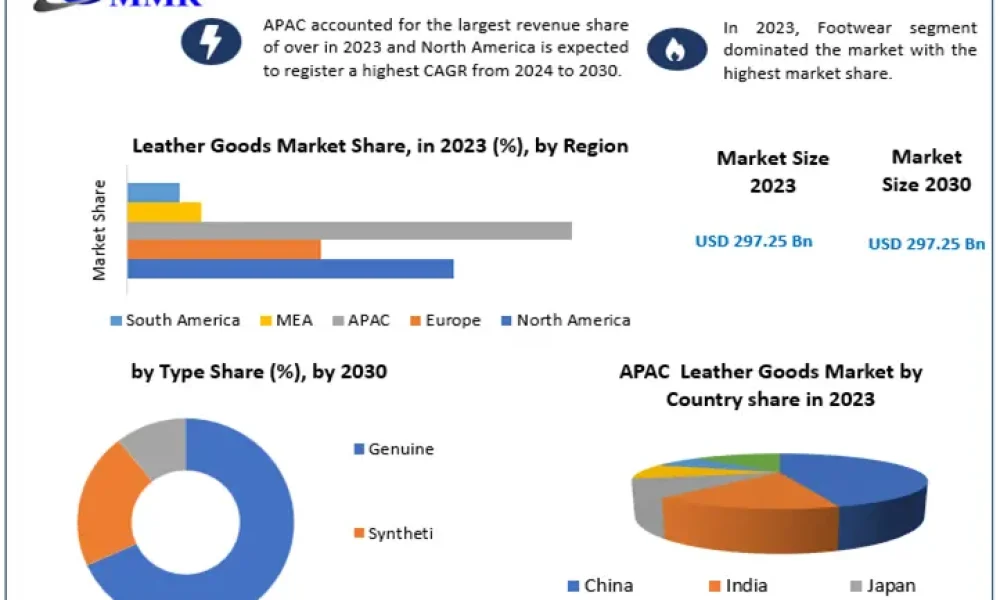
Leather Goods market is projected to grow from USD 531 billion in 2025 to USD 855 billion by 2032, registering a strong CAGR of 7.05%. Asia Pacific emerges as the dominant region due to increasing disposable incomes, urbanization, expanding e-commerce, and a rising appetite for premium and luxury leather accessories. Europe remains a key market with established luxury brands while North America drives growth through lifestyle and sustainability trends.
Key Highlights & Insights
Market Size & Growth: Expected to increase from USD 531 billion in 2025 to USD 855 billion by 2032, growing at a CAGR of 7.05%.
Dominating Region: Asia Pacific leads the market, propelled by the rapidly growing middle class in China, India, Japan, and Southeast Asia, alongside increasing demand for handbags, footwear, apparel, and travel goods.
Leading Segment: Handbags and small leather goods constitute the largest product segments, collectively accounting for a significant majority share due to their status as fashion and lifestyle staples.
Key Driver: Rising consumer preference for premium, sustainable, and bespoke leather products, boosted by digital retail growth and brand innovations in sustainable and vegan leather alternatives.
Recent Developments
2024–2025: Major players such as LVMH, Kering, Hermès, and Gucci expanded their product portfolios with innovative eco-friendly leather lines incorporating vegetable tanning and mushroom-based alternatives.
India and China witnessed increased investments in leather manufacturing infrastructure, enabling better quality products and cost advantages for domestic and international markets.
E-commerce platforms in Asia Pacific accelerated market penetration by offering wider product access, customization, and digital engagement strategies.
Collaborations between fashion designers and sustainable material innovators gained momentum to meet evolving consumer ethical demands.
Market Dynamics
Growth Drivers:
Expanding middle-class populations and rising disposable incomes in emerging economies drive premium leather goods demand.
Growing awareness and adoption of sustainable and vegan leather alternatives attract environmentally conscious consumers.
Technological advances in manufacturing, customization, and digital retail enhance consumer access and product variety.
Luxury branding and celebrity endorsements amplify consumer desire for exclusive, high-quality leather accessories.
Challenges:
Volatility in raw material prices including hides and leather chemicals.
Ethical concerns over animal welfare leading to demand shifts toward synthetic alternatives.
Supply chain disruptions and regulatory complexities in international trade.
Regional Analysis
Asia Pacific: Largest and fastest-growing market, accounted for the highest revenue share, driven by China, India, Japan, and Southeast Asia with rising luxury brand consumption and manufacturing expansion.
Europe: Home to established leather luxury brands and structured supply chains, sustaining substantial demand for high-end products.
North America: Substantial growth fueled by lifestyle trends emphasizing sustainability, premium fashion demand, and growing interest in vintage and upcycled leather products.
Other Regions: Latin America and Middle East/Africa showing promising growth linked to evolving fashion culture and urbanization.
Product Segmentation
By Product Type:
Handbags and small leather goods (largest)
Footwear
Apparel and accessories
Travel goods and luggage
By Material:
Genuine leather (dominant)
Synthetic leather and alternatives
Recycled and bio-based leather
By Distribution Channel:
Offline retail (department stores, specialty boutiques)
Online retail (e-commerce platforms and brand websites)
Key Trends
Shift toward sustainable and ethically produced leather products including vegetable-tanned and mushroom leather.
Digital engagement through augmented reality, personalization, and influencer collaborations to attract millennial and Gen Z consumers.
Growth in demand for versatile and multi-functional leather goods suited for work-from-home and travel lifestyles.
Increasing use of recycled leather waste and circular economy approaches in leather production.
Rising prominence of small and independent luxury brands focusing on craftsmanship and storytelling.
Frequently Asked Questions (FAQs)
What is the projected size of the leather goods market by 2032?
Expected to reach USD 855 billion.Which region dominates the leather goods market?
Asia Pacific, driven by rapid urbanization and middle-class expansion.What are the key products driving the market?
Handbags and small leather goods hold the largest market share.How is sustainability influencing the market?
Demand for eco-friendly and vegan leather alternatives is growing among younger consumer segments.Who are the major players?
LVMH, Kering, Hermès, Gucci, and emerging regional manufacturers in Asia Pacific.
Conclusion
The global leather goods market is set for robust growth driven by increasing demand for premium, sustainable, and versatile leather products. Asia Pacific leads the market with strong demographic and economic drivers, while established markets in Europe and North America innovate through sustainable practices and digital engagement. With continuous product innovation, expanding e-commerce, and growing environmental consciousness, the leather goods sector promises exciting opportunities for brand owners, manufacturers, and consumers worldwide.
► Get a sample of the report:https://www.maximizemarketresearch.com/request-sample/115698/
◉ Get Market Research Latest Trends
♦ Maximize Market Research is launching a subscription model for data and analysis in the MMR Statistics
Contact Maximize Market Research:
3rd Floor, Navale IT Park, Phase 2
Pune Bangalore Highway, Narhe,
Pune, Maharashtra 411041, India
[email protected]
+91 96071 95908, +91 9607365656
About Maximize Market Research:
Maximize Market Research is a multifaceted market research and consulting company with professionals from several industries. Some of the industries we cover include medical devices, pharmaceutical manufacturers, science and engineering, electronic components, industrial equipment, technology and communication, cars and automobiles, chemical products and substances, general merchandise, beverages, personal care, and automated systems. To mention a few, we provide market-verified industry estimations, technical trend analysis, crucial market research, strategic advice, competition analysis, production and demand analysis, and client impact studies.




