
The lateral flow assay market has evolved from a niche diagnostic segment into a cornerstone of modern point-of-care testing, driven by the global need for fast, reliable, and accessible diagnostic solutions. Lateral flow assays (LFAs) are simple paper-based devices designed to detect the presence or absence of a target analyte in a sample without the need for complex laboratory equipment. Their ability to deliver results within 15–30 minutes has made them indispensable across healthcare systems, particularly in managing infectious diseases, chronic conditions, and home-based diagnostics. As healthcare systems worldwide continue to prioritize early detection and decentralized testing, LFAs are increasingly viewed as essential tools rather than supplementary technologies.
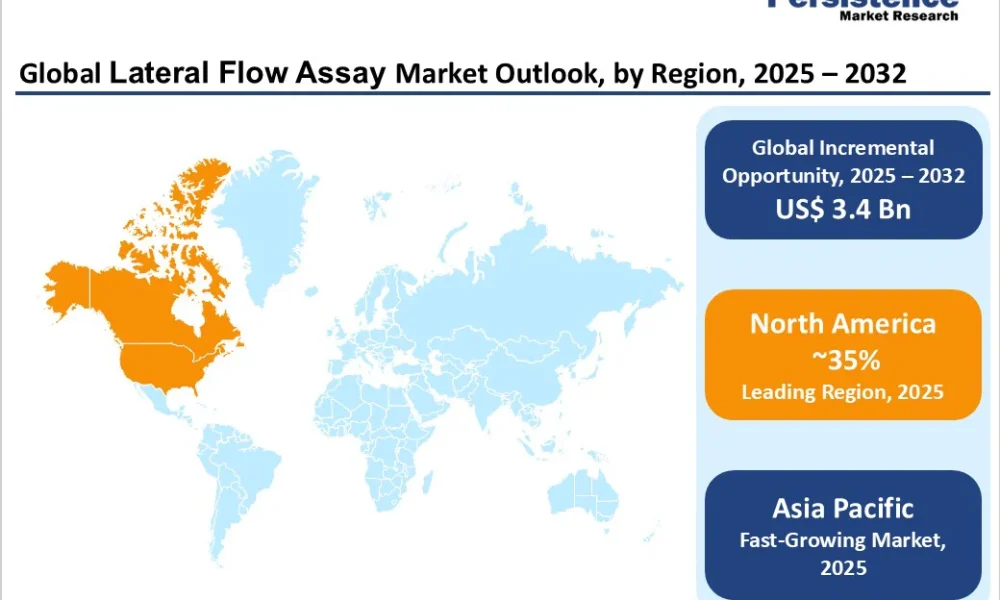
From a market perspective, the global lateral flow assay market is projected to reach a value of US$8.3 billion in 2025 and is expected to grow steadily to US$11.7 billion by 2032, registering a compound annual growth rate of 5.0% during the forecast period. This expansion is underpinned by a convergence of factors, including the rising prevalence of infectious and chronic diseases, advancements in assay sensitivity and digital integration, and the growing acceptance of point-of-care and at-home testing. LFA kits dominate the product landscape, accounting for nearly 70% of market share due to their affordability, portability, and ease of use. Infectious disease testing remains the leading application, contributing over 40% of total revenue, while North America leads geographically with a 35% share in 2025, supported by advanced healthcare infrastructure, strong research and development activity, and high adoption of rapid diagnostic technologies.
Download Your Free Sample & Explore Key Insights: https://www.persistencemarketresearch.com/samples/18613
Key Highlights from the Lateral Flow Assay Market Report
• The global lateral flow assay market is expected to grow from US$8.3 billion in 2025 to US$11.7 billion by 2032 at a CAGR of 5.0%.
• North America leads the market with a 35% share, driven by strong point-of-care testing adoption and advanced healthcare systems.
• Asia Pacific is the fastest-growing region due to rising disease burden and investments in affordable diagnostics.
• LFA kits dominate the market with approximately 70% share, reflecting their widespread use in rapid testing.
• Infectious disease applications account for over 40% of market revenue, fueled by outbreak preparedness and surveillance needs.
• Digital LFA readers and multiplex testing platforms represent a major growth opportunity for next-generation diagnostics.
Market Segmentation Analysis
The lateral flow assay market is segmented across multiple dimensions, including product type, application, and distribution channel, each playing a distinct role in shaping market dynamics. By product type, the market is primarily divided into LFA kits and LFA readers. LFA kits form the backbone of the market due to their simplicity and low manufacturing costs, making them suitable for mass deployment in both developed and developing regions. These kits are widely used for infectious disease detection, pregnancy testing, and chronic disease monitoring. In contrast, LFA readers, while accounting for a smaller share, are experiencing faster growth as healthcare providers increasingly demand quantitative and digitally integrated results that go beyond traditional visual interpretation.
In terms of application, infectious diseases represent the largest segment, driven by the persistent global burden of conditions such as COVID-19, HIV, tuberculosis, and sexually transmitted infections. Rapid detection remains critical for controlling transmission and enabling timely treatment. Chronic disease management, including diabetes monitoring, also contributes significantly to market demand, particularly as the global diabetic population reached an estimated 589 million adults in 2024. Pregnancy and fertility testing has emerged as a fast-growing application segment, supported by rising awareness of reproductive health and the widespread adoption of home-based diagnostic kits that empower consumers to take proactive control of their health.
Distribution channel segmentation further highlights the evolving nature of the market. Hospital pharmacies dominate distribution, contributing nearly 50% of total revenue, as they provide trusted access points for diagnostic products under professional guidance. Their integration within clinical settings ensures appropriate usage and patient education. At the same time, e-commerce platforms are rapidly gaining traction, driven by convenience, privacy, and the growth of direct-to-consumer diagnostic models. Online channels are particularly impactful in urban areas and regions with strong digital infrastructure, enabling faster access to testing kits without the need for physical healthcare visits.
Regional Insights and Market Performance
Regional performance within the lateral flow assay market reflects disparities in healthcare infrastructure, disease prevalence, and regulatory environments. North America stands as the leading regional market, accounting for approximately 35% of global revenue in 2025. The region’s dominance is largely attributed to advanced diagnostic infrastructure, high awareness of preventive healthcare, and significant investments in research and development. The United States plays a pivotal role, with a high prevalence of chronic diseases such as diabetes, affecting nearly 38 million individuals, driving sustained demand for rapid and accurate diagnostic tools. Regulatory support, including fast-track approvals for rapid tests, further accelerates innovation and market penetration.
Europe represents around 25% of the global market, supported by harmonized regulatory frameworks and strong public healthcare systems. Countries such as Germany, France, and the United Kingdom are key contributors, collectively investing billions of euros in diagnostic technologies. Germany’s strength lies in precision engineering and manufacturing excellence, while France’s emphasis on reproductive and prenatal health drives demand for pregnancy and fertility testing kits. The United Kingdom is witnessing increased adoption of digital LFA readers within its national health system, particularly for managing sexually transmitted infections, enhancing both accessibility and diagnostic accuracy.
Asia Pacific commands a similar share of around 25% but stands out as the fastest-growing region in the lateral flow assay market. Rapid population growth, high disease burden, and expanding healthcare access are central to this growth trajectory. China and India are at the forefront, with significant government and private-sector investments aimed at improving early disease detection and management. In China, substantial funding in health technology supports widespread adoption of affordable diagnostic kits, particularly for diabetes management among its large patient population. India’s growth is propelled by national healthcare initiatives and expanding e-commerce distribution, which improve access to diagnostics in rural and underserved areas.
Get Custom Insights Designed for Your Business: https://www.persistencemarketresearch.com/request-customization/18613
Market Drivers Shaping Industry Growth
The primary driver of the lateral flow assay market is the rising prevalence of infectious and chronic diseases worldwide, coupled with the growing demand for rapid and decentralized diagnostic solutions. Infectious diseases continue to pose a major global health challenge, with millions of new cases diagnosed annually. Lateral flow assays offer a practical solution by delivering quick results with high accuracy, making them suitable for use in point-of-care settings where laboratory access is limited. Their role became especially prominent during the COVID-19 pandemic, which normalized rapid testing and increased public acceptance of at-home diagnostics.
Chronic disease management further strengthens market demand, particularly in the context of diabetes, cardiovascular conditions, and metabolic disorders. With diabetes alone affecting hundreds of millions of adults globally, the need for convenient and frequent monitoring solutions has intensified. Lateral flow-based glucose monitoring kits support home-based testing, reducing the burden on healthcare facilities while improving patient compliance. Additionally, global health initiatives and investments exceeding US$10 billion in recent years have accelerated the deployment of affordable diagnostics in low- and middle-income countries, reinforcing the market’s long-term growth potential.
Market Restraints Limiting Expansion
Despite its strong growth outlook, the lateral flow assay market faces notable restraints related to sensitivity limitations and regulatory challenges. While LFAs are valued for convenience, their sensitivity can be lower than that of laboratory-based diagnostic methods, particularly in cases where biomarker concentrations are low. Sensitivity rates can fall to around 70% for certain analytes, increasing the risk of false negatives and necessitating confirmatory testing. This limitation restricts the use of LFAs in critical diagnostic scenarios where absolute accuracy is essential.
Regulatory hurdles also pose significant challenges, as lateral flow assay development requires extensive validation and compliance with stringent quality standards. The cost of bringing a new assay to market can exceed US$20 million due to clinical trials, stability testing, and regulatory submissions. Approval timelines can extend from two to four years, delaying commercialization and increasing financial risk. Smaller companies often struggle to navigate these regulatory complexities, limiting innovation and market diversity, particularly in cost-sensitive regions.
Market Opportunities and Future Potential
Advancements in digital integration and multiplex testing present compelling opportunities for the lateral flow assay market. Digital LFA readers capable of providing quantitative results are transforming traditional visual assays into data-driven diagnostic tools. Integration with smartphones and cloud-based platforms enables remote monitoring, real-time data sharing, and improved disease management, aligning closely with the rapid expansion of telemedicine. These innovations have demonstrated accuracy improvements of up to 98%, significantly enhancing clinical confidence in LFA-based diagnostics.
Multiplex assays represent another major growth avenue, allowing simultaneous detection of multiple analytes from a single sample. This capability is particularly valuable in screening applications and outbreak management, where comprehensive diagnostics are essential. Modular assay designs are reducing development costs and accelerating time-to-market, while integration with wearable devices and digital health ecosystems is improving patient engagement and adherence. As global demand for point-of-care diagnostics continues to rise, these technological advancements are expected to drive sustained market expansion, particularly in technologically advanced regions.
Checkout Now & Download Complete Market Report: https://www.persistencemarketresearch.com/checkout/18613
Company Insights and Competitive Landscape
The lateral flow assay market is highly competitive, characterized by the presence of established multinational corporations alongside innovative regional players. Leading companies focus on expanding product portfolios, improving assay sensitivity, and integrating digital technologies to maintain competitive advantage. Strategic collaborations, acquisitions, and continuous research investment are common strategies employed to strengthen market position and address evolving healthcare needs.
• Thermo Fisher Scientific
• Roche
• Abbott
• Becton Dickinson
• PerkinElmer
• Siemens Healthineers
• QIAGEN
• bioMérieux
• Bio-Rad
• Maternova
• Quidel
• Healgen Scientific
• Meridian Bioscience
• Abcam
• Access Bio
• Humasis
• DIALUNOX
• Detekt Biomedical
• Others
Recent developments in the market highlight the pace of innovation within the industry. In July 2025, VolitionRx Limited introduced a lateral flow test capable of quantifying nucleosomes in whole blood within minutes, enabling rapid detection of immune disruptions in emergency and critical care settings. Earlier, in May 2025, researchers published findings on a centrifugation-assisted lateral flow platform that significantly enhances sensitivity by regulating capillary flow, demonstrating superior performance in detecting biomarkers such as hCG and hemoglobin compared to conventional assays.
Market Segmentation
By Product Type
- LFA Readers
- LFA Kits
By Application
- Sexually Transmitted Diseases
- Infectious Diseases
- Diabetes
- Pregnancy and Fertility Testing
- Drug of Abuse Testing
By Distribution Channel
- Hospital Pharmacies
- Retail Pharmacies
- Supermarkets/Hypermarkets
- E-Commerce
By Region
- North America
- Europe
- East Asia
- South Asia and Oceania
- Latin America
- Middle East and Africa
Conclusion
The lateral flow assay market stands at a pivotal point, transitioning from simple qualitative testing tools to sophisticated, digitally integrated diagnostic platforms. With steady growth projected through 2032, the market is being shaped by rising disease prevalence, expanding point-of-care testing, and continuous technological innovation. While challenges related to sensitivity and regulatory complexity persist, advancements in digital readers, multiplex assays, and telemedicine integration are unlocking new opportunities across both developed and emerging regions. As healthcare systems increasingly prioritize rapid, accessible, and patient-centric diagnostics, lateral flow assays are set to remain a vital component of the global diagnostic landscape, supporting early detection, improved disease management, and better health outcomes worldwide.




