
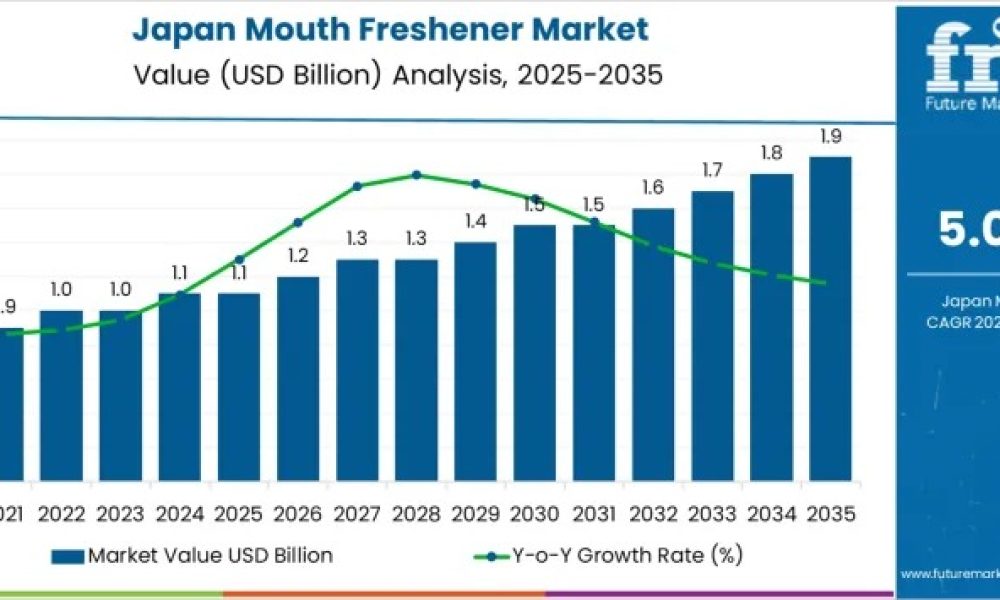
The demand for mouth fresheners in Japan is entering a sustained growth phase, with the market projected to expand from USD 1.1 billion in 2025 to USD 1.9 billion by 2035, registering a 5% CAGR. Rising attention to oral hygiene, social etiquette, and personal freshness is shaping consumer habits, making mouth fresheners a daily-use product across multiple age groups.
Products such as mint candies, chewing gum, sprays, and breath strips are becoming essential for Japan’s urban population, where convenience and discreet use are highly valued. The growing shift toward sugar-free and functional variants is further reinforcing demand as consumers look beyond simple breath-freshening toward added oral and wellness benefits.
Request For Sample Report | Customize Report | Purchase Full Report – https://www.futuremarketinsights.com/reports/sample/rep-gb-29589
Access the full report for detailed market trends.
Between 2025 and 2030, market expansion will remain steady, supported by habitual consumption and rising health awareness. Market value is expected to progress from USD 1.1 billion in 2025 to USD 1.5 billion by 2029, as consumers increasingly adopt products containing herbal ingredients, vitamins, and antibacterial formulations. Functional positioning is no longer a niche strategy but a central growth lever.
From 2030 to 2035, growth momentum is forecast to accelerate. The market is projected to climb from USD 1.5 billion in 2030 to USD 1.9 billion by 2035, supported by innovation in flavor technology, improved ingredient safety, and wider retail plus e-commerce penetration. Brands focusing on premium, health-oriented mouth fresheners are likely to gain competitive advantage as the category matures.
Key Market Highlights
- 2025 Market Value: USD 1.1 Billion
- 2035 Forecast Value: USD 1.9 Billion
- CAGR (2025–2035): 5%
- Leading Product Type: Mint Candies (38% share)
- Top Distribution Channel: Retail Stores (54% share)
Growth Drivers Shaping Demand
Japan’s strong cultural emphasis on cleanliness and etiquette continues to support consistent usage of breath-freshening products. Working professionals, students, and commuters prefer portable formats that can be used discreetly after meals or social interactions. Sugar-free variants are gaining traction as dental health awareness grows, aligning with national wellness trends.
Technological advancements in formulation are also influencing consumption. Manufacturers are enhancing odor-neutralizing capabilities, extending flavor stability, and introducing multi-benefit claims such as stress relief and digestive support. Compact packaging, resealable containers, and pocket-sized designs are improving usability for on-the-go consumers.
Segment Insights
Mint candies dominate with 38% market share, owing to their portability, familiarity, and strong association with freshness. They remain the preferred format in both personal and professional settings.
Retail stores account for 54% of total sales, driven by convenience stores, supermarkets, and drugstores with high foot traffic. Impulse buying behavior, in-store promotions, and immediate product comparison continue to make offline retail the dominant channel, though online sales are rising steadily.
Regional Outlook
Demand growth varies across Japan’s regions, reflecting demographic and lifestyle differences.
- Kyushu & Okinawa: 6.3% CAGR
- Kanto: 5.8% CAGR
- Kansai: 5.1% CAGR
- Chubu: 4.5% CAGR
- Tohoku: 3.9% CAGR
- Rest of Japan: 3.7% CAGR
Kyushu & Okinawa lead growth due to rising health consciousness and tourism-driven consumption. Kanto benefits from dense urban populations and fast-paced lifestyles, while Kansai’s strong food culture supports frequent post-meal usage. Other regions are witnessing gradual adoption as awareness of oral hygiene expands.
Challenges and Market Constraints
Despite positive momentum, intense brand competition and price sensitivity may limit margin expansion. Regulatory oversight on functional ingredients can increase compliance costs. Additionally, some consumers prefer traditional oral hygiene methods such as brushing or mouthwash over frequent mint or gum use, which could moderate premium segment growth.
Access the full report for detailed market trends. https://www.futuremarketinsights.com/reports/brochure/rep-gb-29589
Competitive Landscape
Major companies shaping the industry include Johnson & Johnson, The Hershey Company, Mars, Incorporated, Kraft Foods Inc., and Lotte. These firms focus on product innovation, sugar-free formulations, and convenient packaging to retain consumer loyalty in a competitive environment. Continuous flavor development and functional positioning remain central to differentiation strategies.
As Japan’s consumers increasingly connect fresh breath with overall hygiene and confidence, mouth fresheners are expected to maintain strong relevance. Brands prioritizing health benefits, quality ingredients, and user-friendly designs will be best positioned to capture long-term growth.
Key Players in Japan Mouth Freshener Demand
- Johnson & Johnson
- The Hershey Company
- Mars, Incorporated
- Kraft Foods Inc.
- Lotte
About Future Market Insights (FMI)
Future Market Insights, Inc. (FMI) is an ESOMAR-certified, ISO 9001:2015 market research and consulting organization, trusted by Fortune 500 clients and global enterprises. With operations in the U.S., UK, India, and Dubai, FMI provides data-backed insights and strategic intelligence across 30+ industries and 1200 markets worldwide



