
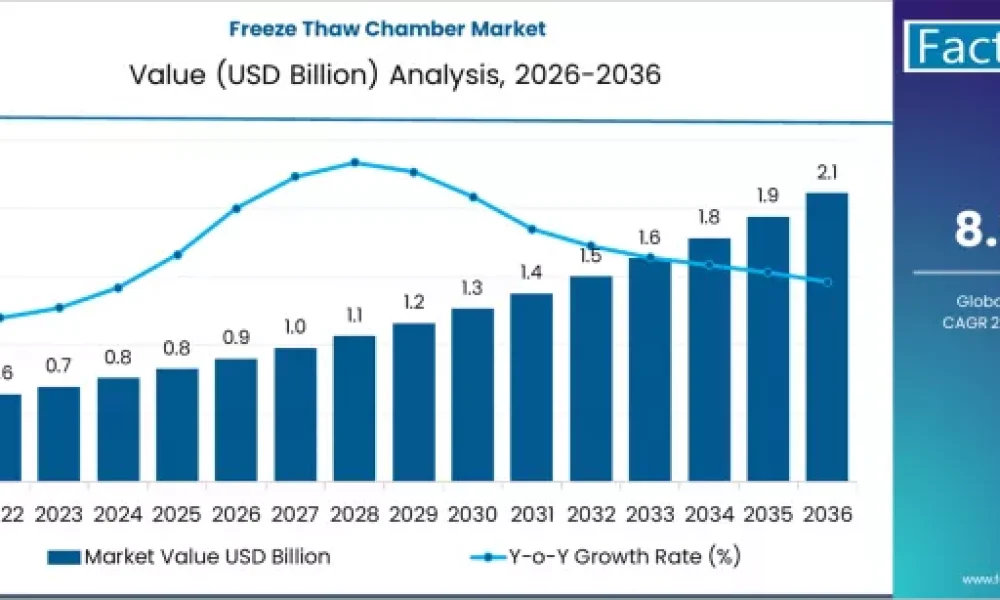
As global industries pivot toward higher standards of material resilience and therapeutic integrity, the Freeze Thaw Chamber Market has reached a critical valuation milestone. Driven by the twin pressures of a booming biopharmaceutical pipeline and the need for climate-resilient construction, these specialized environmental testing systems are transitioning from elective lab equipment to mandatory quality assurance infrastructure.
As of early 2026, the market is defined by a shift toward high-precision, automated cycling. By simulating the extreme thermal fluctuations products encounter during their lifecycle—from the harsh winters of North America to the sensitive “cold chain” logistics of vaccines—freeze thaw chambers allow engineers and scientists to identify structural weaknesses and chemical degradation before products reach the consumer.
Request for Sample Report | Customize Report |purchase Full Report – https://www.factmr.com/connectus/sample?flag=S&rep_id=13618
The Resilience Mandate: Who, What, and Why
The demand for advanced freeze thaw chambers is being spearheaded by major industrial players and specialized manufacturers, including Darwin Chambers, Labtop Instruments, Thermo Fisher Scientific, and Weiss Technik. These organizations are delivering systems that range from lab-scale units to massive walk-in environmental rooms, all designed to execute complex ramp/soak programming with unparalleled accuracy.
The “why” behind this market surge is rooted in three distinct industrial sectors:
- Biopharmaceutical Stability: With the global biopharma market reaching new heights in 2026, the structural integrity of monoclonal antibodies and mRNA vaccines depends on precise freeze-thaw protocols. Even minor concentration gradients during the thawing process can lead to protein denaturation, making controlled-rate chambers essential.
- Infrastructure Longevity: In the construction sector, clear floor tiles, asphalt, and concrete are subjected to rigorous ASTM and AASHTO freeze-thaw resistance testing. This ensures that the materials used in bridges and roadways can withstand the “frost-heave” cycles of changing climates.
- Food & Beverage Safety: Commercial thawing cabinets are increasingly integrated into high-volume kitchens to maintain food texture and safety standards, reducing waste and ensuring compliance with stringent HACCP regulations.
Technological Benchmarks: Automation and IoT Integration
The 2026 landscape is defined by the move toward “Digital Twin“ integration and smart connectivity.
- PLC and HMI Control: Modern chambers utilize Programmable Logic Controllers (PLC) with multi-level password protection, allowing for the storage of up to 200,000 readings and remote monitoring via Ethernet.
- Energy Efficiency: Manufacturers are prioritizing eco-friendly refrigerants like R404A and high-density CFC-free PUF insulation, reducing power consumption by up to 15% compared to legacy models.
- Uniformity and Recovery: Advanced unidirectional air flow systems ensure temperature uniformity of ±2.0°C, allowing for quick thermal recovery even after frequent door openings in busy laboratory environments.
Regional Outlook: Asia-Pacific Accelerates Infrastructure Testing
While North America remains the largest market due to its established research infrastructure and strict FAA/FDA frameworks, the Asia-Pacific region is experiencing the most rapid acceleration. Targeting a 10.6% CAGR, the region is being fueled by massive infrastructure projects in India and the expansion of the “Make in China 2025” biopharma initiative.
“Thermal stability is the new frontier of product safety,” says a senior materials scientist. “In 2026, we aren’t just testing if a product breaks; we are using freeze-thaw data to engineer materials that can survive the next 50 years of climate volatility.”
Strategic Outlook for 2026 and Beyond
For investors and lab directors, the focus is shifting toward “Validation-as-a-Service.” Companies that provide not just the hardware, but also the digital traceability and 21 CFR Part 11 compliant software, are capturing the highest market share. As the industry moves toward 2030, the integration of AI to predict material fatigue based on accelerated freeze-thaw cycling is expected to become the new global standard for R&D.
About the Freeze Thaw Chamber Market Intelligence:
This press release is based on 2026 market intelligence, providing a comprehensive overview of the technological and economic drivers defining the future of environmental testing and stability monitoring.
About Fact.MR
Fact.MR is a global market research and consulting firm, trusted by Fortune 500 companies and emerging businesses for reliable insights and strategic intelligence. With a presence across the U.S., UK, India, and Dubai, we deliver data-driven research and tailored consulting solutions across 30+ industries and 1,000+ markets. Backed by deep expertise and advanced analytics, Fact.MR helps organizations uncover opportunities, reduce risks, and make informed decisions for sustainable growth.



