
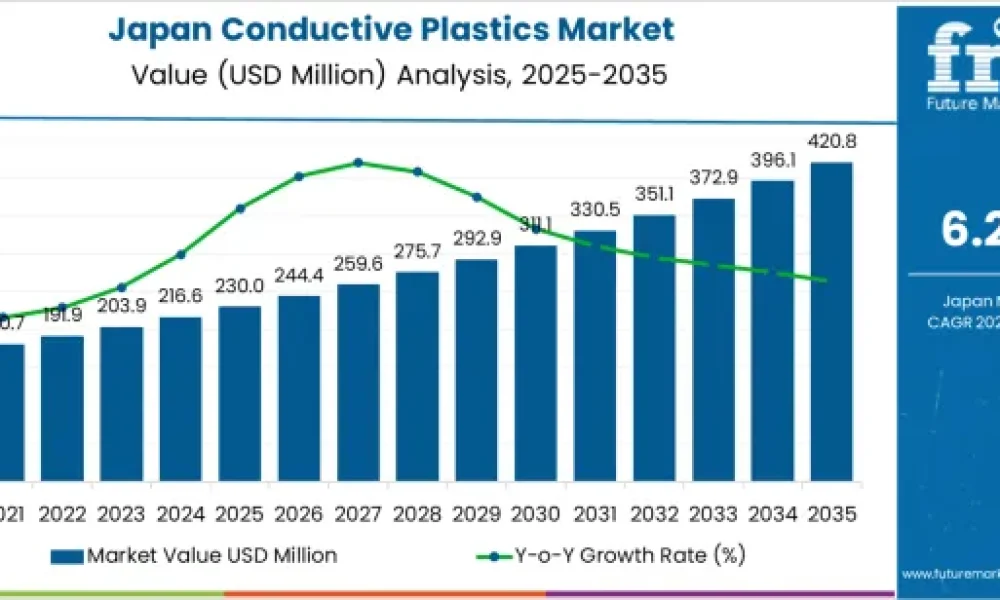
The Japan conductive plastics market is projected to increase from USD 230.0 million in 2025 to approximately USD 420.8 million by 2035, advancing at a steady CAGR of about 6.2 percent. Growth is being fueled by the rising use of conductive polymer materials in automotive electronics, battery systems, electrical components, telecommunications hardware, and industrial applications that require lightweight construction combined with reliable electrical conductivity and thermal stability.
Key Market Insights at a Glance
Conductive plastics are rapidly transitioning from niche engineering materials to essential components across Japan’s high-performance manufacturing ecosystem. Their ability to reduce part weight, enhance design flexibility, and improve electromagnetic interference (EMI) shielding performance makes them a preferred alternative to traditional metals in several next-generation applications. Increasing electrification in vehicles, expansion of advanced electronics production, and miniaturization of smart devices are creating sustained demand momentum across both domestic and export-oriented industries.
Automotive manufacturers are incorporating conductive plastics into sensor housings, battery modules, under-hood components, and interior electronics assemblies to balance performance reliability with lightweight design. In parallel, Japan’s electronics sector is leveraging these materials for connectors, printed circuitry, device casings, and antistatic components where durability, precision molding capability, and conductivity must coexist in a single material platform.
Segment Overview
The market is structured across product type, application, and end-use industry segments. Polyphenylene sulfide (PPS) continues to represent the dominant material category due to its high heat resistance and dimensional stability in demanding operating environments. Other widely adopted materials include polyamide, polycarbonate, polypropylene, polyethylene, and PBT blends, each selected according to conductivity, mechanical strength, and processing requirements.
From an application standpoint, conductive plastics are gaining wider use in antistatic packaging, coatings, batteries, sensors and actuators, capacitors, solar and electroluminescent components, and printed circuit board-related functions. Among end-use industries, automotive leads market contribution, followed by electrical and electronics, industrial equipment, telecommunications, aerospace and defense, and healthcare technologies that benefit from precision-engineered polymer-based conductors.
Regional Overview
Demand growth is visible across major industrial regions of Japan, led by emerging clusters with strong automotive and electronics production bases. Regions with high concentrations of component manufacturing, assembly facilities, and R&D activities are witnessing accelerated adoption as supply chains integrate advanced polymer materials for performance-critical components. Other regions continue to display stable and incremental uptake as small and medium-scale manufacturers modernize material portfolios to support new product platforms and export competitiveness.
To access the complete data tables and in-depth insights, request a sample report here
Competitive Landscape
The competitive environment is characterized by material innovation, formulation enhancement, and application-specific product development. Leading market participants are focused on improving filler dispersion, optimizing electrical conductivity profiles, and strengthening processing efficiencies to meet the stringent performance standards of Japanese manufacturing industries. Strategic priorities include expanding technical collaboration with OEMs, advancing recyclable and sustainability-aligned polymer systems, and reinforcing domestic supply capabilities for high-value specialty materials.
Market Outlook: Powering the Next Decade
Looking ahead, the conductive plastics market in Japan is positioned for resilient long-term expansion as electrification, automation, and digital infrastructure investment continue to reshape material selection strategies. The growth of electric and hybrid vehicles, rapid deployment of 5G-enabled devices, and scaling of smart manufacturing systems are expected to significantly increase the use of conductive polymers across structural and functional component categories. Enhancements in lightweight engineering, EMI shielding performance, and energy-efficient materials design will remain central to product innovation over the coming decade.
Key Players of Sustainable Label Industry
Market leaders are also aligning with sustainability-driven manufacturing initiatives by advancing recyclable conductive formulations and reducing metal-intensive component dependence. Their research and development programs emphasize material lifecycle efficiency, improved environmental performance, and compatibility with circular manufacturing pathways while supporting Japan’s commitment to energy-efficient industrial transformation.
Recent Strategic Developments
Recent industry developments include investments in new material grades tailored for high-frequency electronics, expanded production capabilities to support growing EV component demand, and technology partnerships focused on precision molding and performance validation. These initiatives reinforce Japan’s position as an innovation-driven hub for advanced conductive plastics technologies and strengthen the market’s foundation for sustained growth through 2035.
Have a specific Requirements and Need Assistant on Report Pricing or Limited Budget please contact us – [email protected]
About Future Market Insights (FMI)
Future Market Insights, Inc. (FMI) is an ESOMAR-certified, ISO 9001:2015 market research and consulting organization, trusted by Fortune 500 clients and global enterprises. With operations in the U.S., UK, India, and Dubai, FMI provides data-backed insights and strategic intelligence across 30+ industries and 1200 markets worldwide.
Why Choose FMI: https://www.futuremarketinsights.com/why-fmi



