
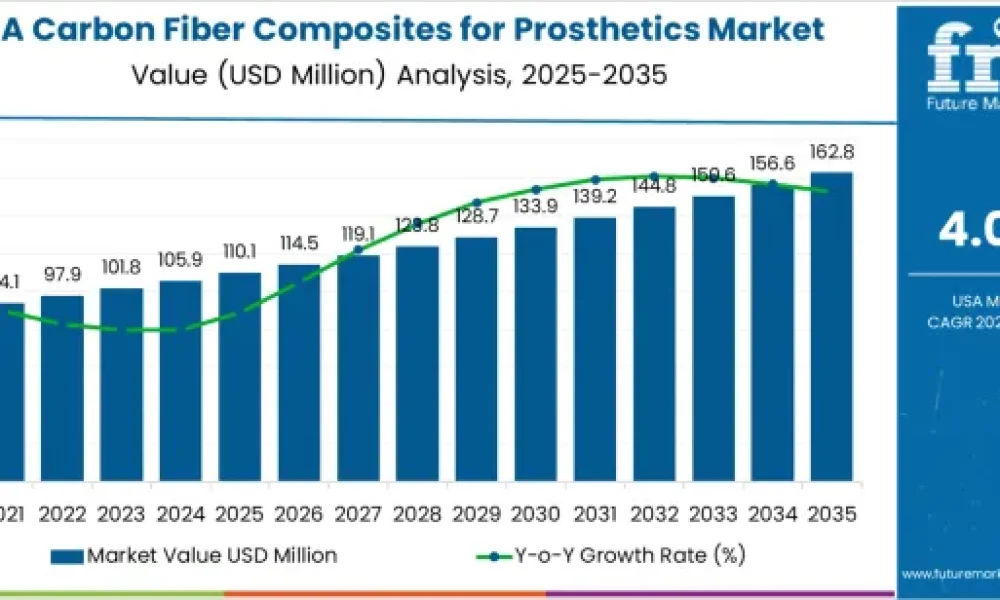
The United States Carbon Fiber Composites for Prosthetics Market is on a strong upward trajectory, projected to increase from an estimated USD 110.1 million in 2025 to USD 162.8 million by 2035, registering a steady compound annual growth rate of approximately 4%. The market outlook is fueled by rising amputee rehabilitation needs, advancements in material engineering, and a growing emphasis on high-performance prosthetic designs that enhance comfort, durability, and mobility outcomes for users nationwide.
Carbon fiber composites continue to transform modern prosthetic manufacturing due to their exceptional strength-to-weight ratio, fatigue resistance, and ability to support dynamic movement. These characteristics enable improved gait efficiency, reduced user fatigue, and greater adaptability for both everyday and athletic activity, reinforcing their role as a preferred material among prosthetic engineers, clinicians, and rehabilitation specialists across the U.S.
Key Market Insights at a Glance
Market expansion is driven by increasing cases of limb loss associated with diabetes, vascular conditions, trauma, and accident-related injuries. Alongside this, patient expectations for ergonomic, performance-oriented prosthetic systems continue to rise. Carbon fiber composite adoption is further supported by advancements in design precision, socket customization, and modular prosthetic components that prioritize stability and biomechanical alignment. While production costs and fabrication complexities remain market challenges, ongoing innovation in molding technologies and material optimization is helping improve accessibility and lifecycle value.
Segment Overview
The market is broadly segmented by product type and end-use environment. Lower-limb prosthetics account for the largest share of market demand, reflecting their critical role in patient rehabilitation and mobility restoration. Carbon fiber composite use is especially prominent in prosthetic feet, pylons, and structural components where shock absorption and flexibility are essential. Upper-limb prosthetics, customized prosthetic frameworks, and specialty components are also experiencing rising adoption as manufacturers enhance product ergonomics and weight distribution. Across end-users, hospitals, rehabilitation centers, orthopedic clinics, and specialized prosthetic facilities continue to represent the core channels for fitting, evaluation, and long-term patient support.
Regional Overview
Growth trends vary across U.S. regions, with strong adoption concentrated in innovation-driven healthcare ecosystems and areas with expanding rehabilitation infrastructure. Higher uptake is observed in regions with strong clinical research networks and advanced prosthetic care centers, while broader national growth is supported by increasing insurance coverage, patient awareness initiatives, and the expansion of specialized mobility care services.
To access the complete data tables and in-depth insights, request a sample report here
Competitive Landscape
The competitive environment is shaped by material performance leadership, manufacturing efficiency, and advancements in composite engineering. Key participants are prioritizing lightweight structural integrity, durability under repetitive stress, and improved shock-response characteristics to elevate patient comfort and functional reliability. Leading market contributors are also investing in custom fabrication technologies, collaborative product development programs, and patient-centric performance testing to strengthen product portfolios and long-term clinical acceptance.
Market Outlook: Powering the Next Decade
Over the coming decade, the U.S. carbon fiber composites for prosthetics market is expected to benefit from increasing integration of additive manufacturing, digital scanning, precision-fit socket systems, and intelligent mobility enhancements. These advancements support greater prosthetic personalization while reducing design variability and improving long-term alignment outcomes. A continued shift toward high-efficiency materials and patient-specific engineering is anticipated to reinforce the strategic importance of carbon fiber technologies in the prosthetics sector.
Key Players of Sustainable Label Industry
Sustainability-focused initiatives are also emerging, including ongoing research into carbon fiber recycling processes and environmentally conscious composite manufacturing approaches. These initiatives signal an industry shift toward long-term material stewardship, performance consistency, and responsible production lifecycle management.
Recent Strategic Developments
Recent market developments include technology upgrades in composite layering, collaborative innovation agreements between material suppliers and prosthetic manufacturers, and targeted investments in cost-efficient fabrication platforms. These advancements continue to strengthen market competitiveness while supporting broader patient access to next-generation prosthetic mobility solutions.
Have a specific Requirements and Need Assistant on Report Pricing or Limited Budget please contact us – [email protected]
About Future Market Insights (FMI)
Future Market Insights, Inc. (FMI) is an ESOMAR-certified, ISO 9001:2015 market research and consulting organization, trusted by Fortune 500 clients and global enterprises. With operations in the U.S., UK, India, and Dubai, FMI provides data-backed insights and strategic intelligence across 30+ industries and 1200 markets worldwide.
Why Choose FMI: https://www.futuremarketinsights.com/why-fmi



