
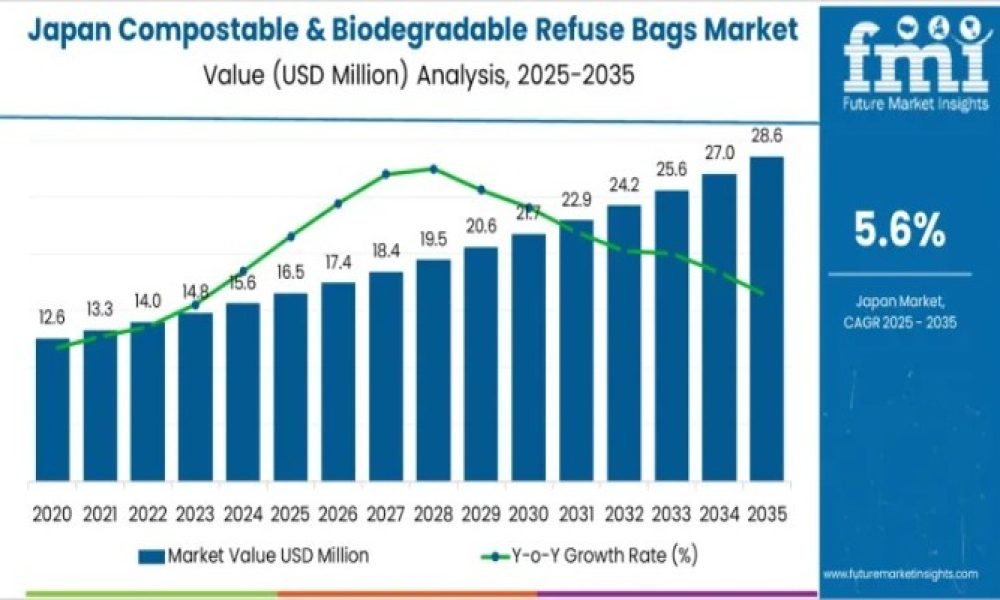
The demand for compostable and biodegradable refuse bags in Japan is valued at USD 16.5 million in 2025 and is projected to reach USD 28.6 million by 2035, registering a CAGR of 5.6%.
From 2025 to 2030, the market is expected to expand by USD 5.2 million, reaching USD 21.7 million, driven by early adoption across urban regions and rising regulatory pressure. During this period, annual demand increases of around USD 1.0 million reflect steady penetration into household and retail applications.
Growth accelerates further between 2030 and 2035, with an additional USD 6.9 million added, supported by stronger policy enforcement, improved composting infrastructure, and broader acceptance of biodegradable materials in everyday waste disposal.
Subscribe for Year-Round Insights → Stay ahead with quarterly and annual data updates – https://www.futuremarketinsights.com/reports/sample/rep-gb-29591
Japan’s commitment to sustainability is steadily reshaping its packaging and waste management landscape. Among the most notable shifts is the growing adoption of compostable and biodegradable refuse bags, driven by rising environmental awareness, stricter plastic regulations, and evolving consumer preferences. As Japan accelerates its transition toward a circular economy, eco-friendly refuse bags are emerging as a practical alternative to conventional plastic waste liners across households, retail, and commercial sectors.
Between 2025 and 2035, the demand for compostable and biodegradable refuse bags in Japan is forecast to grow consistently, reflecting the country’s long-term environmental vision and technological progress in biodegradable materials.
Meaning and Market Context
Compostable and biodegradable refuse bags are designed to break down naturally through biological processes, significantly reducing long-term environmental impact. Compostable bags decompose under controlled composting conditions, leaving no toxic residue, while biodegradable bags break down over time through microbial activity. In Japan, these products align closely with national waste segregation practices, recycling culture, and plastic reduction initiatives.
Unlike conventional plastic refuse bags, these sustainable alternatives support organic waste separation and help minimize landfill dependency, making them increasingly relevant in both residential and institutional waste management systems.
Market Overview
Japan’s compostable and biodegradable refuse bag market is structured across product types, capacities, materials, thickness levels, end uses, and regions. Compostable bags dominate demand due to their compatibility with food waste and municipal composting programs. Retail and consumer applications form the largest end-use segment, while institutional and commercial users continue to adopt these solutions for compliance and sustainability branding.
Materials such as PLA, PBAT, PBS, PHA, and starch blends are widely used, with ongoing innovation improving strength, leak resistance, and affordability.
Growth, Demand, and Trends
Growth Drivers
- Strong government focus on plastic waste reduction and resource circulation
- Rising consumer awareness of marine pollution and climate impact
- Expansion of composting and organic waste separation programs
- Advancements in biodegradable polymer technologies
Demand Dynamics
- Growing adoption in households for food and organic waste disposal
- Increased retail availability through supermarkets and online platforms
- Rising use in hospitality, tourism, and institutional sectors
- Urban regions leading early adoption, followed by regional expansion
Key Trends
- Shift from biodegradable to certified compostable bags
- Preference for plant-based and renewable raw materials
- Improved bag strength and durability matching plastic alternatives
- Integration of compostable bags into zero-waste and circular economy initiatives
Why Demand Is Growing in Japan
Japan’s long-standing culture of waste segregation and recycling has created a favorable environment for compostable refuse bags. With increasing concern over plastic pollution, particularly its impact on oceans and ecosystems, consumers are actively choosing greener alternatives. Government regulations encouraging plastic reduction and sustainable materials further support this transition.
In addition, technological improvements have made compostable bags more durable and cost-effective, eliminating earlier concerns about leakage and tearing. As quality improves, consumers no longer have to compromise functionality for sustainability.
Segment-Wise Insights
By product type, compostable bags account for 54.6% of total demand, making them the preferred option due to their suitability for organic waste. Retail and consumer applications lead end-use demand at 45%, driven by household adoption and retailer-led sustainability initiatives.
Popular capacity ranges include 7–20 gallons, 20–30 gallons, and 30–40 gallons, catering to both residential kitchens and commercial settings. Thickness options vary from lightweight liners to heavy-duty refuse bags for wet and bulky waste.
Regional Demand Outlook
Regional demand spans Kyushu & Okinawa, Kanto, Kansai, Chubu, Tohoku, and the rest of Japan. Kyushu & Okinawa leads growth with a 7.0% CAGR, supported by sustainability-focused local policies and tourism-driven waste management needs. Kanto follows closely at 6.5% CAGR, fueled by urban population density and heightened environmental awareness.
Kansai and Chubu show steady expansion, while Tohoku and other regions experience moderate but consistent growth as sustainability awareness spreads beyond major urban centers.
Competitive Landscape
The competitive landscape includes both global and regionally active suppliers offering certified compostable and biodegradable refuse bags. Leading players include Vegware Global, Cedo Ltd., BioBag International AS, Clondalkin Group Holdings B.V., and Cardia Compostable, with Vegware Global holding a notable market share.
These companies focus on compliance with compostability standards, material innovation, and expanding product portfolios to serve diverse end-use needs. As regulations tighten and consumer expectations evolve, competition is expected to intensify around performance, pricing, and sustainability credentials.
Why FMI: https://www.futuremarketinsights.com/why-fmi
About Future Market Insights (FMI)
Future Market Insights, Inc. (FMI) is an ESOMAR-certified, ISO 9001:2015 market research and consulting organization, trusted by Fortune 500 clients and global enterprises. With operations in the U.S., UK, India, and Dubai, FMI provides data-backed insights and strategic intelligence across 30+ industries and 1200 markets worldwide.



