
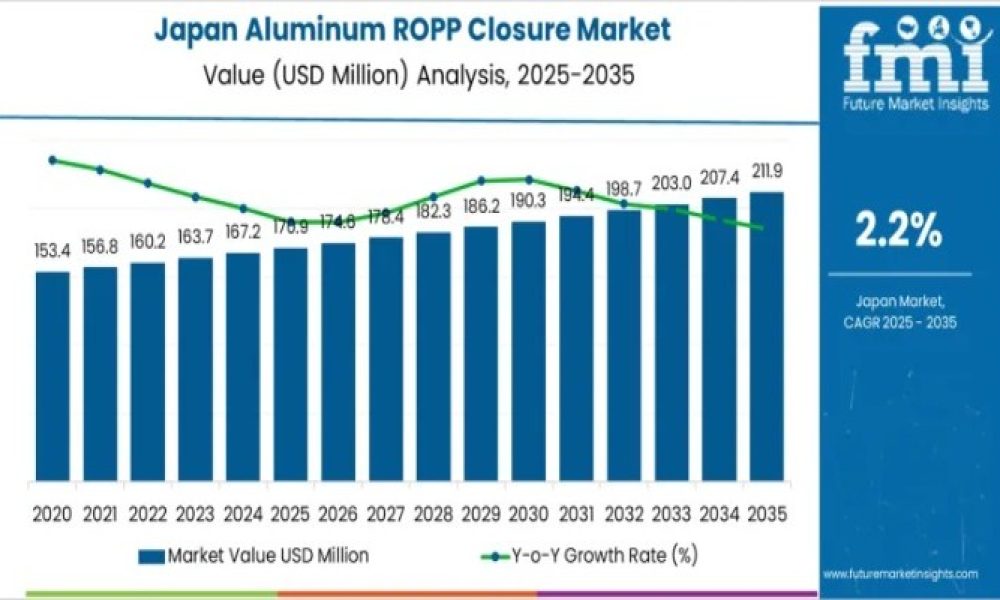
Japan’s aluminum Roll-On Pilfer Proof (ROPP) closure market is entering a decade of steady, structurally anchored growth, shaped less by volume expansion and more by precision packaging requirements across pharmaceuticals, beverages, and premium liquid products. Valued at USD 170.9 million in 2025, the demand for aluminum ROPP closures in Japan is projected to reach USD 211.9 million by 2035, expanding at a compound annual growth rate (CAGR) of 2.2% over the forecast period.
Unlike high-growth emerging markets, Japan’s aluminum ROPP closure industry is built on mature consumption patterns, regulatory discipline, and a strong culture of packaging quality. Demand is closely linked to stable pharmaceutical production, export-grade beverage bottling, and premium positioning rather than mass-market beverage proliferation.
Subscribe for Year-Round Insights → Stay ahead with quarterly and annual data updates – https://www.futuremarketinsights.com/reports/sample/rep-gb-29587
Market Snapshot: Quick Stats
- Market Value (2025): USD 170.9 million
- Forecast Value (2035): USD 211.9 million
- Forecast CAGR (2025–2035): 2.2%
- Leading Product Type: Pourer Insert ROPP Closures (33%)
- Dominant End-Use: Pharmaceuticals (38%)
- Preferred Neck Size: 24–38 mm (69.5% share)
- Manufacturing Structure: Inhouse production (76.7%)
- Key Growth Regions: Kyushu & Okinawa, Kanto, Kinki, Chubu
Demand Outlook: 2025 to 2035
Between 2025 and 2030, the market expands from USD 170.9 million to USD 186.2 million, adding USD 15.3 million in value. This phase reflects replacement-driven demand across existing bottling lines, particularly in spirits, pharmaceutical syrups, edible oils, and functional beverages. Growth is supported by export packaging standards, SKU stability, and the gradual substitution of plastic closures in regulated liquid formats.
From 2030 to 2035, demand accelerates modestly, rising to USD 211.9 million and adding a further USD 25.7 million. Annual incremental gains strengthen as premiumization deepens across spirits, nutraceutical drinks, and health tonics. Aluminum ROPP closures continue to benefit from stricter tamper-evidence expectations, export compliance requirements, and the rejection of single-use plastics in high-value liquid packaging.
What Is Fueling Demand in Japan?
The demand for aluminum ROPP closures in Japan is driven by structural factors rather than short-term packaging trends:
- Pharmaceutical Packaging Stability: Liquid medicines, syrups, and oral solutions require torque-controlled, tamper-evident sealing.
- Premium Beverage Bottling: Spirits, sake, whisky, and craft alcohol rely on aluminum closures for brand integrity and export acceptance.
- Export-Oriented Manufacturing: Globally recognized ROPP formats simplify international logistics and regulatory compliance.
- Glass Bottle Dominance: Premium liquid products in Japan continue to favor glass, reinforcing aluminum closure usage.
Printed closures currently account for just 25% of demand, highlighting a continued preference for functional branding over decorative finishes.
Product and Manufacturing Structure
By Product Type:
- Pourer insert ROPP closures lead with 33% share, favored for spirits, edible oils, and pharmaceutical syrups.
- Child-resistant designs account for 25%, reflecting safety-driven regulatory shifts.
- Standard and customized ROPP closures serve niche and specialty applications.
By Manufacturing Process:
- Inhouse manufacturing dominates at 76.7%, underscoring Japan’s emphasis on quality control, confidentiality, and process integration.
- Contract manufacturing remains limited to seasonal peaks and specialty designs.
Vertical integration allows Japanese brand owners to maintain precise threading tolerance, liner compatibility, and torque consistency—key performance parameters in high-speed bottling environments.
Regional Demand Dynamics
- Kyushu & Okinawa (2.7% CAGR): Growth led by spirits bottling, functional beverages, and export-oriented food processing.
- Kanto (2.5% CAGR): Japan’s largest concentration of pharmaceutical syrup plants and automated bottling lines sustains high baseline demand.
- Kinki (2.2% CAGR): Traditional sake brewing and specialty condiments drive steady, craft-oriented usage.
- Chubu (1.9% CAGR): Contract packers and bottled water facilities anchor volume-driven consumption.
- Tohoku & Rest of Japan (1.6–1.7% CAGR): Smaller-scale operations with longer replacement cycles limit faster expansion.
Competitive Landscape: Precision Over Price
Competition in Japan’s aluminum ROPP closure market increasingly hinges on:
- Threading accuracy and seal integrity
- Tamper-evidence reliability
- Compatibility with high-speed bottling lines
- Compliance with food and pharmaceutical regulations
Unit pricing plays a secondary role compared to operational reliability and audit readiness.
Key players operating in Japan include:
- Silgan Holdings Inc.
- Guala Closures S.p.A.
- Amcor Plc.
- Crown Holdings Inc.
- Herti JSC
Domestic and international suppliers compete on tooling precision, liner technology, recyclability credentials, and technical support capabilities.
Why FMI: https://www.futuremarketinsights.com/why-fmi
About Future Market Insights (FMI)
Future Market Insights, Inc. (FMI) is an ESOMAR-certified, ISO 9001:2015 market research and consulting organization, trusted by Fortune 500 clients and global enterprises. With operations in the U.S., UK, India, and Dubai, FMI provides data-backed insights and strategic intelligence across 30+ industries and 1200 markets worldwide.



