
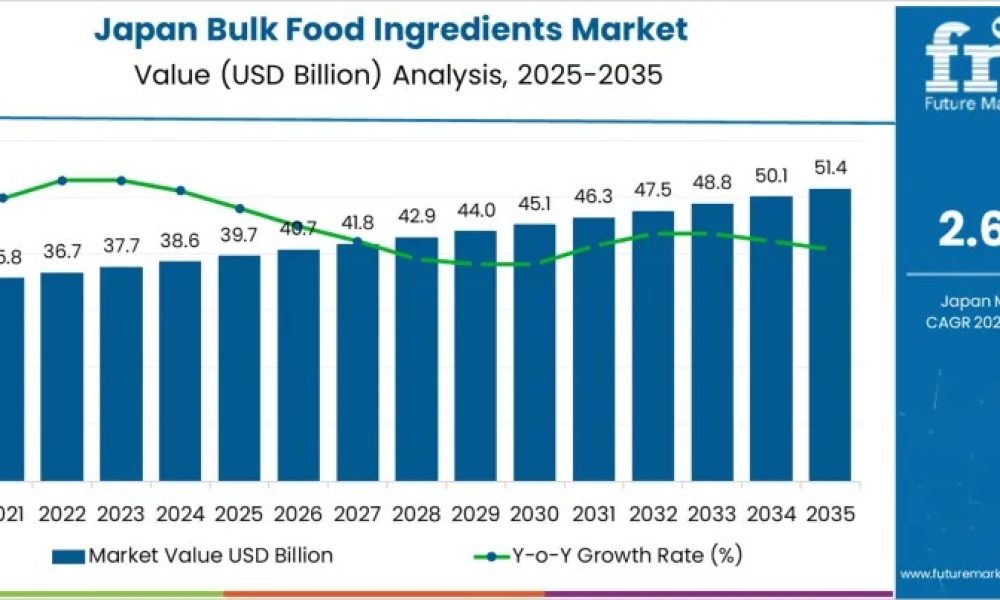
The demand for bulk food ingredients in Japan is projected to grow from USD 39.7 billion in 2025 to USD 51.4 billion by 2035, registering a CAGR of 2.6% over the forecast period. This growth trajectory reflects the country’s ongoing expansion in processed foods, bakery products, beverages, and institutional catering, underpinned by a need for reliable, high-volume ingredient supply.
Early-phase growth, from 2025 to 2029, is slightly stronger, with demand rising from USD 39.7 billion to approximately USD 42.9 billion. During this period, steady procurement by processed-food manufacturers, bakeries, beverage producers, and institutional kitchens drives the market, with starches, sugars, edible oils, dairy solids, and protein concentrates forming the core volume contributors. Growth is supported by stable domestic food output, private-label expansion, and ongoing reliance on predictable bulk inputs by convenience-food producers.
Request for Sample Report | Customize Report | Purchase Full Report – https://www.futuremarketinsights.com/reports/sample/rep-gb-29400
From 2030 onward, the market enters a more mature phase, with demand advancing from around USD 44.0 billion to USD 51.4 billion by 2035. Value growth during this stage is increasingly driven by ingredient specification upgrades rather than pure volume expansion. Specialty starches, fermentation-derived proteins, and tailored fat systems gain market share, supported by foodservice recovery in urban centers and export-oriented processed food production. Pricing trends are influenced by raw material volatility, energy costs, and long-term contracts with milling, crushing, and fermentation operators.
Market Dynamics and Drivers
The demand for bulk food ingredients in Japan has expanded alongside changes in consumption patterns, retail distribution, and industrial food processing. Key drivers include:
- Processed and packaged food growth: Ready meals, snacks, sauces, and beverages rely on high-volume base ingredients.
- Private-label and convenience food expansion: Central kitchens and institutional caterers require predictable bulk inputs.
- Functional and high-value ingredients: Rising demand for protein-fortified, low-carb, and fortified mixes fuels specialty ingredient growth.
Between 2025 and 2035, growth is shifting from volume-driven expansion toward higher-value ingredient mixes. Functional proteins, specialty carbohydrates, fermentation-derived inputs, and health-positioned additives are increasingly incorporated in nutritional foods, convenience meals, and fortified beverages. Export-oriented production, automated processing lines, and private-label scaling further strengthen the long-term growth curve.
Product Type and Application Analysis
- Processed grains, pulses, and cereals (30% of market): Used in rice-based meals, noodles, baked goods, and snack products, offering controlled particle sizing and consistent cooking performance.
- Bakery and confectionery (35% of total demand): Continuous requirement for flours, sugars, oils, cocoa derivatives, and flavorings supports steady ingredient throughput.
- Other key products: Vegetable oils, sweeteners, tea, coffee, cocoa, flours, and functional additives cater to diverse food manufacturing needs.
Bulk ingredients in Japan function primarily as production stabilizers rather than cost-saving measures. Manufacturers prioritize consistency in taste, texture, and shelf life, making bulk procurement essential for standardization and operational efficiency. Centralized kitchens, private-label food programs, and large-scale processed food operations convert bulk ingredient demand into continuous industrial flows.
Regional Insights
- Kyushu & Okinawa: Leading growth at 3.3% CAGR, driven by seafood processing, condiment production, and export-oriented foods.
- Kanto: CAGR of 3.0%, supported by dense networks of bakeries, beverage plants, and central kitchens.
- Kansai: Balanced growth at 2.7%, shaped by confectionery, noodle, and snack production.
- Chubu: CAGR of 2.3%, fueled by dairy processing and industrial seasonings.
- Tohoku: Moderate 2.0% CAGR, tied to grain, soybean, and frozen food processing.
- Rest of Japan: Steady 1.9% CAGR, driven by institutional catering and small-scale packaged food production.
Key Suppliers
Global suppliers stabilizing Japan’s bulk ingredient supply include:
- Cargill, Inc.
- Archer Daniels Midland Company (ADM)
- Ingredion Incorporated
- Tate & Lyle PLC
- Olam International
These companies provide grains, starches, sweeteners, oils, pulses, and functional solutions at scale, ensuring reliable ingredient access for processed food manufacturers, convenience-food producers, and beverage plants.
Future Outlook
Looking ahead, bulk food ingredients in Japan will evolve toward functionalization, health reformulation, and regional menu adaptation. Ingredients engineered for reduced sodium, high solubility proteins, resistant starches, and texture modification will increasingly replace neutral building blocks, reflecting consumer health consciousness, aging-population nutrition programs, and menu localization demands.
About Future Market Insights (FMI)
Future Market Insights, Inc. (FMI) is an ESOMAR-certified, ISO 9001:2015 market research and consulting organization, trusted by Fortune 500 clients and global enterprises. With operations in the U.S., UK, India, and Dubai, FMI provides data-backed insights and strategic intelligence across 30+ industries and 1,200 markets worldwide.



