
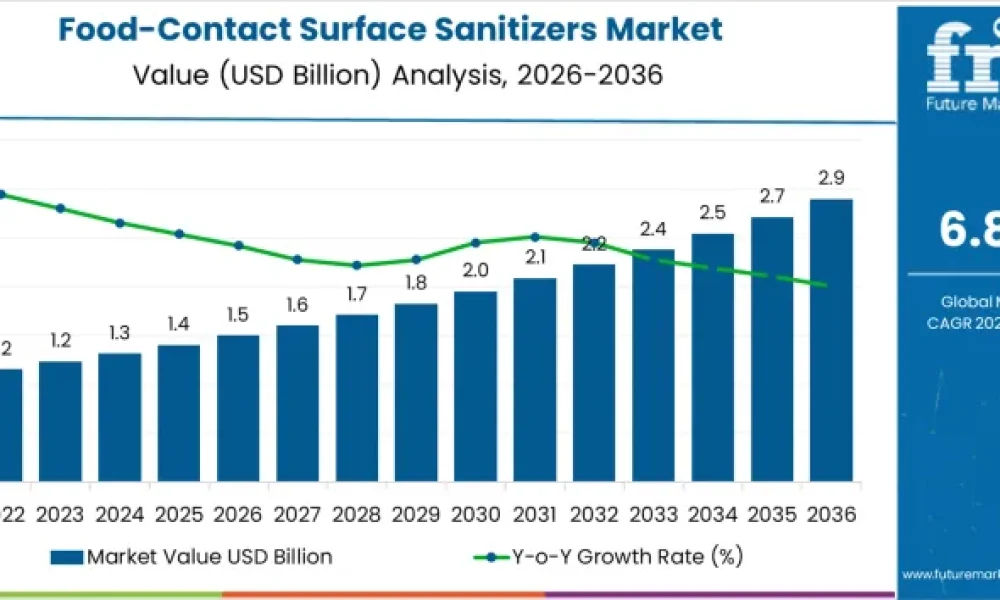
The global Food-Contact Surface Sanitizers Market is poised for robust expansion, projected to grow from an estimated USD 1.5 billion in 2026 to USD 2.9 billion by 2036, reflecting a compelling compound annual growth rate (CAGR) of 6.8% through 2036, driven by rising regulatory hygiene mandates, enhanced food safety protocols, and escalating adoption of advanced sanitizing solutions across food processing and service segments. This dynamic growth trajectory underscores the strategic importance of surface sanitization solutions in protecting food chain integrity and minimizing contamination risks, especially in an environment where operational compliance and consumer safety are paramount.
Key Market Insights at a Glance
The growth story of the Food-Contact Surface Sanitizers Market is rooted in regulatory pressures and hygiene standards that are reshaping operational priorities across commercial kitchens, food manufacturing units, dairy and beverage processing plants, and institutional foodservice environments. Sanitizers compliant for direct food contact are being integrated into daily sanitation programs to meet stringent microbial reduction criteria, reduce foodborne illness incidences, and satisfy compliance auditing requirements across markets worldwide.
Quaternary ammonium compounds (Quats) account for approximately 38% of active chemistry demand, reflecting their widespread use for routine sanitation due to balanced efficacy and residue profiles. Clean-in-place (CIP) systems are a leading application format, capturing nearly a quarter of total usage due to their automation compatibility and efficiency in large-scale processing environments.
Segment Overview
Beyond active chemistry, the market is markedly segmented by application format and end-use. CIP sanitizing solutions dominate as the leading application format, owing to their integration with automated systems that reduce labor intensity and enhance consistency of microbial control. Other important formats include spray and foam sanitizers, ready-to-use wipes, immersion/dip solutions, and concentrated dosing systems tailored to varied operational demands. End-use segments like food processing plants lead market demand, followed by dairy and beverage facilities and commercial kitchens, where sanitation compliance directly impacts food safety outcomes and consumer trust. The emphasis on surface compatibility, contact time validation, and residue-free performance continues to shape procurement decisions and product innovation across segments.
Regional Overview
Globally, growth patterns vary by region, with China and Brazil exhibiting some of the fastest projected expansion rates through 2036, supported by rapid industrialization of food service and processing sectors. China’s market is estimated to grow at a CAGR of approximately 8.1%, reflecting surging demand from restaurants, institutional kitchens, and industrial facilities, while Brazil follows close behind at 7.9% CAGR, propelled by regulatory compliance and operational sanitation expansion. The United States maintains strong growth at around 6.7% CAGR, driven by recurring cleaning schedules and established food safety standards, with demand centered in restaurants, industrial kitchens, and institutional foodservice providers. European markets such as Germany and the United Kingdom are also notable, growing at roughly 6.1% and 6.2% CAGR respectively, as mature hygiene frameworks and compliance requirements sustain steady adoption of surface sanitization solutions.
Competitive Landscape
The competitive arena for food-contact surface sanitizers is shaped by established global players and specialized regional operators focused on performance validation, regulatory acceptance, and operational reliability. Key participants include Ecolab, Kersia Group, Neogen Corporation, Solenis (Diversey), Virox Technologies, Christeyns, SC Johnson Professional, Reckitt, Lanxess, and 3M, each leveraging unique product portfolios and value-added services to differentiate in a market where efficacy under real-use conditions and compliance assurances are strategic differentiators. Competitive strategies emphasize partnerships with food processors, distributor networks, and service contracts that align product performance with hygiene audit requirements.
Market Outlook: Powering the Next Decade
Looking forward, the Food-Contact Surface Sanitizers Market is expected to sustain momentum as food safety protocols evolve and regulatory frameworks tighten globally. Automation, digital validation tools, and real-time microbial monitoring technologies are set to further enhance operational adoption, driving demand for sanitizers that integrate seamlessly with advanced sanitation systems. Moreover, the alignment of sanitization practices with corporate sustainability goals and eco-friendly formulation initiatives is increasingly influencing procurement strategies, positioning the market for both qualitative and quantitative growth over the next decade.
Key Players of Sustainable Label Industry
The industry’s leading brands are not only expanding their chemical sanitizer offerings but are also incorporating sustainability criteria into product development, focusing on reduced environmental impact, biodegradable formulations, and improved safety profiles without compromising antimicrobial efficacy. This strategic evolution is reinforcing long-term market resilience and unlocking new opportunities within food processing, healthcare catering services, and large-scale institutional foodservice implementations.
Recent Strategic Developments
Recent vendor initiatives reflect a broader trend toward value-added sanitation programs that combine high-performance products with training, compliance documentation support, and customized sanitation workflows. Investments in R&D to enhance biocidal performance, reduce surface damage, and improve worker safety continue to differentiate successful players in the marketplace, aligning with industry expectations for dependable, validated sanitation solutions that mitigate contamination and uphold global food safety standards.
Have a specific Requirements and Need Assistant on Report Pricing or Limited Budget please contact us – [email protected]
About Future Market Insights (FMI)
Future Market Insights, Inc. (FMI) is an ESOMAR-certified, ISO 9001:2015 market research and consulting organization, trusted by Fortune 500 clients and global enterprises. With operations in the U.S., UK, India, and Dubai, FMI provides data-backed insights and strategic intelligence across 30+ industries and 1200 markets worldwide.
Why Choose FMI: https://www.futuremarketinsights.com/why-fmi



