
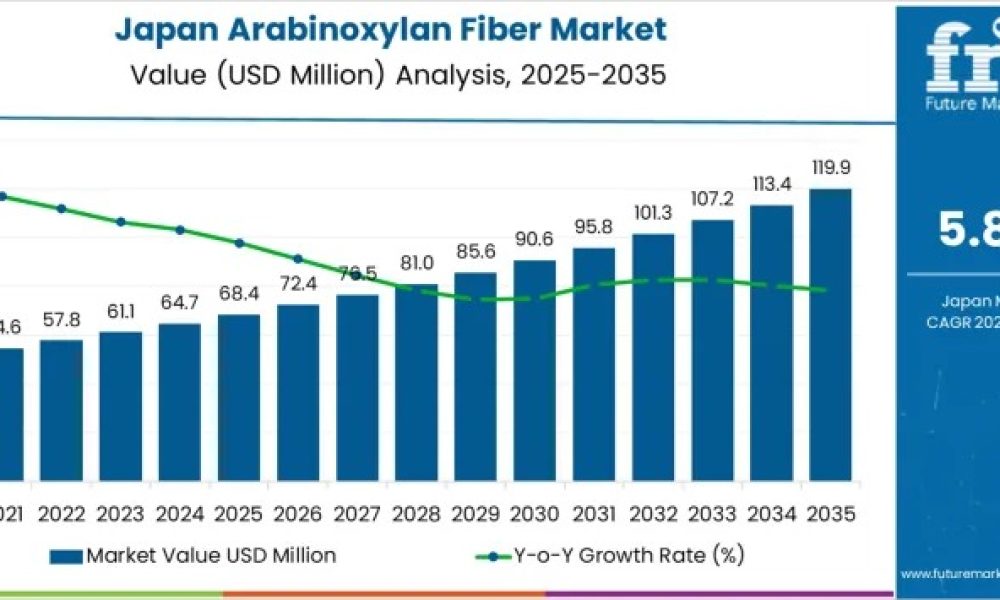
Japan’s arabinoxylan fiber industry is entering a strong growth phase as functional nutrition gains momentum across food, feed, and supplement sectors. The market is valued at USD 68.4 million in 2025 and is forecast to reach USD 119.9 million by 2035, expanding at a 5.8% CAGR. Growth reflects rising consumer focus on digestive wellness, plant-based nutrition, and scientifically backed functional ingredients.
Arabinoxylan, a soluble dietary fiber extracted mainly from cereal grains, is gaining traction for its prebiotic properties and role in supporting gut microbiome balance. Its integration into mainstream food formulations signals a shift in Japan’s nutrition landscape toward preventive health and clean-label fiber solutions.
Request For Sample Report | Customize Report | Purchase Full Report – https://www.futuremarketinsights.com/reports/sample/rep-gb-29593
Demand is expanding across multiple industries, with animal feed accounting for 27% of total consumption. Livestock producers are incorporating arabinoxylan to improve digestion efficiency and nutrient absorption in poultry, swine, and cattle. This aligns with Japan’s push toward higher-quality animal nutrition and sustainable production systems.
From a formulation standpoint, powder form dominates with a 44% share, favored for its stability, ease of blending, and high concentration. It allows precise dosing in bakery products, functional beverages, dairy alternatives, and dietary supplements without affecting flavor or texture.
Key Growth Drivers
- Rising awareness of gut microbiome health among aging consumers
- Growing demand for plant-based, clean-label ingredients
- Increased use of functional fibers in dietary supplements
- Advancements in extraction and purification technologies
- Expansion of fiber-enriched foods in retail channels
Wheat remains the primary raw material source, supported by established grain-processing infrastructure. Rye, corn, barley, rice, and sorghum also contribute, but wheat-derived arabinoxylan offers consistent quality and functional performance.
Regionally, growth varies based on demographics, dietary behavior, and industrial activity.
Kyushu & Okinawa lead with a 7.2% CAGR, fueled by strong interest in digestive wellness and Okinawa’s aging population seeking longevity-focused nutrition. Functional foods and supplements tailored to senior health are driving localized demand.
Kanto follows at 6.6% CAGR, supported by its dense urban population and strong functional food retail ecosystem. Consumers in Tokyo and surrounding areas increasingly prefer fiber-enriched ready-to-eat products, beverages, and nutraceuticals.
Kansai grows at 5.8% CAGR, reflecting its dynamic food culture and expanding supplement market. Osaka and Kyoto-based manufacturers are integrating arabinoxylan into bakery innovations and health snacks.
Chubu, Tohoku, and the Rest of Japan show steady expansion at 5.1%, 4.5%, and 4.3% CAGR, respectively. While adoption is slower outside major cities, awareness campaigns and improved product availability are broadening reach.
Technological innovation is strengthening the supply chain. Modern extraction methods now yield higher-purity arabinoxylan with better solubility and viscosity control. These improvements allow formulators to develop fiber-rich foods with improved sensory profiles, accelerating commercial adoption.
However, market expansion faces some constraints. Processing costs remain higher than conventional fibers such as inulin or FOS. Variability in cereal raw materials can also affect functional consistency, creating formulation challenges for large-scale manufacturers.
Despite this, Japan’s broader shift toward preventive healthcare nutrition is sustaining momentum. Fiber intake remains below recommended levels, creating opportunity for ingredient suppliers and food brands to bridge the gap with fortified offerings.
Access the full report for detailed market trends. https://www.futuremarketinsights.com/reports/brochure/rep-gb-29593
Competitive activity is intensifying as global and regional players expand their presence. Leading companies include:
- Acetar Bio-tech Inc.
- Antimex Pharmaceuticals & Chemicals Ltd.
- BioActor BV
- Cargill
- Comet Biorefining
These firms focus on innovation, quality assurance, and application development to meet Japan’s strict food standards and evolving consumer preferences.
As research continues to validate arabinoxylan’s prebiotic and metabolic benefits, its role in functional nutrition is expected to deepen. The ingredient’s compatibility with beverages, baked goods, supplements, and animal nutrition positions it as a versatile growth driver across industries.
Japan’s arabinoxylan fiber industry is poised for sustained expansion as health-conscious consumers, technological advancements, and functional food innovation converge to reshape the country’s dietary fiber landscape.
About Future Market Insights (FMI)
Future Market Insights, Inc. (FMI) is an ESOMAR-certified, ISO 9001:2015 market research and consulting organization, trusted by Fortune 500 clients and global enterprises. With operations in the U.S., UK, India, and Dubai, FMI provides data-backed insights and strategic intelligence across 30+ industries and 1200 markets worldwide.



