
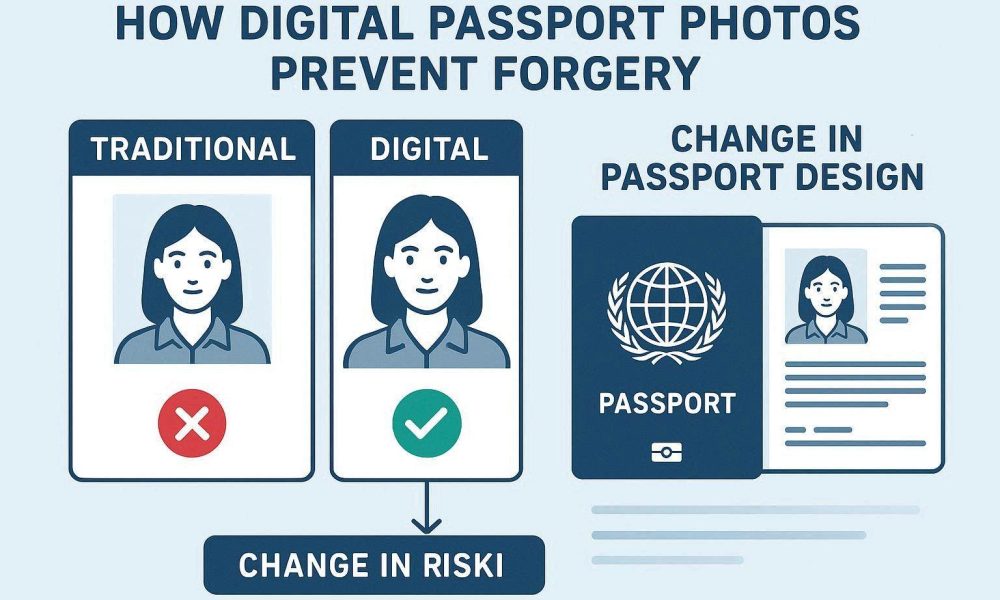
The 1990s shift to digitally printed images helped make passports tougher, cleaner, and far more secure.
WASHINGTON, DC — April 10, 2026
For years, one of the oldest passport fraud tricks was also one of the most intuitive. Change the photograph, keep the rest of the booklet looking real enough, and hope the person checking the document trusted the paper more than the face standing in front of them.
That vulnerability defined the old glued-photo era.
When a passport treated the portrait as a separate physical element, something attached to the page rather than built into it, the image became an obvious attack point. A fraudster did not always need to counterfeit the entire document. In some cases, a real passport could be repurposed simply by removing the original photo, inserting another, and hiding the damage well enough to survive a rushed inspection.
Modern passport design changed that equation.
The move toward digitally printed portraits in the 1990s, followed by more advanced personalization methods such as laser engraving and polycarbonate data pages, transformed the photo from a weak attachment into an integrated security feature. Once the image stopped being something stuck onto the page and became part of the page itself, classic photo substitution became far harder to do cleanly. That one shift helped make passports tougher, cleaner, and much more resistant to the type of forgery that once caused serious trouble at borders.
The U.S. State Department’s description of the Next Generation Passport points in exactly that direction. Highlighting the move to a polycarbonate data page and laser engraving shows how modern passport design now treats the identity page as a built-in security surface rather than a vulnerable paper panel waiting to be tampered with.
The old passport photo was a structural weakness, not just a design choice.
The biggest problem with older passport photos was not simply that they looked dated. It was that they existed as separate objects.
A glued-in or laminated photograph could be protected with stamps, seals, laminate overlays, and clever page design, but the image still began life as something distinct from the document page itself. That gave fraudsters a target. If the original image could be lifted, peeled, softened, scraped, or otherwise disturbed without damaging the document too much, the passport could sometimes be turned into a new identity tool.
This is why older fraud methods are so often centered on the face rather than the whole document. A full passport counterfeit is hard. Altering a genuine document can be easier, especially if the attacker only needs to change one crucial feature.
That is also why the old glued-photo passport gradually became harder for governments to defend. The more international travel expanded, the more valuable genuine documents became to criminal networks, and the more dangerous it became to leave the identity portrait as something that might be physically separated from the page.
The answer was not to glue the photo better. The answer was to stop treating the photo as a separate piece at all.
Digital printing changed the fraud problem from substitution to destruction.
This is the core security story.
Once governments began printing passport photos directly onto secure document material, the challenge of fraud changed completely. The old attack depended on isolating the portrait. The new design made the portrait part of the page.
That matters because a digitally printed image is much harder to remove or swap without damaging surrounding features. If the portrait is printed directly into the data page, the attacker can no longer rely on lifting one item and replacing it with another. To successfully alter the image, they often have to attack the document’s surface itself.
That means scratching, scraping, delaminating, overprinting, or otherwise damaging the page in ways that are more likely to leave evidence.
The portrait ceases to be a detachable identity token and becomes a structural part of the document.
That is what made the 1990s shift so important. It did not just update passport aesthetics. It changed the physics of passport fraud.
The photo became part of a larger page-security system.
Modern passports do not rely on the portrait alone to prove identity. The image now sits inside a broader page architecture designed to make tampering obvious.
Fine-line printing, background patterns, microtext, UV-reactive elements, overlapping design features, and machine-readable data all help make the image part of a coordinated security field. Instead of looking like a picture placed on top of a page, the portrait is visually and materially fused with the page.
That is one reason Amicus International Consulting’s review of the high-tech features that make passports secure is useful in understanding the larger shift. The image is no longer protected by one feature. It is protected by the way multiple features overlap.
This matters greatly in fraud detection.
In the old glued-photo model, an inspector might focus on bubbling laminate, disturbed corners, broken seals, or whether a stamp crossing from page to photo still lined up naturally. In the newer model, the fraud question becomes broader and harder for the attacker. Does the image sit correctly inside the page design? Do the background patterns flow normally through the portrait area? Has the print quality changed? Does the page show signs of abrasion, rework, or material disturbance?
That wider field makes document tampering harder to hide because the image is no longer a small island sitting by itself.
The 1990s mattered because passport design was becoming industrial and digital.
The shift to digital photos did not happen in isolation. It arrived at a moment when passport production itself was becoming more system-driven, more standardized, and more closely tied to modern border technology.
By the 1990s, governments were under growing pressure from rising travel volumes, cross-border fraud, and the need to produce cleaner machine-readable documents. A data page built around digital printing fits much better into that new reality than a passport still dependent on physically attached photographs.
Digital production made identity pages more uniform. It helped align portrait placement with other printed security features. It made it easier to build cleaner, more predictable biographical pages suited for scanners and later for electronic verification systems.
In other words, the digital photo was not just a better photo. It was part of a broader redesign of how passports were manufactured and trusted.
That broader modernization is also reflected in Amicus International Consulting’s explainer on electronic passports, which shows how modern passport systems rely on the close relationship between the visible identity page, machine-readable data, and electronically stored identity information. The move to integrated portraits fit naturally into that wider evolution.
Cleaner documents also made inspection easier.
Another advantage of directly printed photos is that they make good passports look more coherent and suspicious passports easier to question.
This is not just a cosmetic benefit. Clean design matters because border officers and document examiners work by looking for inconsistencies. The more unified a genuine passport appears, the easier it becomes to spot visible disruption.
A glued-in photo can sometimes create natural-looking seams because the design already expects separate layers. A digitally integrated portrait reduces that ambiguity. The more fully the image belongs to the page, the more obvious tampering becomes when someone tries to alter it.
That means digital printing improved not just document strength, but inspection logic.
It made genuine documents more internally consistent and forged documents more likely to reveal their own manipulation.
Photo substitution became much riskier, even if forgery did not disappear.
It is important to be precise here. Digitally printed passport photos did not make forgery impossible. Fraud adapts. Attackers shifted toward page substitution, full counterfeit production, stolen blank documents, synthetic identity abuse, and later electronic attacks against document ecosystems.
But digital portrait integration did make one classic method much harder to pull off convincingly.
That point is easy to understand if you look at older criminal patterns. Reuters once reported on a fake passport racket in Thailand where authorities said real passports were sometimes altered with new photographs before entering criminal circulation. That Reuters account remains a useful illustration of why the old glued-photo model created such a tempting attack route. If a real passport could be repurposed by changing the face, the criminal did not need to counterfeit the whole document from scratch.
Digital printing attacked that weakness directly.
By integrating the portrait into secure document production, governments pushed fraudsters away from relatively straightforward image swapping and toward riskier, more technically demanding forms of tampering.
That did not end document fraud, but it sharply raised the cost of this particular attack.
The e-passport era made the printed photo more important, not less.
Some travelers assume that once passports became electronic, the printed image stopped mattering as much because the chip carried the real identity data.
In practice, the printed photo became even more important because it became one visible part of a larger identity-verification chain.
Modern e-passports tie the printed data page to chip-stored biographic and biometric data. Border systems can compare the printed image, the chip content, and, in many cases, the traveler’s live face. That means the visible portrait now operates inside a much stronger trust structure than it did in the era of visual inspection alone.
A substituted image would have to withstand a quick human glance. It would increasingly have to coexist with machine-readable data, chip verification and biometric checks.
That is one reason the modern passport photo remains central to document security. The electronic layer did not make the printed portrait less relevant. It made it part of a deeper security network.
Polycarbonate pushed the logic even further.
The digital-photo shift of the 1990s was a major turning point, but many governments later took the same anti-tamper logic further by moving to polycarbonate data pages and laser personalization.
This is where modern passport design became especially tough.
A polycarbonate page allows identity data and portrait information to be laser-engraved into the layered material rather than printed on a more vulnerable surface. That makes the page harder to alter because attempts to scratch, lift, soak, or substitute material are more likely to leave obvious physical destruction.
The identity page is no longer just carrying the photo. It is built around the photo.
That is exactly the kind of design philosophy visible in the U.S. government’s modern passport architecture. It reflects the broader lesson governments learned over time: the safest photo is not one that is merely protected after it is added. It is one that cannot be cleanly separated from the document at all.
The passport photo became part of the document architecture.
That is the simplest way to understand what changed.
The old passport photo was something added to the page.
The modern passport photo is something built into the page.
That single design shift reshaped passport security by changing the nature of the attack. In the older world, a fraudster could try to target the image as a separate component. In the newer world, changing the image often means attacking the page itself.
That is why digital passport photos helped make modern passports tougher, cleaner, and far more secure. They did not just improve the look of the document. They made one of the oldest passport fraud methods much harder to execute without obvious signs of tampering.
In the end, that is the real design legacy of the 1990s shift. Governments stopped treating the photo as an attachment and started treating it as part of the identity page’s core security structure. Once that happened, passport forgery changed with it.




