
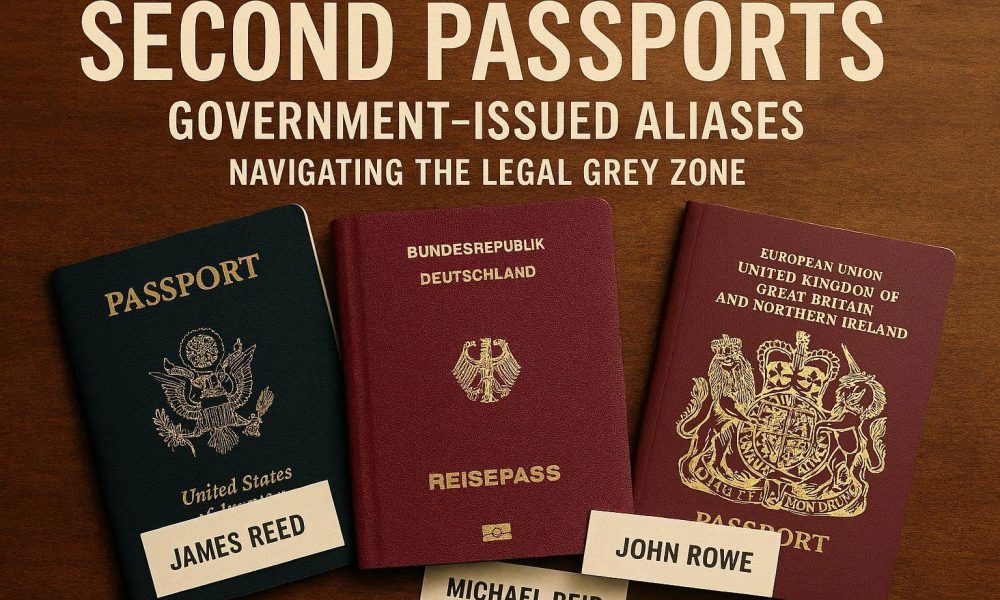
How multiple citizenships and state-sanctioned aliases intersect with international law, privacy, and the limits of modern identity.
WASHINGTON, DC — April 10, 2026
The fantasy is simple. One person, two lawful biographies. Two passports, two names, two lives, all cleanly separated by paperwork and sovereign borders.
The legal reality is much messier.
In the modern world, it is possible for one person to hold more than one citizenship and more than one passport. It is also possible, in rare and tightly controlled situations, for a government to authorize an alternate legal identity for safety or operational reasons. But those two realities do not add up to a free-floating right to maintain parallel selves. Most legal systems still insist on traceability. Most borders still care about continuity. And most governments tolerate multiple statuses only if they can still link them to a single legally accountable person.
That is where the grey zone begins.
A second passport can be fully lawful. A legal name change can be fully lawful. A protected identity issued for witness security or sensitive state work can also be lawful. But the closer a person gets to the idea of running two separate biographies at once, the more the system begins to ask hard questions about fraud, disclosure, tax obligations, border compliance, and the state’s right to know who is really moving across its checkpoints.
The result is not a world of secret legal doubles. It is a world of overlapping identity records, conflicting national rules, and shrinking privacy assumptions.
Multiple citizenships are legal in many places, but they are not legally neutral.
A second passport is often the easiest piece of the puzzle to understand because it usually arises from citizenship law rather than deception.
A person may hold two or more citizenships through birth, descent, marriage, naturalization, or a state’s own nationality rules. The United States openly recognizes this reality. The State Department’s page on dual nationality explains that a person can be a national of two countries at once and may owe legal duties to both. That means a second passport is not inherently suspicious. In many cases, it is simply the travel expression of lawful dual citizenship.
That is the clean part.
The complications start when each state insists on its own version of the person. One country may treat the traveler primarily as its citizen and require entry on its own passport. Another may do the same. One may expect military obligations, tax filing, or registration. Another may limit foreign consular protection if the traveler is also a national of that state.
So a second passport is legal in many cases, but it does not create a second invisible self. It often creates a second set of obligations.
That is why private planning around lawful international mobility, including a second-passport strategy, belongs in a very different category from identity evasion. The passport may be lawful. The administrative consequences are still real.
The border often collapses your “parallel” identities back into one.
One of the most important truths about dual nationality is that borders do not always let you choose which biography matters.
On paper, a dual national may hold two passports. In practice, each state can insist on reading the traveler through its own citizenship rules. That can mean using one passport to leave one country and another passport to enter the next. It can also mean that the state does not care very much about the traveler’s other nationality once the person is on its soil. It sees only its own citizens.
That is why the idea of dual biographies sounds neater than it really is. The traveler may hold multiple lawful documents, but the state at the border still wants one legally coherent person standing before it.
A recent example made that principle unusually visible. New UK rules required many British dual nationals to present a British passport or a formal certificate proving right of abode in order to travel to the United Kingdom. The resulting confusion, reported by The Guardian, showed how quickly the “I’ll just use my other passport” assumption can collapse when a state decides it wants to see its own citizenship reflected in the document presented at the border.
That is not a fringe issue. It is the modern reality of dual status. Holding two passports may expand lawful mobility, but it does not guarantee freedom to present whichever identity narrative feels most convenient in every jurisdiction.
A government-issued alias is usually not what people think it is.
The phrase “government-issued alias” sounds cinematic, but in ordinary civilian life, it is much less common than people imagine.
Most governments do not casually issue alternate legal selves. They recognize a single current legal name for ordinary civil purposes, even if earlier names remain on record. A legal name change replaces the public-facing identity, but it usually does not erase the historical record. Courts, agencies, and identity systems preserve the link precisely because states do not want names to become tools for the disappearance of debt, criminal exposure, or legal accountability.
That is why the ordinary legal route is not an alternative creation. It is identity continuity through updated records.
The rare exceptions tend to fall into narrow categories. Witness protection is the clearest example. In such cases, the state may create a New Legal Identity because physical safety depends on severing day-to-day public traceability. Certain undercover or intelligence roles may also involve state-managed alternate identities, though those operate under strict internal rules rather than as general privacy tools. In some safety-related cases, court records may also be sealed or administrative exposure reduced.
But these are not consumer options. They are exceptional state responses to danger or operational necessity.
So the phrase “government-issued alias” can be legally true in narrow contexts, yet deeply misleading in ordinary conversation. For most people, the law recognizes a traceable legal identity, not a set of interchangeable government-approved selves.
The real dividing line is between an alias and a legal identity.
This is where the grey zone becomes clearer.
An alias, in the informal sense, is just another name someone uses. A legal identity is the name and status structure that the state recognizes for official purposes. Those are not the same thing. A person can use a pen name, stage name, or professional name without changing their passport. But once travel documents, banking, tax reporting, immigration records, or security screening enter the picture, the legal identity matters.
That is why most serious systems resist the idea of a permanent parallel civilian alias that functions as a second legal person. The law generally allows name changes. It generally allows record updates. It sometimes allows sealed records for safety. It sometimes creates protected identities in rare programs. What it resists is untraceable multiplication of the legal self.
Even when privacy concerns are legitimate, governments tend to address them through controlled record linkage rather than by officially forgetting who someone used to be.
That is a critical distinction for anyone tempted by the idea of “two fully legal parallel identities.” In ordinary lawful life, the system usually prefers a single legal chain, even when the surface name changes.
Privacy is where the dream of dual biographies runs into the modern state.
A lot of the appeal of a second passport or alternate legal identity is really about privacy.
People imagine that multiple citizenships might compartmentalize their movements, separate their records, or allow different states to see different versions of them. Sometimes that intuition made more sense in an earlier era of paper borders and weak data sharing. It makes less sense now.
Modern borders are increasingly built around data rather than around the booklet alone. Airlines transmit passenger records. Border agencies scan documents. Entry-exit systems retain travel history. Biometric systems tie faces and fingerprints to records. Name changes may update the front-facing record, but they do not necessarily dissolve the administrative trail behind it.
That is why the privacy value of dual nationality is often overstated. A second passport may change the document you present. It does not guarantee that your broader identity trail becomes truly compartmentalized. In many cases, it simply means the same person is now visible to more than one state through more than one lawful citizenship channel.
This is also why Amicus International Consulting often frames privacy, second passports, and legal identity planning as related but distinct conversations. Privacy is not the same thing as legal invisibility. A second passport may facilitate lawful mobility, but it does not suspend reporting duties, border rules, or the growing ability of states to link records.
International law does not, in and of itself, create a right to maintain two separate selves.
Another source of confusion is the assumption that if one state lawfully recognizes one status and another state lawfully recognizes another, international law must somehow protect the person’s ability to keep those streams separate.
That is too broad.
International law is much better at recognizing sovereignty than at ensuring the compartmentalization of identity. States set their own citizenship rules. States determine how passports are issued. States decide when a name change is recognized and how it must be documented. States also decide what they require at their own border.
This means a person can be perfectly lawful in holding multiple citizenships and still face conflicting state demands. One country may want its own passport used. Another may not recognize the same naming convention. Another may refuse to treat a sealed or protected identity as invisible for all purposes if it has a lawful reason to inquire further.
The “grey zone” is not usually about the person doing something illegal, but rather about the person operating in more than one legal framework. The grey zone is that the frameworks are not designed to preserve a fantasy of perfect separation.
The state is generally willing to tolerate complexity. It is much less willing to tolerate discontinuity without explanation.
The lawful edge cases are real, but they are edge cases.
It is important to make it clear that lawful complexity exists.
A dual national may travel with two valid passports. A person who legally changes their name may have records under both old and new names across different time periods. A witness protection participant may live under a state-created legal identity. A survivor of violence may obtain sealed records or reduced public exposure in a name-change process. A diplomat, undercover operative, or intelligence asset may operate under identity arrangements most civilians never encounter.
All of that is real.
But none of it means the ordinary legal system has embraced the idea that one person may freely maintain two equal, parallel, permanently usable biographies for ordinary life. The deeper norm still favors accountability through linkage.
That is why the lawful exceptions are managed exceptions. They are supervised, limited, and usually justified by safety, state necessity, or formal citizenship status, not by the individual’s desire for elegant personal compartmentalization.
The future is less about parallel identities and more about layered records.
The modern identity landscape is moving in a clear direction. It is not giving people more room to maintain separate documentary selves. It is giving states more tools to reconcile the layers.
That does not make privacy impossible. It does make simplistic ideas about parallel legal identities less realistic than they once seemed. The future belongs less to the fantasy of two independent biographies and more to the reality of one person moving through overlapping legal systems with multiple records, multiple statuses, and limited control over how states connect them.
That is the hard truth inside the legal grey zone.
A second passport can be lawful. A legal name change can be lawful. A state-protected alternate identity can be lawful. But the system almost never treats them as invitations to become two unrelated people.
In the end, the modern state is willing to recognize complexity. What it resists is disappearance.




