
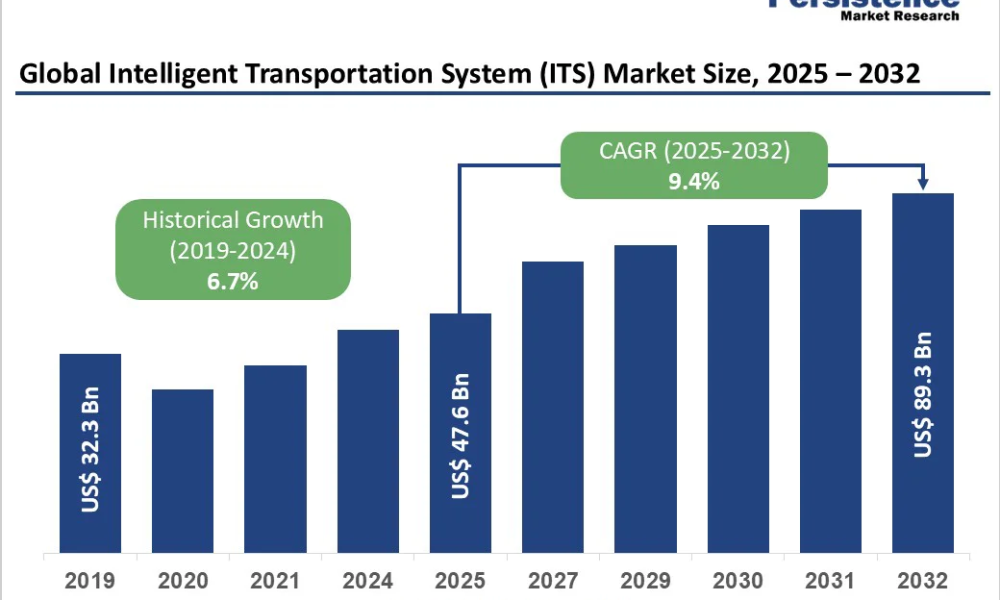
The global Intelligent Transportation System (ITS) market is experiencing rapid growth, driven by technological advancements, the need for urban mobility solutions, and policy-driven deployments. According to Persistence Market Research, the ITS market was valued at US$47.6 billion in 2025 and is expected to reach US$89.3 billion by 2032, reflecting a compound annual growth rate (CAGR) of 9.4% during the forecast period from 2025 to 2032. The primary drivers behind this expansion are increasing urbanization, congestion mitigation efforts, and the growing demand for enhanced safety features on roads. Moreover, the deployment of connected vehicle technologies, along with the integration of artificial intelligence (AI) and video analytics, is significantly reshaping the industry.
As cities become more densely populated and traffic congestion continues to rise, the demand for intelligent solutions to improve traffic flow, reduce accidents, and enhance the overall transportation experience is increasing. ITS technologies, such as smart traffic management systems, connected vehicles, and real-time traffic monitoring, are designed to address these challenges effectively. Leading segments in the ITS market include traffic management systems, intelligent traffic lights, connected vehicles, and vehicle-to-infrastructure (V2I) communication systems. Geographically, North America is the leading region for ITS adoption, driven by technological advancements and strong government support for intelligent transportation projects.
Get Your FREE Sample Report Instantly Click Now: https://www.persistencemarketresearch.com/samples/35785
Company Insights
Key players in the ITS market include:
- Siemens AG
- Hitachi Ltd.
- DENSO Corporation
- Cubic Corporation
- Kapsch TrafficCom AG
- Thales Group
- IBM Corporation
- Huawei Technologies Co., Ltd.
- TomTom International BV
- Garmin Ltd.
- Iteris Inc.
- FLIR Systems
- GMV Innovating Solutions
- EFKON GmbH
- Cisco Systems, Inc.
- Indra Sistemas S.A.
- SWARCO
- Q-Free ASA
- NEC Corporation
- Teledyne Technologies Incorporated
- HERE Technologies
- ST Engineering
Key Highlights from the Report:
➤ The ITS market is projected to grow from US$47.6 billion in 2025 to US$89.3 billion by 2032, at a CAGR of 9.4%.
➤ The market is driven by increasing urbanization, the need for congestion mitigation, and improving safety on the roads.
➤ Connected vehicle pilots, along with AI and video analytics, are playing a pivotal role in the market’s expansion.
➤ Traffic management systems and intelligent traffic lights are among the leading segments in ITS.
➤ Policy-driven deployments of ITS technologies are gaining momentum, especially in smart city projects.
➤ North America leads the ITS market, supported by technological advancements and strong government initiatives.
Market Segmentation
By Offering
- Hardware
- Sensors
- Surveillance Devices
- Communication Equipment
- Control & Signaling Devices
- Software
- Visualization Software
- Video Detection Management Software
- Transit Management Software
- Others
- Services
- Cloud Services
- Business Services
- Professional Services
By Mode of Transportation
- Roadways
- Railways
- Aviation
- Maritime
By System Type
- Advanced Traffic Management Systems (ATMS)
- Advanced Traveler Information Systems (ATIS)
- Advanced Public Transportation Systems (APTS)
- Advanced Transportation Pricing Systems (ATPS)
- Vehicle-to-Everything (V2X) Communication Systems
- Surveillance and Monitoring Systems
By Application
- Traffic Management
- Public Transport Management
- Parking Management
- Tolling Systems
- Freight Management
- Surveillance and Security
- Others
By Region
- North America
- Europe
- East Asia
- South Asia & Oceania
- Latin America
- Middle East &Africa
Customize This Report for Your Exact Requirements: https://www.persistencemarketresearch.com/request-customization/35785
Regional Insights
North America continues to be the leading region for ITS adoption, accounting for a substantial share of the market. The growth in this region is fueled by high technological adoption, well-established infrastructure, and government policies aimed at reducing traffic congestion and improving road safety. The United States, in particular, has seen significant developments in connected vehicle technologies and smart city projects, which are propelling the ITS market.
Europe is another key market for ITS, with countries like the UK, Germany, and France leading the way in the implementation of intelligent transportation solutions. European governments have been actively investing in infrastructure projects to promote sustainable mobility, reduce carbon emissions, and improve traffic management in urban areas. Moreover, the European Union has provided substantial support for ITS deployment as part of its efforts to enhance road safety and mobility efficiency.
Market Drivers
- Urbanization and Traffic Congestion: As urban populations grow, cities are facing increasing traffic congestion, which results in longer commute times, higher fuel consumption, and increased pollution. ITS technologies, such as smart traffic signals, real-time traffic updates, and advanced parking management systems, help alleviate these issues by optimizing traffic flow and providing better transportation management. Urbanization is, therefore, a key driver for ITS adoption as cities seek to improve the efficiency and sustainability of their transportation networks.
- Government Support and Policy-Driven Initiatives: Governments across the globe are increasingly focusing on reducing traffic congestion and improving road safety through the deployment of intelligent transportation solutions. Public-private partnerships, government funding, and policy initiatives aimed at promoting smart city development have accelerated the adoption of ITS technologies. In regions like North America, Europe, and parts of Asia-Pacific, governments are investing in infrastructure improvements and implementing regulations that drive the adoption of ITS solutions.
The growing trend toward digitalization and connected infrastructure also supports the growth of ITS technologies. Through better integration of data, AI, and machine learning, ITS solutions can make real-time adjustments to traffic conditions, enhancing both safety and efficiency.
Market Restraints
- High Implementation Costs: One of the primary challenges in the widespread adoption of ITS solutions is the high upfront cost of implementing these systems. Infrastructure investments required for the installation of smart traffic management systems, sensors, and data analytics platforms can be significant. Although the long-term benefits in terms of reduced congestion and improved safety are evident, the initial financial burden may deter some municipalities, especially in developing regions.
- Data Privacy and Security Concerns: The deployment of connected vehicles and intelligent transportation systems relies heavily on data exchange between vehicles, infrastructure, and traffic management systems. However, this raises concerns about data privacy and security. The vast amounts of data collected and exchanged could be susceptible to cyberattacks or unauthorized access, leading to potential misuse. Ensuring robust cybersecurity and data protection mechanisms is critical to the widespread adoption of ITS technologies.
Market Opportunities
- Smart Cities and IoT Integration: The rise of smart cities presents a significant opportunity for the ITS market. As urban areas become more digitized, integrating IoT solutions with transportation systems can create more efficient, sustainable, and safer mobility networks. Real-time monitoring, predictive analytics, and automated decision-making powered by AI and IoT can enhance transportation management and improve the quality of life for city dwellers.
- Connected and Autonomous Vehicles: The development of connected and autonomous vehicles (CAVs) is expected to create new opportunities for ITS. These vehicles require sophisticated communication networks and data-sharing infrastructure to operate safely and efficiently. The deployment of V2V and V2I communication systems will play a critical role in ensuring the seamless integration of autonomous vehicles into existing transportation systems. As autonomous driving technology progresses, the demand for ITS solutions that support CAVs will continue to grow.
Frequently Asked Questions
➤ What are the primary factors driving the growth of the Intelligent Transportation System (ITS) Market from 2025 to 2032?
➤ Which companies are leading the Intelligent Transportation System (ITS) Market?
➤ What are the key opportunities and risks in the ITS Market?
➤ Which regions are expected to lead in the adoption of ITS technologies in the coming years?
➤ How do emerging technologies, such as AI and IoT, impact the future of the ITS Market?
Ready to Dive Deep? Buy Full Report Today: https://www.persistencemarketresearch.com/checkout/35785
Recent Developments:
- June 2025: Siemens Mobility launched a next-generation intelligent traffic management system designed to optimize urban mobility and reduce congestion in smart cities.
- September 2026: Thales Group introduced a new AI-powered video analytics solution for improving road safety and reducing accidents in high-traffic urban areas.
Future Opportunities and Growth Prospects
The ITS market holds immense potential for growth, particularly in the context of smart city development and the integration of autonomous vehicles. With increasing urbanization, congestion mitigation, and safety improvement as key priorities for governments and municipalities, the demand for intelligent transportation systems will continue to rise. Advancements in AI, IoT, and connected vehicle technologies are set to drive further innovation in the ITS space, offering new opportunities for market expansion in the years to come.




