
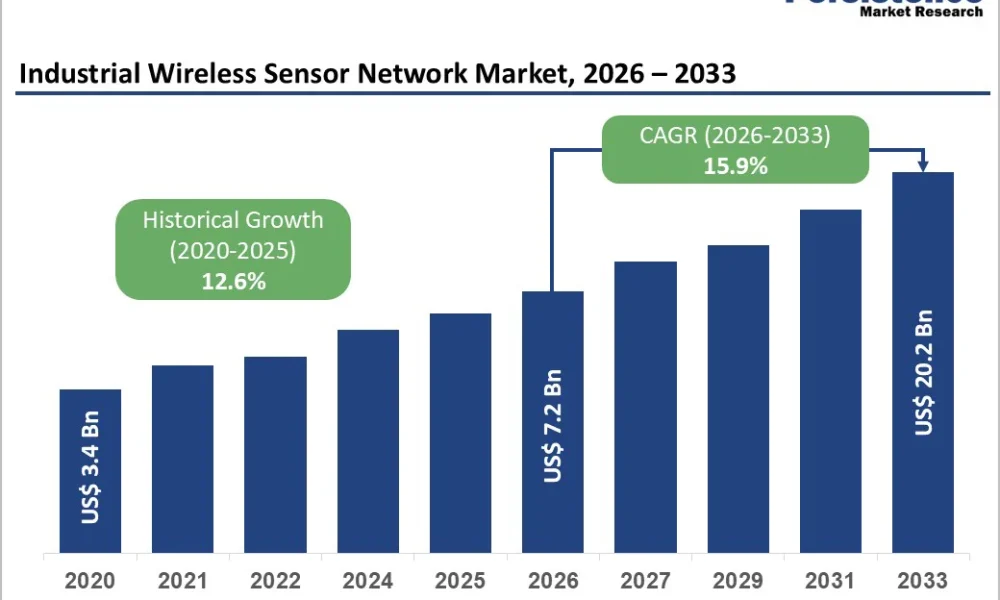
The global Industrial Wireless Sensor Network (IWSN) market is undergoing rapid expansion as manufacturing, energy, and process industries accelerate their digital transformation agendas. The market is projected to grow from US$ 7.2 billion in 2026 to US$ 20.2 billion by 2033, registering a robust CAGR of 15.9% between 2026 and 2033. This represents a significant acceleration compared to the historical CAGR of 12.6% from 2020 to 2026, reflecting intensifying demand for real-time monitoring, predictive maintenance, and smart factory automation.
Industrial wireless sensor networks form the backbone of modern Industry 4.0 ecosystems. By enabling continuous data collection from equipment, pipelines, production lines, and environmental systems, IWSNs empower organizations to optimize efficiency, enhance safety, and reduce downtime.
Market Overview and Growth Momentum
- Market Size (2026E): US$ 7.2 Billion
- Market Forecast (2033F): US$ 20.2 Billion
- CAGR (2026–2033): 15.9%
- Historical CAGR (2020–2026): 12.6%
- Leading Region: North America (30% share)
- Fastest-Growing Region: East Asia (23.6% CAGR)
- Dominant Sensor Type: Temperature Sensors (24% share)
The accelerating growth trajectory highlights structural shifts in industrial operations toward automation, data-driven asset management, and energy efficiency.
Core Growth Drivers
- Government-Backed Digitalization and Industry 4.0 Programs
Public policy initiatives are playing a pivotal role in driving capital investments in smart manufacturing infrastructure.
In Germany, the Industrie 4.0 initiative has significantly accelerated digital factory adoption. Similarly, India’s Production Linked Incentive (PLI) scheme under the Government of India is encouraging domestic manufacturing modernization and IoT integration.
Across North America, federal funding programs and smart manufacturing incentives have boosted deployment of industrial IoT technologies, including wireless sensor networks, particularly in automotive, aerospace, and oil & gas sectors.
These initiatives reduce capital risk and encourage enterprises to transition from wired legacy monitoring systems to scalable wireless architectures.
- Predictive Maintenance and Operational Efficiency
Predictive maintenance has emerged as one of the strongest adoption catalysts. Industrial wireless sensor networks enable real-time condition monitoring of:
- Rotating equipment
- Pumps and compressors
- Industrial motors
- Pipelines
- High-temperature systems
Studies show predictive maintenance strategies can reduce unplanned downtime by 35–45% while extending asset life cycles. Industries such as automotive manufacturing, petrochemicals, and mining are deploying sensor networks to shift from reactive to proactive maintenance models.
The cost savings achieved through downtime reduction and optimized spare parts inventory create strong ROI justification for IWSN investments.
- Convergence of 5G, Wi-Fi 6, and Industrial Protocols
The convergence of broadband wireless standards and industrial communication protocols is reshaping the competitive landscape.
Industrial deployments increasingly integrate:
- 5G private networks
- Wi-Fi 6 connectivity
- WirelessHART
- ISA100.11a
5G provides ultra-low latency and high device density support, making it ideal for high-volume sensor deployments across large industrial campuses.
At the same time, specialized protocols such as WirelessHART ensure secure, deterministic communication in mission-critical environments.
This hybrid ecosystem supports scalable, resilient, and high-performance sensor networks.
- Energy Harvesting and Batteryless Sensor Architectures
Energy-efficient and batteryless sensor technologies are transforming remote monitoring. Advances in energy harvesting allow sensors to draw power from:
- Vibration
- Thermal gradients
- Solar exposure
- RF energy
These innovations reduce maintenance costs and enable deployment in hazardous or inaccessible industrial locations. The reduction in battery replacement cycles significantly improves total cost of ownership.
Batteryless systems are particularly valuable in oil refineries, offshore platforms, and large chemical processing facilities.
Market Restraints
Cybersecurity Concerns
As wireless deployments expand, cybersecurity risks intensify. Critical infrastructure sectors such as utilities, energy, and defense require stringent security frameworks.
Challenges include:
- End-to-end encryption requirements
- Network segmentation
- Authentication protocols
- Firmware security updates
Small and medium enterprises (SMEs), especially in developing economies, often struggle with the high costs of cybersecurity compliance.
Integration Complexity
Industrial environments contain heterogeneous legacy systems. Integrating wireless sensor networks with SCADA, ERP, and MES systems can be technically demanding.
Compatibility issues and network interference in dense industrial environments require careful engineering design and specialized expertise.
Elevate your business strategy with comprehensive market data. Request a sample report now: https://www.persistencemarketresearch.com/samples/18298
Segment Analysis
Sensor Type Insights
Temperature sensors dominate the market with approximately 24% revenue share. They are widely deployed in:
- Power generation plants
- Chemical processing
- Food & beverage facilities
- Oil & gas operations
Temperature monitoring is essential for process optimization and safety compliance.
Pressure sensors represent the fastest-growing segment due to rising safety standards and regulatory mandates in hazardous environments.
Other key sensor types include vibration, flow, humidity, and gas detection sensors.
Application Insights
Industrial wireless sensor networks are primarily deployed in:
- Predictive maintenance
- Asset tracking
- Environmental monitoring
- Process control
- Energy management
Predictive maintenance remains the largest application segment due to strong ROI validation.
End-User Industry Insights
Key industry adopters include:
- Automotive manufacturing
- Oil & gas
- Chemicals
- Power generation
- Mining
- Food & beverage
The oil & gas sector is particularly aggressive in remote wireless monitoring due to the operational risks and costs associated with equipment failure.
Regional Insights
North America
North America leads with approximately 30% market share, driven by advanced manufacturing modernization and industrial IoT adoption.
The presence of major industrial automation companies and strong 5G rollout further accelerates regional deployment.
The U.S. industrial sector prioritizes predictive analytics, cybersecurity compliance, and digital twin integration.
Europe
Europe remains a key market supported by sustainability regulations and smart manufacturing initiatives under the European digital transformation agenda.
Germany’s industrial leadership under the Industrie 4.0 framework continues to shape regional adoption patterns.
Environmental regulations and energy efficiency mandates also promote sensor network expansion.
East Asia
East Asia is projected to grow at 23.6% CAGR, making it the fastest-growing region.
China’s government-backed smart city and smart manufacturing programs are driving high-density sensor deployments across industrial parks.
Japan and South Korea are investing heavily in robotics integration and AI-enabled manufacturing systems, further stimulating IWSN demand.
Emerging Trends
Edge AI Integration
Edge computing and AI are moving intelligence closer to industrial assets. Instead of transmitting raw data to centralized servers, edge-enabled sensors can:
- Detect anomalies locally
- Trigger automated responses
- Reduce network bandwidth consumption
- Improve real-time decision-making
Edge AI supports autonomous asset management and reduces latency in mission-critical operations.
Self-Healing Network Protocols
Advanced mesh networking enables self-healing capabilities. If one node fails, data reroutes automatically through alternate pathways.
This ensures high reliability in industrial environments where downtime is unacceptable.
Integration with Digital Twins
Wireless sensor networks increasingly feed real-time data into digital twin platforms, enabling:
- Predictive simulation
- Process optimization
- Lifecycle management
Digital twin adoption strengthens the strategic value of sensor deployments.
Competitive Landscape
The IWSN market is moderately fragmented, with global industrial automation leaders competing alongside niche IoT solution providers.
Key players typically compete on:
- Network reliability
- Protocol compatibility
- Cybersecurity robustness
- Energy efficiency
- AI-enabled analytics capabilities
Strategic partnerships between telecom providers and industrial automation vendors are increasing, especially in private 5G deployments.
Companies are also investing heavily in R&D for energy harvesting and edge intelligence integration.
Future Outlook
The Industrial Wireless Sensor Network market is positioned for sustained high-growth momentum through 2033.
Key future growth enablers include:
- Expansion of private 5G networks
- AI-native industrial automation
- Autonomous asset management
- Government smart manufacturing incentives
- ESG-driven energy optimization
As industries increasingly prioritize sustainability, safety, and operational efficiency, wireless sensor networks will become foundational infrastructure components.
The convergence of AI, 5G, and energy-harvesting innovations will continue to expand deployment use cases across remote and high-risk environments.
Conclusion
The global Industrial Wireless Sensor Network market is on track to reach US$ 20.2 billion by 2033, growing at an impressive 15.9% CAGR. Accelerating Industry 4.0 adoption, predictive maintenance validation, government-backed modernization programs, and advances in connectivity technologies are driving rapid expansion.
Despite cybersecurity and integration challenges, the long-term outlook remains highly favorable. Enterprises investing in scalable, secure, and AI-enabled wireless sensor ecosystems will unlock substantial operational efficiencies and competitive advantages in the evolving industrial landscape.
Related Reports:
Tank Level Monitoring System Market




